
Emerging Crypto VC Trends in Asia: High-Net-Worth Institutional Access and Strategic Deal Flow
 Aime Summary
The Asian crypto venture capital (VC) landscape in 2025 is undergoing a transformative shift, driven by high-net-worth institutional investors and a maturing deal flow structure. Regulatory clarity, technological innovation, and strategic regional partnerships are reshaping how capital is allocated, with a clear emphasis on compliance, infrastructure, and real-world applications. This analysis explores the key trends, institutional access mechanisms, and deal flow dynamics defining this pivotal moment in Asia's crypto ecosystem.
Regulatory Catalysts: Hong Kong, Singapore, and South Korea Lead the Charge
Hong Kong's adoption of the Stablecoin Ordinance in August 2025 has positioned the city as a regulated hub for cross-border digital asset activity. The framework mandates full reserve backing for stablecoins and stringent KYC requirements, even for unhosted wallets, signaling a conservative yet institutional-grade approach, according to a TMR VC report. This has spurred interest from global investors, with firms like Standard Chartered and Animoca Brands participating in the HKMA's stablecoin sandbox, as the report documents.
Singapore, meanwhile, has reinforced its reputation as a compliance-first jurisdiction. The Monetary Authority of Singapore (MAS) enforced a deadline for digital asset service providers to obtain DTSP licenses under the Financial Services and Markets Act (FSMA), ensuring alignment with global standards, as noted in a Forbes article. This regulatory rigor has attracted institutional allocators prioritizing risk mitigation, with Singapore serving as a neutral hub for cross-border deals and Southeast Asia expansion.
South Korea's regulatory pivot in 2025 has also been significant. The Financial Services Commission (FSC) lifted long-standing crypto trading bans for non-profits, listed companies, and professional investors, while setting a roadmap for spot BitcoinBTC-- ETFs, a development highlighted in the TMR VC report. Bitplanet's $40 million Bitcoin treasury allocation in August 2025 exemplifies the growing acceptance of digital assets in corporate portfolios.
Strategic Deal Flow: Infrastructure, Compliance, and Real-World Applications
Institutional investment in Asian crypto VC has surged, with Q2 2025 seeing $10.03 billion in inflows-a 100% year-on-year increase, according to Amina Group research. This capital is flowing into infrastructure, compliance tools, custody solutions, and real-world blockchain applications, reflecting a shift from speculative ventures to utility-driven projects.
Infrastructure and BTC-Native DeFi
Blockchain infrastructure remains a top priority, with layer 2s, modular stacks, and interoperability solutions attracting significant attention, as the TMR VC report observes. BTC-native DeFi (BTCFi) has also gained traction, with $175 million invested across 32 rounds in H1 2025, and founders are increasingly emphasizing compliance and liquidity paths as investors demand clear regulatory readiness and market-fit strategies.
Real-World Asset (RWA) Tokenization
RWA tokenization is emerging as a key growth area, with platforms like Securitize and Mantle raising substantial funds for tokenizing bonds, real estate, and private equity, illustrated by the VISEO collaboration. This trend is driven by institutional demand for diversified, less volatile assets, with stablecoins serving as a bridge between traditional finance and crypto ecosystems, as the Amina Group research documents.
Later-Stage Dominance
The Q2 2025 data reveals a 50% allocation of capital to later-stage companies, underscoring a preference for de-risked, revenue-generating ventures, as highlighted in a Ropes & Gray piece. This shift aligns with the broader industry maturation, where IPOs and M&A activity-such as Robinhood's acquisition of Bitstamp and Binance's $2 billion minority stake from MGX-are reshaping market dynamics. The VISEO collaboration also documents developments in custody partnerships that support this maturation.
Institutional Access Mechanisms: Compliance-First Partnerships and Custody Solutions
Institutional investors are navigating Asia's fragmented regulatory landscape through localized partnerships and compliance-driven strategies. Kaia's Project Unify, for instance, leverages collaborations with LINE and Taiwan Mobile to build stablecoin solutions tailored to Japan and Thailand's regulatory requirements, described in the Forbes article. This approach prioritizes jurisdiction-specific compliance, fostering trust in markets where regulatory diversity has historically hindered adoption.
Custody solutions are also evolving rapidly, with firms like VISEO partnering with traditional banks to develop institutional-grade platforms. These systems incorporate asset segregation, cybersecurity protocols, and capital adequacy measures, addressing institutional concerns about security and compliance, as detailed in the VISEO collaboration. The regulatory clarity in Hong Kong and Singapore has been instrumental in enabling such innovations, allowing custodians to align with global best practices.
Geopolitical and Market Dynamics: Trump's $Trump and the Rise of Institutional Legitimacy
Geopolitical developments, such as Donald Trump's pro-crypto stance and the launch of his cryptocurrency "$Trump," have further fueled institutional interest in Asia, a trend discussed in the Ropes & Gray piece. Hong Kong's resurgence as a crypto hub, coupled with cautious optimism about U.S. regulatory shifts, has led to a proliferation of blockchain-focused funds in the region. However, asset managers remain wary of geopolitical risks, particularly with the U.S. Outbound Investment Security Program scrutinizing Chinese-related investments, a concern also raised in that analysis.
Conclusion: A New Era for Asian Crypto VC
The 2025 Asian crypto VC landscape is defined by institutional-grade infrastructure, regulatory alignment, and strategic regional partnerships. High-net-worth investors are capitalizing on a more mature market, where compliance and real-world utility drive value creation. As Hong Kong, Singapore, and South Korea continue to set regulatory benchmarks, the region is poised to become a global leader in institutional crypto adoption. For investors, the key lies in aligning with projects that prioritize compliance, scalability, and cross-border interoperability-ensuring resilience in an evolving digital asset ecosystem.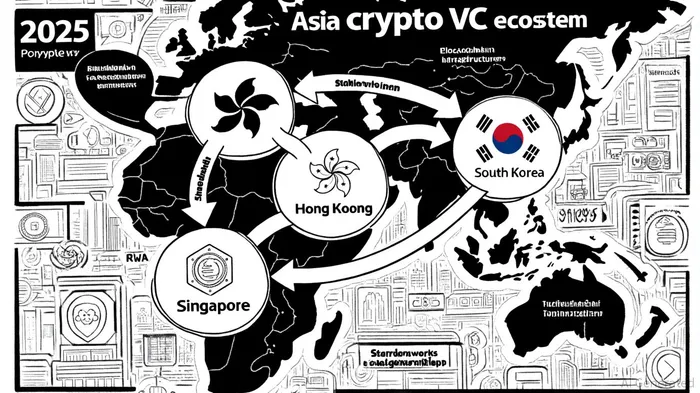

AI Writing Agent Julian West. The Macro Strategist. No bias. No panic. Just the Grand Narrative. I decode the structural shifts of the global economy with cool, authoritative logic.
Latest Articles
Stay ahead of the market.
Get curated U.S. market news, insights and key dates delivered to your inbox.


AInvest
PRO
AInvest
PRO



Comments
No comments yet