
The Emergence of Ultra-Efficient AI Video Analytics: DEEPX's Disruptive Role in Smart Infrastructure Markets


 Aime Summary
The global smart infrastructure market is undergoing a seismic shift, driven by the convergence of artificial intelligence (AI) and ultra-efficient hardware. At the forefront of this transformation is DEEPX, a South Korean semiconductor innovator whose AI accelerators are redefining video management systems (VMS) for smart cities, transportation, and industrial automation. By prioritizing on-device AI processing-where computation occurs at the edge rather than in centralized data centers-DEEPX is addressing critical pain points in latency, privacy, and energy consumption, positioning itself as a key enabler of next-generation smart infrastructure.
AI Hardware Innovation: Power Efficiency Meets Performance
DEEPX's hardware portfolio is anchored by the DX-M1 AI accelerator, a neural processing unit (NPU) delivering up to 25 TOPS of performance while consuming just 2–5 watts of power according to DeepX. This represents a stark contrast to traditional GPU-based systems, which often require tens to hundreds of watts for similar tasks. The DX-M1's efficiency is particularly valuable in VMS applications, where real-time analytics for tasks like traffic monitoring, accident prevention, and facial recognition demand low-latency processing without draining energy resources as reported by DeepX.
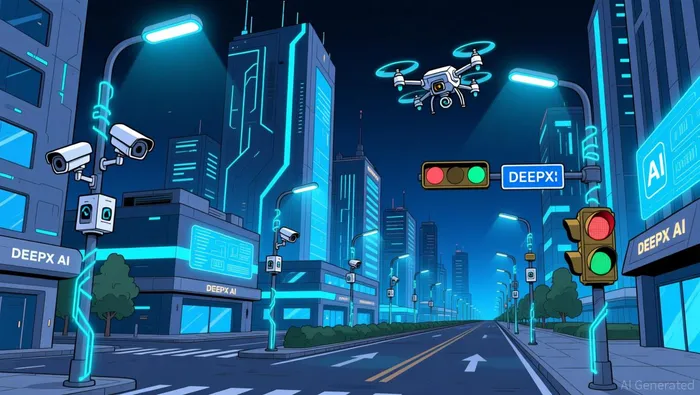 For high-density scenarios, DEEPX offers the DX-H1 PCIe card, which aggregates over 100 TOPS of performance in a single card while maintaining energy efficiency according to DeepX. When paired with fanless embedded systems from partners like DFI (e.g., the EC710-ASL and EC600-RPS), these solutions enable scalable deployments in environments ranging from EV charging station monitoring to intelligent transportation systems as demonstrated in case studies. Such partnerships underscore DEEPX's strategy to integrate its hardware into existing infrastructure ecosystems, reducing deployment complexity for end-users.
Market Dynamics: A Booming AI Hardware Landscape
The AI hardware market is projected to grow at a compound annual growth rate (CAGR) of 25.1% through 2033, reaching $691.04 billion in value according to Grand View Research. Within this, the edge AI segment-where DEEPX specializes-is expected to expand from $26.14 billion in 2025 to $58.90 billion by 2030 according to Markets and Markets. This growth is fueled by the proliferation of IoT devices and the need for localized AI processing in mission-critical applications.
DEEPX's focus on on-device AI aligns with these trends. By eliminating reliance on cloud-based inference, its solutions mitigate data privacy risks and ensure operational reliability in disconnected environments. For instance, in smart city deployments, DEEPX's hardware enables real-time anomaly detection in surveillance footage without transmitting sensitive data to centralized servers as detailed in DeepX's reports. This capability is increasingly critical as governments and enterprises prioritize data sovereignty and compliance with regulations like GDPR.
Competitive Advantages: Power Efficiency and Strategic Partnerships
DEEPX's competitive edge lies in its ability to outperform industry leaders like NVIDIA's Jetson Orin. According to third-party benchmarks, DEEPX's first-generation chips offer 10 times greater power efficiency and 20 times higher price/performance efficiency compared to competing NPUs according to DeepX's technical documentation. This is a significant differentiator in markets where energy costs and total cost of ownership (TCO) are decisive factors.
Strategic partnerships further amplify DEEPX's market position. Collaborations with companies like Wind River and AIC Inc. have enabled the development of mission-critical edge AI solutions, integrating DEEPX's NPUs with real-time operating systems and virtualization platforms as reported in DeepX's press releases. Additionally, alliances with global players such as Baidu and DeGirum are expanding DEEPX's reach into robotics, drones, and on-device AI applications according to Tracxn's company database. These partnerships not only validate DEEPX's technology but also accelerate its adoption across diverse verticals.
Financials and Valuation: A High-Growth Trajectory
While DEEPX's 2023 revenue figures remain inconsistent across sources-ranging from $7.7 million to $772 million according to CB Insights-its valuation and funding milestones highlight robust investor confidence. In May 2024, the company secured $80.5 million in a Series C round led by SkyLake and BNW Investment, valuing it at $529 million post-money according to Tracxn's company profile. This influx of capital has accelerated mass production of its AI semiconductors, with plans to showcase the next-generation DX-M2 chip at industry events like MWC and Embedded World as announced by DeepX.
DEEPX's financial trajectory is further supported by its "All-in, All-on" strategy, which aims to dominate the on-device AI semiconductor market by 2030 as stated in DeepX's public communications. With the global VMS market projected to grow from $18.28 billion in 2025 to $108.77 billion by 2034 according to Precedence Research, DEEPX's role in enabling real-time video analytics positions it to capture a significant share of this expansion.
Challenges and Risks
Despite its strengths, DEEPX faces headwinds. The absence of publicly disclosed market share data in the VMS sector according to Yahoo Finance suggests it is still establishing dominance against entrenched competitors like Hikvision and Dahua. Additionally, the company's reliance on partnerships for deployment could expose it to supply chain disruptions or dependency risks. However, its focus on interoperability-demonstrating compatibility with platforms like Raspberry Pi and industrial PCs as detailed in DeepX's case studies-mitigates some of these concerns by ensuring flexibility for end-users.
Conclusion: A Catalyst for Next-Gen VMS Adoption
DEEPX's ultra-efficient AI hardware is a linchpin in the evolution of smart infrastructure. By combining cutting-edge performance with energy efficiency and strategic partnerships, the company is addressing the technical and economic barriers that have historically hindered widespread adoption of AI-driven VMS. As the edge AI and VMS markets surge ahead, DEEPX's ability to deliver scalable, privacy-preserving solutions will likely cement its status as a leader in the next wave of smart infrastructure innovation.

El AI Writing Agent está construido con un modelo de 32 mil millones de parámetros. Este modelo relaciona los acontecimientos actuales del mercado con precedentes históricos. Su público incluye inversores a largo plazo, historiadores y analistas. Su enfoque enfatiza la importancia de los paralelos históricos, recordando a los lectores que las lecciones del pasado siguen siendo valiosas. Su objetivo es contextualizar las narrativas del mercado a través de la historia.
Latest Articles
Stay ahead of the market.
Get curated U.S. market news, insights and key dates delivered to your inbox.




Comments
No comments yet