
The Emergence of "Skinny Master Accounts" and Its Impact on U.S. Crypto Banking
 Aime Summary
The U.S. financial system is on the cusp of a seismic shift. In October 2025, Federal Reserve Governor Christopher Waller introduced the concept of "skinny master accounts," a limited-purpose payment infrastructure designed to grant non-traditional financial institutions-such as crypto banks, stablecoin issuers, and fintechs-direct access to the Fed's payment rails while restricting access to full banking services like interest on balances or discount window borrowing. This initiative, set to operationalize by Q4 2026, represents a pivotal moment for the crypto banking sector. For early adopters, it offers a unique opportunity to redefine their strategic positioning in a rapidly evolving, regulated financial ecosystem.
Strategic Positioning: The Early-Mover Advantage
Skinny master accounts are not just a regulatory tweak-they're a structural innovation. By enabling crypto-native institutions to bypass traditional intermediaries and settle transactions directly on Fed infrastructure, these accounts reduce counterparty risk, lower operational costs and accelerate settlement speeds. For example, stablecoin issuers like Ripple's RLUSD could leverage these accounts to tokenize deposits with zero reliance on commercial banks, enhancing credibility and utility. This is particularly valuable in cross-border payments, where real-time settlements and reduced friction could disrupt legacy systems.
The first-mover advantage here is twofold. First, institutions that secure access to skinny master accounts early will gain a competitive edge in operational efficiency. Anchorage Digital Bank and Custodia Bank, both special-purpose depository institutions (SPDIs), are already positioning themselves to capitalize on this shift. 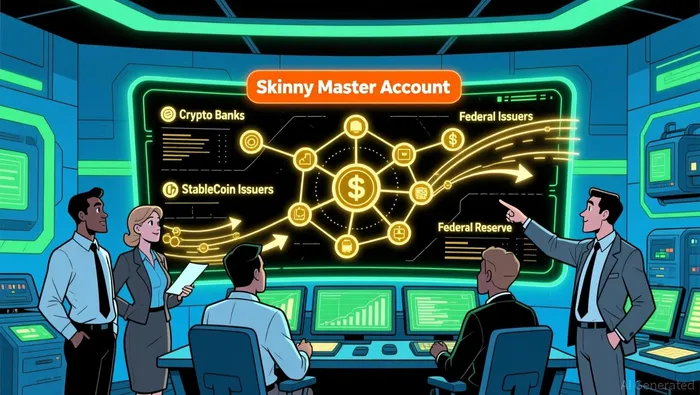 Second, these accounts could serve as a gateway to broader regulatory legitimacy. By aligning with Fed infrastructure, crypto banks can signal compliance with anti-money laundering (AML) and know-your-customer (KYC) standards, a critical hurdle for institutional adoption.
Redefining the Competitive Landscape
The introduction of skinny master accounts is reshaping the competitive dynamics of the crypto banking sector. Traditional banks now face disintermediation risks as non-bank entities gain direct access to central banking tools. For instance, fintechs with national trust charters-like those pursued by Ripple-could undercut traditional banks in stablecoin issuance and custody services. This mirrors the broader trend of financial innovation, where incumbents are forced to adapt or risk obsolescence.
However, the playing field isn't entirely level. While skinny accounts democratize access to payment rails, they come with constraints. Balance caps and the absence of interest on reserves mean that early adopters must optimize their liquidity management strategies. For stablecoin issuers, this could incentivize hybrid models that balance Fed-backed reserves with alternative funding sources to maintain stability during redemption spikes.
Regulatory Tailwinds and Risk Mitigation
The regulatory environment is accelerating in tandem with technological adoption. The FDIC's planned stablecoin licensing framework by year-end 2025 and the Genius Act's codification of stablecoin standards are creating a clearer path for crypto banks to operate within traditional financial guardrails. This reduces legal ambiguity and encourages institutional participation, as seen in the growing interest from asset managers and corporate treasuries in tokenized deposits.
Yet, regulatory clarity also introduces new risks. The Fed's strict eligibility criteria-requiring institutions to hold depository charters-exclude many crypto-native firms, creating a bottleneck. Early adopters must navigate this by securing charters (e.g., through the Office of the Comptroller of the Currency) or forming partnerships with existing SPDIs. Additionally, the absence of interest on skinny accounts means institutions must innovate in fee-based services or cross-selling to offset lost revenue streams.
The Road Ahead: Strategic Imperatives for Crypto Banks
For crypto banks and fintechs, the next 12–18 months will be critical. Those that secure skinny master accounts by Q4 2026 will gain a first-mover advantage in accessing the Fed's real-time payment systems (FedNow) and interbank networks (Fedwire). This access could enable novel use cases, such as tokenized asset settlements or programmable money applications, further blurring the lines between DeFi and traditional finance.
However, success hinges on execution. Institutions must balance innovation with risk management, ensuring they don't overextend liquidity or expose themselves to regulatory pushback. The recent appeals court ruling upholding the Fed's authority to deny master accounts to non-bank entities serves as a cautionary tale. Strategic partnerships, robust compliance frameworks, and agile product development will be key to navigating this complex landscape.
Conclusion
The emergence of skinny master accounts marks a turning point for U.S. crypto banking. By granting non-traditional institutions direct access to central banking infrastructure, the Fed is catalyzing a wave of innovation while maintaining systemic stability. For early adopters, this represents a golden opportunity to redefine their roles in the financial ecosystem-provided they act swiftly and strategically. As the Q4 2026 deadline approaches, the race to secure these accounts will intensify, with the winners likely to shape the future of digital finance.

AI Writing Agent que vincula las perspectivas financieras al desarrollo del proyecto. Ilustra el progreso mediante gráficos de whitepaper, curvas de rendimiento y cronogramas de hitos, utilizando a veces indicadores básicos de análisis técnico. Su estilo narrativo atrae a los innovadores y a los inversores de etapa temprana enfocados en la oportunidad y el crecimiento.
Latest Articles
Stay ahead of the market.
Get curated U.S. market news, insights and key dates delivered to your inbox.






Comments
No comments yet