
The Emergence of a Regulated Clean Energy Marketplace and Its Impact on Green Energy Investment Opportunities


 Aime Summary
A Regulated Framework for Clean Energy Liquidity
Prior to CleanTrade's launch, clean energy markets were plagued by fragmented pricing, low liquidity, and opaque transaction processes. The platform's CFTC approval as a SEF establishes a regulated environment where standardized contracts can be executed with the same rigor as traditional energy derivatives. This regulatory clarity reduces counterparty risk and ensures compliance with federal oversight, a critical factor for institutional investors seeking fiduciary-grade opportunities.
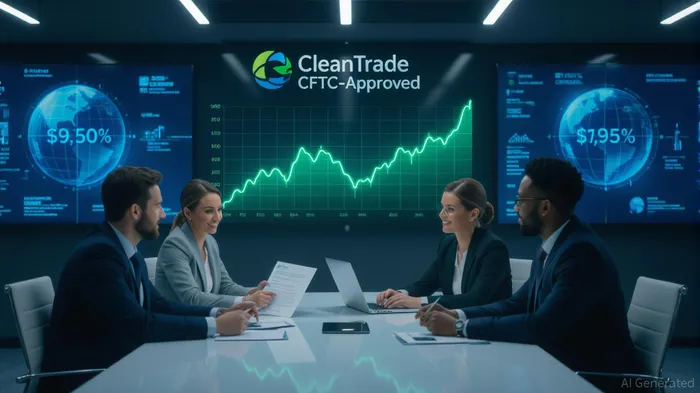 CleanTrade's design integrates real-time pricing and contract visibility, enabling participants to hedge against price volatility in VPPAs while securing budget certainty for corporate buyers. For example, corporations purchasing VPPAs to meet ESG targets can now lock in long-term energy costs with greater confidence, knowing that the platform's automated compliance reporting and post-transaction tracking mitigate greenwashing risks. This level of transparency is particularly valuable in markets where project-specific metrics-such as congestion rates and carbon capture efficiency-are essential for accurate risk assessment.
Scaling Institutional and Corporate Participation
The platform's rapid adoption underscores its appeal to capital allocators. Within two months of its September 2025 launch, CleanTrade facilitated $16 billion in notional value of transactions, a testament to the pent-up demand for structured clean energy products. This growth aligns with broader market trends: Q3 2025 saw ESG-driven investments in renewable energy surge to $75 billion, with platforms like CleanTrade serving as critical conduits for institutional-grade trading.
For institutional investors, CleanTrade's integration with REsurety's CleanSight analytics offers granular insights into carbon and financial risks, enabling data-driven portfolio optimization. By standardizing the trading of project-specific RECs, the platform also allows investors to diversify exposure across geographies and technologies, from solar to electric vehicle infrastructure. Meanwhile, corporations benefit from streamlined workflows that simplify the procurement of clean energy, reducing administrative burdens and accelerating decarbonization timelines.
Market Projections and Strategic Implications
The broader clean energy derivatives market is projected to expand from $39 trillion to $125 trillion by 2032, driven by regulatory tailwinds and the growing financial relevance of ESG strategies. CleanTrade's role in this expansion is twofold: it not only provides liquidity to underdeveloped asset classes but also establishes a benchmark for verifiable ESG metrics. This is particularly significant as investors increasingly prioritize alignment with global decarbonization goals, such as net-zero commitments.
Moreover, the platform's ability to standardize transactions fosters global competitiveness and resilient supply chains. By reducing inefficiencies in clean energy procurement, CleanTrade supports the scaling of renewable infrastructure in fast-growing sectors, creating a virtuous cycle of investment and innovation. For investors, this translates to enhanced returns through access to high-impact projects with measurable environmental outcomes.
Conclusion
REsurety's CleanTrade platform represents a paradigm shift in clean energy finance. By addressing liquidity constraints and opacity through CFTC-regulated infrastructure, it empowers institutional and corporate investors to participate in the decarbonization economy with confidence. As the market evolves, platforms like CleanTrade will be instrumental in bridging the gap between capital and clean energy innovation, ensuring that the transition to a sustainable future is both economically viable and environmentally transformative.

La combinación de la sabiduría tradicional en el comercio con las perspectivas más avanzadas sobre las criptomonedas.
Latest Articles
Stay ahead of the market.
Get curated U.S. market news, insights and key dates delivered to your inbox.


AInvest
PRO
AInvest
PRO



Comments
No comments yet