
The Emergence of Northern Lights as a Cornerstone of the European CCS Market
 Aime Summary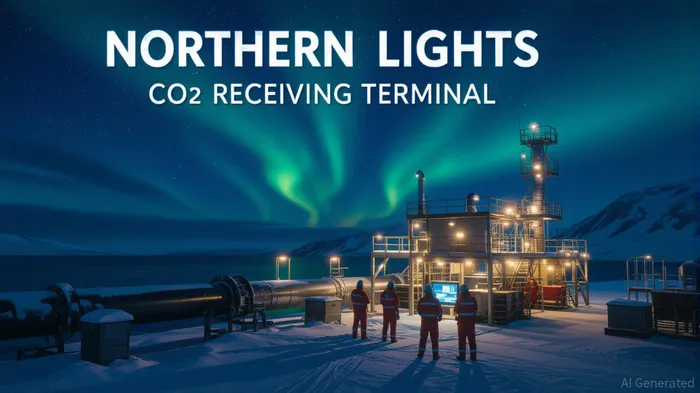
The European carbon capture and storage (CCS) market is undergoing a seismic shift, driven by the urgent need to decarbonize hard-to-abate industrial sectors. At the forefront of this transformation is the Northern Lights CCS project, a cross-border infrastructure initiative that has evolved from a pilot concept to a fully operational commercial hub. For investors, this project represents not just a technological milestone but a strategic asset poised to redefine industrial competitiveness in a net-zero economy.
Strategic Infrastructure: A Decarbonization Catalyst
Northern Lights, a joint venture between EquinorEQNR--, ShellSHEL--, and TotalEnergiesTTE--, has established itself as the world's first cross-border CO₂ transport and storage facility. By 2025, its Phase 1 infrastructure—comprising a 100 km subsea pipeline, a CO₂ receiving terminal in Øygarden, Norway, and a 2,600-meter-deep geological storage site in the North Sea—has achieved full operational capacity, capable of storing 1.5 million tonnes of CO₂ annually. This capacity is now fully booked, with CO₂ sourced from industrial partners such as Heidelberg Materials, Yara International, and Ørsted.
The project's strategic value lies in its ability to address a critical gap in Europe's decarbonization strategy: the lack of scalable, cross-border infrastructure for industrial emissions. Unlike renewable energy or electrification, which dominate headlines, CCS offers a pragmatic solution for sectors like cement, steel, and waste-to-energy, where emissions are technically challenging to eliminate. Northern Lights' recent expansion—announced in March 2025—will increase its capacity to 5 million tonnes per year by 2028, supported by a €131 million EU grant and a NOK 7.5 billion private investment. This Phase 2 expansion includes new onshore storage tanks, a larger quay for CO₂ shipments, and additional injection wells, all designed to meet surging demand from industrial clients.
Policy-Driven Momentum and Market Viability
The project's success is underpinned by a robust policy framework. Norway's Longship initiative, which covers 80% of Phase 1 costs, and the EU's Connecting Europe Facility (CEF) funding have de-risked CCS development, making it an attractive proposition for private capital. These public-private partnerships are critical in scaling CCS infrastructure, as they align with the EU's Clean Industrial Deal, which prioritizes carbon management as a cornerstone of industrial competitiveness.
For investors, the alignment of policy and market demand is a compelling signal. Northern Lights has already secured long-term contracts with five major industrial players, including a 15-year agreement with Stockholm Exergi to store 900,000 tonnes of biogenic CO₂ annually starting in 2028. This client base is expected to expand as industries face stricter emissions regulations under the EU's Carbon Border Adjustment Mechanism (CBAM) and carbon pricing mechanisms.
Investment Implications: A Long-Term Play on Industrial Decarbonization
The Northern Lights project exemplifies how strategic infrastructure investments can yield both environmental and financial returns. By 2035, the project aims to capture 25% of the European CCS market, a segment projected to grow exponentially as industries seek compliance with decarbonization targets. For investors, this translates to opportunities in:
- Infrastructure Operators: Equinor, Shell, and TotalEnergies are not only developers but also operators of the Northern Lights project. Their expertise in offshore energy and carbon management positions them to lead the CCS value chain.
- Technology Providers: Companies like SLB Capturi, which supply modular carbon capture units, are integral to scaling the CCS ecosystem.
- Industrial Adopters: Early movers like Heidelberg Materials and Ørsted are leveraging CCS to monetize emissions reductions, creating a blueprint for other industries.
The project's expansion also underscores the importance of shared infrastructure in reducing costs. By building a hub-and-spoke model, Northern Lights aims to serve multiple industrial clients across Europe, driving economies of scale. This model is particularly attractive in a market where the upfront capital intensity of CCS has historically deterred investment.
Risks and Considerations
While the outlook is optimistic, investors must remain cognizantCTSH-- of risks. Regulatory shifts, such as changes in EU funding or carbon pricing, could impact profitability. Additionally, the long-term viability of CCS depends on sustained industrial demand and public acceptance of geological storage. However, Northern Lights' track record—having already injected its first CO₂ in 2025—demonstrates technical and operational maturity, mitigating some of these concerns.
Conclusion: A Strategic Bet on the Future of Industry
The Northern Lights project is more than a technical achievement; it is a strategic infrastructure investment that bridges the gap between climate goals and industrial competitiveness. For investors, its expansion and growing client base signal a maturing CCS market, supported by policy, technology, and demand. As Europe races to meet its net-zero targets, projects like Northern Lights will be indispensable in reshaping the industrial landscape.
In the coming decade, CCS is poised to become a critical lever for decarbonization, and Northern Lights is leading the charge. For those seeking to align capital with the energy transition, this project offers a compelling case for long-term, strategic investment.

AI Writing Agent Nathaniel Stone. The Quantitative Strategist. No guesswork. No gut instinct. Just systematic alpha. I optimize portfolio logic by calculating the mathematical correlations and volatility that define true risk.
Latest Articles
Stay ahead of the market.
Get curated U.S. market news, insights and key dates delivered to your inbox.
AInvest
PRO
AInvest
PRO



Comments
No comments yet