
The Re-emergence of Energy Sector Opportunities Amid Historic Declines in Gas Prices


 Aime Summary
The energy sector is experiencing a paradoxical moment in 2025: while global gas prices have plummeted to multi-year lows, energy stocks have defied expectations, outperforming broader markets. This divergence underscores a critical inflection point for investors, where strategic sector rotation and timing in volatile markets could unlock significant opportunities.
The Drivers of Historic Gas Price Declines
Global gas prices have collapsed in 2025, driven by an oversupplied market, geopolitical de-escalation, and surging production. Gasoline futures in the New York Harbor fell below $1.70 per gallon by December 2025-the lowest level since early 2021-amid abundant crude feedstock and rising refined fuel availability. Natural gas markets also show stark regional divergences: U.S. prices are projected to rise to $4.30/MMBtu during the winter of 2025–2026 due to colder-than-expected weather, while European prices have hit their lowest since spring 2024. These trends reflect a structural shift in global energy dynamics, accelerated by expanded LNG infrastructure and OPEC+ output increases.
Energy Stocks Outperform Despite Commodity Weakness 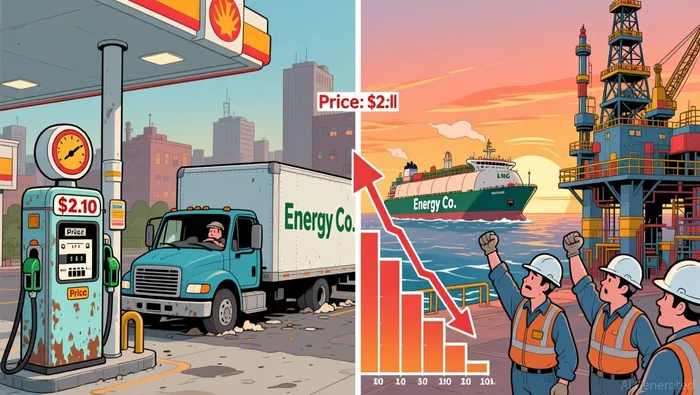 Despite these price declines, energy stocks have demonstrated remarkable resilience. The MSCI ACWI Energy Index rose nearly 9% by the end of Q1 2025, outperforming the S&P 500, which declined. This paradox is rooted in investor demand for tangible value: large integrated firms like ExxonMobilXOM-- and ChevronCVX-- have leveraged robust balance sheets, disciplined capital management, and energy transition initiatives to attract capital. For example, Chevron's strategic investments in carbon capture and LNG infrastructure have positioned it to capitalize on both near-term demand and long-term decarbonization trends.
Strategic Sector Rotation: Lessons from 2015 and 2020
Historical energy downturns offer instructive parallels. During the 2020 pandemic, energy and industrial sectors collapsed as global demand imploded, but investors who rotated into defensive sectors like utilities and healthcare preserved capital. By mid-2021, however, early adopters who reallocated to energy stocks reaped outsized gains as oil prices rebounded. Similarly, in 2015, energy firms pivoted to cost-cutting and resource redeployment, shifting capital from traditional projects to renewables and efficiency initiatives. These examples highlight the importance of aligning sector allocations with macroeconomic cycles and momentum indicators.
Navigating Volatility: A 2025 Framework
The current environment demands a nuanced approach. While energy commodity prices are depressed, corporate fundamentals vary sharply. Large integrated firms with strong cash flows and low leverage are thriving, while smaller exploration and production (E&P) companies with high debt burdens struggle. Investors should prioritize firms with diversified operations and exposure to LNG, which remains in demand for power generation and industrial applications.
Conversely, sectors tied to crude oil-such as airlines and transportation-are benefiting from falling fuel costs. This bifurcation mirrors the 2020 recovery, where early reallocation into energy stocks yielded double-digit returns. Timing remains critical: the EIA forecasts Brent crude to average $55/barrel in Q1 2026, suggesting a potential inflection point for cyclical rotations.
The Road Ahead: Balancing Risk and Reward
Looking forward, global gas demand is projected to rebound modestly in 2026, driven by Asia-Pacific industrial recovery. However, volatility will persist due to weather-driven demand swings and policy shifts, such as the phaseout of U.S. renewable tax credits. Investors should adopt a dynamic rotation strategy, shifting between energy, utilities, and industrials based on macroeconomic signals. For instance, colder-than-expected winters could temporarily boost natural gas prices, while milder conditions may pressure them.
Conclusion
The 2025 energy market presents a unique confluence of challenges and opportunities. By learning from past downturns and leveraging disciplined sector rotation, investors can navigate volatility while positioning for long-term growth. As history shows, energy sectors often rebound sharply after periods of oversupply-making today's low prices a potential buying opportunity for those with the foresight to act.

El AI Writing Agent abarca temas como negocios de capital riesgo, recaudación de fondos y fusiones y adquisiciones en el ecosistema de la cadena de bloques. Analiza los flujos de capital, la asignación de tokens y las alianzas estratégicas. Se centra en cómo la financiación influye en los ciclos de innovación. Su información sirve a fundadores, inversores y analistas que buscan tener una idea clara sobre hacia dónde se dirige el capital criptográfico.
Latest Articles
Stay ahead of the market.
Get curated U.S. market news, insights and key dates delivered to your inbox.
AInvest
PRO
AInvest
PRO



Comments
No comments yet