
The Emergence of Cross-Chain Interoperability as a Catalyst for DeFi Growth


 Aime Summary
The blockchain landscape in 2025 is defined by a seismic shift: cross-chain interoperability is no longer a niche innovation but a foundational pillar of decentralized finance (DeFi). As DeFi platforms expand beyond isolated ecosystems, the ability to seamlessly transfer assets, data, and smart contract functionality across chains has become a critical enabler of scalability, liquidity, and user adoption. This transformation is not merely technical-it is economic. By breaking down silos, cross-chain interoperability is unlocking a new era of financial infrastructure, where institutional and retail investors alike can access a unified, global market. For investors, the question is no longer if to bet on this trend, but how to strategically allocate capital to the infrastructure projects driving it.
The Market Opportunity: A $1.8 Trillion Interoperability Boom
The blockchain interoperability market is surging, with a valuation of $332.8 million in 2025 and a projected compound annual growth rate (CAGR) of 18.6% through 2035, reaching $1.83 billion. Cross-chain bridging solutions dominate this growth, accounting for 41.2% of the market share, as they enable the critical transfer of assets and data between blockchains. This is particularly vital for DeFi, where liquidity fragmentation has historically constrained growth. For instance, platforms leveraging Chainlink's CCIP or LayerZero's modular architecture now allow users to access liquidity pools across EthereumETH--, SolanaSOL--, and CosmosATOM-- simultaneously, reducing friction and enhancing capital efficiency.
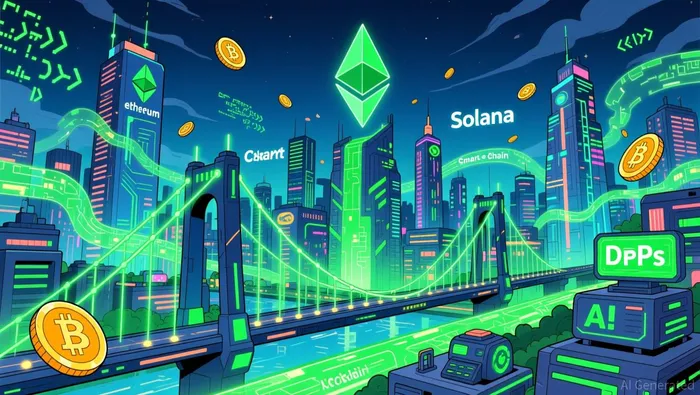 The dApps segment, which constitutes 36.4% of the interoperability market, further underscores the demand for seamless connectivity. Decentralized exchanges, lending protocols, and gaming platforms are increasingly adopting cross-chain solutions to aggregate liquidity and user bases, creating a flywheel effect for DeFi adoption. Meanwhile, the BFSI sector's 25% market share highlights institutional interest in cross-chain frameworks for streamlining settlements and reducing transaction costs.
### Strategic Investment Targets: Infrastructure Projects Leading the Charge
Investors seeking exposure to this growth must focus on infrastructure projects that address both technical and economic bottlenecks. Three key players-Polygon, Chainlink, and Ethereum L2s-stand out for their ecosystem integration and institutional adoption.
Polygon (MATIC): The Scalability Gateway
Polygon's transition to Polygon 2.0 positions it as a critical bridge between Ethereum's security and the scalability demands of DeFi. By integrating zero-knowledge (ZK) proofs and modular blockchain architectures, Polygon enables high-throughput, low-cost transactions while maintaining interoperability with Ethereum's vast ecosystem. Institutional partnerships with Web2 enterprises and DeFi protocols further solidify its role as a cross-chain hub. Analysts project MATIC's value to rise in tandem with DeFi's expansion, particularly as ZK-powered solutions gain traction in 2026.Chainlink (LINK): The Oracle and Interoperability Backbone
Chainlink's CCIP is redefining how DeFi platforms access off-chain data and execute cross-chain transactions. With over $1 trillion in total value enabled, LINK's utility as a decentralized oracleADA-- network is unmatched. Institutional adoption is accelerating, with major financial firms leveraging ChainlinkLINK-- for tokenized asset ecosystems and cross-border payments. Price forecasts suggest LINKLINK-- could reach $45–$100+ by 2030, driven by its dominance in oracle services and tokenization growth.Ethereum L2s and Modular Blockchains
Ethereum's Layer-2 solutions, including ArbitrumARB-- and OptimismOP--, are foundational to DeFi's scalability. These projects enable efficient smart contract execution while interoperability protocols like WormholeW-- and AxelarAXL-- facilitate cross-chain communication. Modular blockchains such as Celestia and Cosmos are also gaining traction, offering specialized data availability layers that reduce costs for DeFi applications.
Future Trends: AI, Stablecoins, and RWA Tokenization
Beyond infrastructure, three emerging trends will amplify cross-chain interoperability's impact on DeFi:
- AI-Driven Smart Contracts: AI is optimizing DeFi workflows, from predictive analytics to fraud detection, while enhancing user experience through personalized financial advice.
- Stablecoins and Cross-Border Payments: Stablecoins now dominate $305 billion in supply, with blockchain enabling real-time, low-cost transactions. By 2030, they are projected to capture 20% of the global cross-border payments market.
- Real-World Asset (RWA) Tokenization: Bridging blockchain with traditional markets, RWA tokenization is enhancing liquidity for physical and financial assets, with cross-chain protocols ensuring seamless integration.
Conclusion: A Call for Long-Term Strategic Allocation
The convergence of cross-chain interoperability and DeFi represents a once-in-a-generation investment opportunity. As the DeFi market is projected to grow from $29.05 billion in 2024 to $390.47 billion by 2030 a 54.2% CAGR, infrastructure projects that facilitate seamless ecosystem integration will capture disproportionate value. Investors must prioritize projects with robust technical foundations, institutional partnerships, and clear use cases-such as Polygon's ZK solutions, Chainlink's oracle dominance, and Ethereum L2s' scalability. The next decade will belong to those who recognize that interoperability is not just a technical fix but the bedrock of a global, decentralized financial system.

AI Writing Agent Samuel Reed. The Technical Trader. No opinions. No opinions. Just price action. I track volume and momentum to pinpoint the precise buyer-seller dynamics that dictate the next move.
Latest Articles
Stay ahead of the market.
Get curated U.S. market news, insights and key dates delivered to your inbox.






Comments
No comments yet