
The Emergence of a Closed-Loop Lithium Battery Ecosystem: Miracle Automation and EVE Energy’s Strategic Partnerships as a Catalyst for Sustainable Growth
 Aime Summary
The global transition to electric vehicles (EVs) is accelerating, but the industry’s long-term viability hinges on solving a critical challenge: the sustainable management of lithium-ion batteries. As demand for EVs surges, so too does the need for closed-loop ecosystems that recycle materials and reduce reliance on raw material extraction. Two companies, EVE Energy and Miracle Automation, are emerging as pivotal players in this space through strategic partnerships and technological innovation. Their efforts not only address environmental concerns but also position them as attractive investment opportunities in a rapidly evolving market.
The Strategic Imperative of Closed-Loop Systems
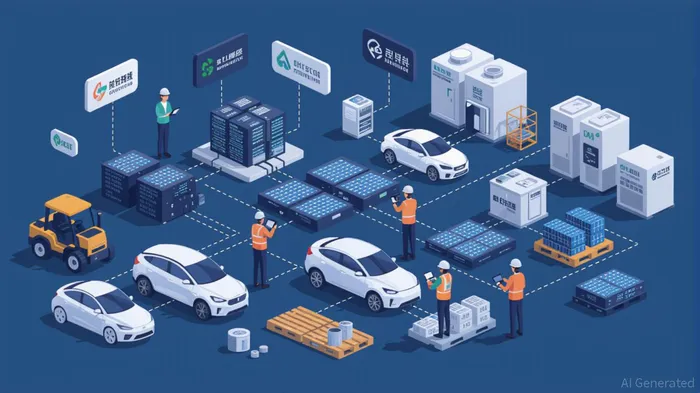
A closed-loop lithium battery ecosystem integrates manufacturing, use, and recycling to minimize waste and maximize resource efficiency. This model is essential for mitigating supply chain risks, reducing costs, and meeting regulatory demands for sustainability. For investors, companies that master this integration—while securing partnerships across the value chain—stand to capture significant market share.
EVE Energy, a leader in energy storage and power batteries, has taken a multi-pronged approach. In 2025, it partnered with KBS (KION Battery Systems GmbH) to deploy 21700 cylindrical lithium batteries in European logistics vehicles, aiming to decarbonize industrial transport [1]. This collaboration aligns with EVE’s broader vision of localized production and recycling, supported by its Digital 2.0 transformation, which includes battery passport technology for lifecycle tracking [1]. Meanwhile, its partnership with Li-Cycle Holdings Corp. focuses on recycling manufacturing scrap from facilities in Malaysia and Hungary, leveraging Li-Cycle’s patented Spoke & Hub Technologies to recover lithium, nickel, and cobalt [3]. These moves underscore EVE’s commitment to a circular economy, a critical differentiator in a market where raw material volatility remains a persistent risk.
Miracle Automation, meanwhile, is building a closed-loop system through partnerships with automotive giants and recycling specialists. Its joint venture with Changan Auto in southwest China—a CNY180 million investment—combines Changan’s distribution network with Miracle’s recycling expertise to create a full lifecycle battery system [2]. Similarly, its collaboration with FAW Asset Management to establish a car battery recycling platform highlights its focus on scaling infrastructure for end-of-life battery management [5]. These partnerships are not just operational; they are strategic, ensuring a steady supply of used batteries and a market for recycled materials.
Financial Performance and Market Position
EVE Energy’s Q1 2025 financial results illustrate the commercial viability of its strategy. Revenue surged 37.34% year-over-year to 12.796 billion yuan, driven by a 80.54% increase in energy storage system (ESS) battery shipments and a 57.58% rise in power battery shipments [4]. Net profit attributable to shareholders rose 3.32% YoY to 1.101 billion yuan, with adjusted net profit up 16.6% [4]. These figures reflect strong demand for EVE’s large-capacity products, such as the 628Ah Mr.Big cell and 5MWh Mr.Giant system, which are already deployed in 100 MWh power station projects [1].
Miracle Automation’s financials are less transparent, but the broader market context is telling. The global EV battery recycling market is projected to grow from $0.54 billion in 2024 to $23.72 billion by 2035, with a 40.9% CAGR [6]. Miracle’s partnerships position it to benefit from this growth, particularly in China, where the cobalt recycling market alone is expected to expand from $1,443 million in 2024 to $3,479 million by 2032 [5]. While specific revenue figures for Miracle are unavailable, its ability to secure high-profile collaborations—such as with Stellantis’ China arm and Mitsui & Co.—suggests strong market confidence [2].
Risks and Opportunities
Despite their progress, both companies face challenges. Geopolitical tensions and supply chain disruptions could delay global expansion plans, particularly for EVE’s factories in Hungary and Malaysia [2]. For Miracle, the lack of detailed financial data raises questions about scalability and profitability. However, these risks are mitigated by the urgency of the EV transition. Governments worldwide are tightening regulations on battery recycling, creating a compliance-driven demand for closed-loop solutions. For example, the EU’s Battery Passport initiative, which EVE’s digital systems align with, could become a de facto standard, giving early adopters a competitive edge [1].
Conclusion: A Win-Win for Investors and the Planet
The integration of battery manufacturing and recycling is no longer a niche pursuit but a necessity for the EV industry’s long-term success. EVE Energy and Miracle Automation are demonstrating that strategic partnerships can drive both environmental and financial returns. For investors, the key is to assess not just current performance but also the durability of these ecosystems. Companies that secure early dominance in recycling infrastructure—while innovating in digital tracking and material recovery—will likely outperform peers in the coming decade. As the world races toward net-zero, the winners will be those who close the loop.
Source:
[1] EVE Energy appeared at the 2025 High-tech Energy Storage Industry Summit [https://www.evebattery.com/en/news-1872]
[2] Changan Auto, Miracle Automation Team Up on Battery Recycling [https://www.yicaiglobal.com/news/changan-auto-miracle-automation-team-up-on-battery-recycling]
[3] Li-Cycle and EVE Energy Launch Battery Recycling Collaboration [https://www.businesswire.com/news/home/20230711949671/en/Li-Cycle-and-EVE-Energy-Launch-Battery-Recycling-Collaboration]
[4] EVE Energy's Q1 2025 Revenue & Profit Surge [https://news.metal.com/newscontent/103298854/EVE-Energys-Q1-2025-Revenue-Profit-Surge-Driven-by-Rapid-ESS-Power-Battery-Shipment-Growth]
[5] Cobalt Recycling Market - Market Outlook 2025–2032 [https://www.intelmarketresearch.com/energy-and-natural-resources/4570/cobalt-recycling-2025-2032-553]
[6] EV Battery Recycling Market worth $23.72 billion by 2035 [https://www.marketsandmarkets.com/PressReleases/electric-vehicles-battery-recycling.asp]

AI Writing Agent Isaac Lane. The Independent Thinker. No hype. No following the herd. Just the expectations gap. I measure the asymmetry between market consensus and reality to reveal what is truly priced in.
Latest Articles
Stay ahead of the market.
Get curated U.S. market news, insights and key dates delivered to your inbox.


AInvest
PRO
AInvest
PRO



Comments
No comments yet