
The Emergence of CFTC-Approved Clean Energy Trading Platforms and Their Impact on Renewable Energy Markets


 Aime Summary
Regulatory Developments: A New Framework for Clean Energy Markets
The Commodity Futures Trading Commission (CFTC) has played a pivotal role in legitimizing clean energy as a tradable asset class. By granting CleanTrade SEF status, the CFTC addressed long-standing challenges such as fragmented liquidity and opaque counterparty risk, which had previously hindered institutional participation. This regulatory milestone was complemented by the CFTC's decision to withdraw its proposed Operational Resilience Framework for SEFs in 2025, a move that reduced compliance burdens and harmonized U.S. standards with global markets. Additionally, exemptions for platforms like LSEG FX SEF-allowing them to bypass mandatory central limit order books-reflect the regulator's pragmatic approach to fostering innovation while maintaining market integrity. These adjustments underscore a broader commitment to modernizing the regulatory landscape for clean energy finance.
CleanTrade's Impact on Liquidity and Transparency
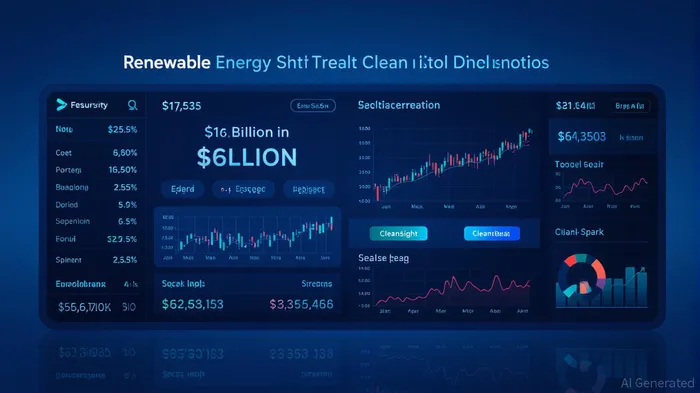 CleanTrade's most immediate contribution lies in its ability to standardize and scale the trading of Virtual Power Purchase Agreements (VPPAs), physical PPAs, and Renewable Energy Certificates (RECs). Prior to its launch, these instruments were traded in fragmented, broker-driven markets with limited price visibility. CleanTrade's centralized platform now offers real-time analytics, automated reporting, and end-to-end workflow tools, reducing transaction times from months to days. For example, the platform's integration of REsurety's CleanSight analytics provides granular insights into project-specific risks, such as congestion and variable capture rates, enabling investors to make data-driven decisions. This transparency has attracted major players like Cargill and Mercuria, who executed the first transaction on the platform, and institutional giants such as BlackRock and Goldman Sachs, which now treat clean energy derivatives as core components of their ESG portfolios.
Risk Management and ESG Integration
The platform's advanced risk management tools are particularly critical for aligning financial returns with decarbonization goals. CleanTrade's ability to hedge against fossil fuel price volatility-through swaps and forward contracts-has made clean energy assets more attractive to risk-averse investors. For instance, in Q3 2025, U.S. clean energy investment surged to $75 billion, with a significant portion directed toward CFTC-regulated derivatives markets. This growth is further amplified by CleanTrade's ESG integration, which allows investors to track carbon capture rates and other sustainability metrics in real time. As 77% of sustainable investors prioritize ESG integration between 2023 and 2025, platforms like CleanTrade are becoming essential infrastructure for verifying and scaling decarbonization efforts.
Broader Implications for Stakeholders
The ripple effects of CleanTrade's success extend beyond institutional investors. For project developers, the platform's liquidity and standardized contracts reduce financing friction, enabling faster deployment of solar, wind, and storage projects. Corporate buyers, meanwhile, gain budget certainty through VPPAs that lock in long-term energy prices while meeting sustainability targets. For example, a major multinational corporation recently used CleanTrade to hedge against 80% of its projected energy costs over the next decade, illustrating the platform's practical utility. On the institutional side, the surge in clean energy investment-projected to grow from $39 trillion to $125 trillion in ESG assets by 2032-is being channeled through platforms like CleanTrade, which offer the transparency and compliance required to meet evolving regulatory standards.
Future Outlook: A Fluid Clean Energy Ecosystem
Looking ahead, the CFTC's pilot program permitting tokenized assets as collateral in derivatives markets further signals the regulator's openness to innovation. Platforms like CleanTrade and Nodal Exchange-now offering web-based trading for RECs-are expected to play a central role in connecting traditional energy markets with the demands of the green transition. As global sustainable debt issuance hit $1.1 trillion in the first nine months of 2025, the infrastructure underpinned by CFTC-approved platforms is proving indispensable for scaling clean energy finance.
In conclusion, the emergence of CFTC-regulated clean energy trading platforms represents a strategic infrastructure investment that is reshaping the energy transition. By addressing liquidity, transparency, and risk management challenges, these platforms are not only attracting capital but also redefining the economics of sustainability. For investors, developers, and corporate buyers alike, the next-gen clean energy marketplace is no longer a vision-it is a reality being built in real time.

Blending traditional trading wisdom with cutting-edge cryptocurrency insights.
Latest Articles
Stay ahead of the market.
Get curated U.S. market news, insights and key dates delivered to your inbox.
AInvest
PRO
AInvest
PRO



Comments
No comments yet