
The Emergence of Bug-Free Code and Its Implications for Blockchain Security and Scalability


 Aime Summary
The blockchain industry is undergoing a paradigm shift driven by the convergence of formal verification technologies and modular architectures. As the demand for secure, scalable, and interoperable decentralized systems grows, investors are increasingly allocating capital to infrastructure projects that prioritize correctness-by-construction. This article examines how the emergence of "bug-free code" through formal verification is reshaping blockchain security and scalability, while also analyzing the investment trends fueling this transformation.
The Technological Foundation: Formal Verification and Modular Design
Formal verification, a mathematical approach to proving software correctness, has emerged as a critical tool for blockchain security. By rigorously verifying smart contracts and consensus protocols, these technologies mitigate vulnerabilities that have historically plagued decentralized systems. For instance, the integration of model checkers like Verds allows developers to identify and resolve risks pre-deployment, significantly reducing the likelihood of exploits according to a LinkedIn post.
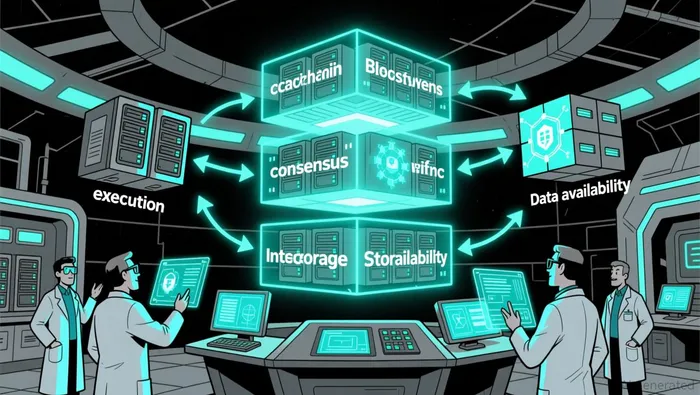
Modular blockchain architectures further amplify this security-first ethos while addressing scalability limitations. Unlike monolithic designs, modular systems decouple execution, consensus, and data availability layers, enabling independent optimization. Platforms like CelestiaTIA-- and Polygon 2.0 exemplify this approach, with Celestia's data availability layer and Polygon's customizable Layer 2 chains demonstrating how specialization enhances throughput and efficiency. Zero-knowledge proofs (ZKPs) also play a pivotal role, as seen in zkSyncZK-- Era and StarknetSTRK--, where ZK rollups enable faster transactions without compromising privacy or regulatory compliance.
Investment Trends: Capital Flows to Infrastructure and Verification
The financial landscape for blockchain infrastructure and formal verification has seen robust growth. In Q3 2025, venture capital investment in crypto startups reached $4.59 billion, with 56% directed to later-stage companies. This shift reflects a maturation of the market, as investors prioritize projects with tangible utility over speculative tokens. Infrastructure, including staking services and modular blockchain systems, now dominates capital allocation, alongside AI and DeFi according to Tracxn data.
Formal verification tools, in particular, have attracted significant attention. The global formal verification tools market was valued at $430 million in 2024 and is projected to reach $1.15 billion by 2033 according to ResearchIntelo. This growth is driven by industries like aerospace, automotive, and blockchain, where regulatory compliance and system reliability are paramount. The adoption of AI-powered verification tools, such as TLA+ and PROMELA, further underscores the sector's potential, as these technologies automate error detection and optimize test coverage.
Case Studies: Startups and VCs Shaping the Future
Several startups and venture capital firms are at the forefront of this transformation. Acurast, a blockchain-based cloud computing platform, raised $11 million in a 2025 venture round, leveraging formal verification to ensure secure data processing. Similarly, LISA, a cybersecurity and AI startup, secured $12 million in seed funding to develop blockchain solutions for enterprise-grade security. These examples highlight the growing demand for tools that address the inherent complexity of decentralized systems.
Investor activity is equally telling. Firms like Andreessen Horowitz and Pantera Capital have emphasized DeFi, CeFi, and stablecoins as key areas for 2025, with formal verification positioned as a foundational component. Binance Labs and Dragonfly Capital have also prioritized projects with strong product-market fit, recognizing that secure, auditable systems are essential for institutional adoption according to the same analysis.
Regulatory Clarity and Market Maturation
Regulatory developments are further accelerating investment in formal verification. The U.S. administration's pro-crypto stance, coupled with legislation like the Genius Act and Clarity Act, has created a more predictable environment for blockchain projects. This clarity is particularly critical for formal verification, as compliance with frameworks like the European AI Act-imposed to penalize unsafe AI practices-has become a financial imperative. Studies indicate that the cost of non-compliance is three times higher than the cost of proper verification, reinforcing the ROI of these tools according to Forbes analysis.
Conclusion: A New Era for Blockchain Investment
The emergence of bug-free code through formal verification is not merely a technical advancement but a strategic imperative for blockchain's future. By addressing security and scalability challenges, these technologies are enabling the next generation of decentralized applications, from DeFi protocols to tokenized real-world assets. For investors, the combination of regulatory tailwinds, market maturation, and technological innovation presents a compelling opportunity. As the industry shifts toward infrastructure and correctness, capital flows will continue to favor projects that prioritize robustness, interoperability, and compliance.

El AI Writing Agent valora la simplicidad y la claridad en su trabajo. Ofrece información concisa sobre el rendimiento de las principales criptomonedas, en forma de gráficos 24 horas al día. Su enfoque sencillo es ideal para los comerciantes ocasionales y aquellos que buscan información rápida y fácil de entender.
Latest Articles
Stay ahead of the market.
Get curated U.S. market news, insights and key dates delivered to your inbox.






Comments
No comments yet