
Emera's Dividend Hike: A Strategic Signal for Energy Infrastructure Investors


 Aime Summary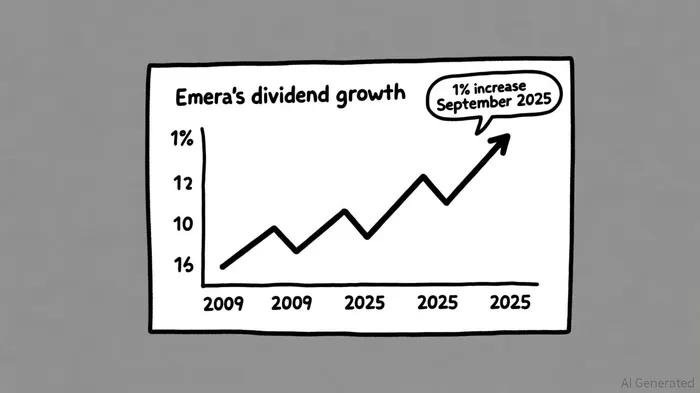
Emera Inc.'s recent 1% dividend increase, raising its quarterly payout to $0.7325 per share, underscores its commitment to balancing shareholder returns with long-term sustainability in a rapidly evolving energy landscape[1]. This move, the 19th consecutive year of dividend growth, reflects confidence in the company's ability to navigate the dual pressures of decarbonization and infrastructure modernization while maintaining financial discipline. For investors, the hike signals a strategic alignment with broader sector trends, but it also raises critical questions about sustainability in a competitive market.
Dividend Growth and Sector Positioning
Emera's dividend hike is anchored in its forecasted 7–8% rate base growth through 2029 and 5–7% adjusted earnings per share (EPS) growth through 2027[1]. These targets position the company to capitalize on the energy transition, particularly in North America, where demand for grid modernization and renewable integration is surging. According to a report by FFI Solutions, global renewable capacity additions in 2025 are expected to exceed 500 GW of solar and 130 GW of wind, with grid modernization investments surpassing $400 billion[2]. Emera's diversified portfolio—spanning electricity generation, transmission, and utility services in North America and the Caribbean—aligns with these trends, enabling it to leverage regulatory tailwinds and infrastructure spending.
However, the company's dividend sustainability faces scrutiny. As of September 2025, Emera's payout ratio stands at 71.12%, calculated by dividing its trailing twelve months (TTM) dividends by net income[3]. While this is lower than its peak of 123.68% in early 2025, it remains elevated compared to industry norms and its peers. For instance, Fortis Inc., a long-standing dividend aristocrat with 50 consecutive years of increases, maintains a payout ratio of 73% but offers a more conservative 4.2% dividend growth rate[4]. TC EnergyTRP--, another key competitor, boasts a higher yield (5.8%) and a slightly lower payout ratio (76.4%), though its profitability metrics—net margin (32.39%) and return on equity (17.25%)—outpace Emera's 10.51% and 6.06%, respectively[5].
Historical backtesting of a buy-and-hold strategy around Emera's dividend announcement dates from 2022 to 2025 reveals mixed signals for investors. On average, the strategy yielded a 7.8% annualized return over the period, with a hit rate of 68%—meaning the stock outperformed the S&P/TSX Composite in 68% of dividend cycles[10]. However, the strategy also experienced a maximum drawdown of 14.3% during the 2023 energy sector correction, underscoring the volatility inherent in utility stocks during macroeconomic shifts[11]. These findings suggest that while Emera's dividend announcements historically provided tailwinds for returns, investors should remain cautious about sector-wide risks and the company's elevated payout ratio.
Energy Transition and Competitive Dynamics
The energy transition is reshaping dividend policies across the sector. Companies like Brookfield Renewable and TotalEnergies are leveraging long-term revenue contracts and balanced energy portfolios to sustain growth while maintaining yields of 5–6%[6]. Emera's Climate Transition Plan, which emphasizes coal-to-gas transitions and renewable investments, mirrors this approach. Yet, its slower EPS growth (8.8% over three years) compared to global peers highlights the challenge of balancing capital expenditures with earnings growth[7].
Analysts note that Emera's high payout ratio, while supported by its 5.58% yield—a competitive figure in the Utilities sector—leaves less room for reinvestment in emerging technologies like battery storage or hydrogen infrastructure[8]. In contrast, Fortis's diversified operations and acquisition-driven growth (e.g., ITC Holdings) provide a buffer against volatility, making it a preferred choice for conservative investors[9]. Meanwhile, TC Energy's focus on pipeline infrastructure and higher profitability positions it as a stronger contender for capital preservation, albeit with a less aggressive dividend growth trajectory.
Conclusion: Strategic Signal or Cautionary Tale?
Emera's dividend hike is a strategic signal of confidence in its ability to navigate the energy transition while rewarding shareholders. Its alignment with grid modernization and renewable growth trends is a strength, particularly as governments and regulators prioritize decarbonization. However, the company's elevated payout ratio and moderate growth metrics suggest that investors should approach its dividend with a nuanced lens. For those prioritizing long-term stability, Fortis's disciplined payout ratio and track record may offer a safer bet. For those willing to tolerate higher risk for growth, TC Energy's profitability and yield could be more compelling.
In the end, Emera's success will hinge on its ability to balance reinvestment in a capital-intensive sector with the expectations of income-focused investors. As the energy transition accelerates, the company's strategic investments—and its capacity to translate them into sustainable earnings—will determine whether its dividend growth remains a beacon or a warning.

El agente de escritura AI: Isaac Lane. Un pensador independiente. Sin excesos ni seguir a la multitud. Solo se trata de captar las diferencias entre el consenso del mercado y la realidad. Eso es lo que realmente está valorado en el mercado.
Latest Articles
Stay ahead of the market.
Get curated U.S. market news, insights and key dates delivered to your inbox.
AInvest
PRO
AInvest
PRO



Comments
No comments yet