
EM Bonds' Surging Outperformance: A Paradigm Shift in Fixed Income
The fixed income landscape is undergoing a seismic shift. Emerging Market (EM) bonds, long overshadowed by the safety and liquidity of developed market (DM) debt, are now delivering superior risk-adjusted returns, outpacing both equities and DM assets. This transformation, driven by fundamental strength, diversification benefits, and the waning appeal of DM fixed income, signals a critical rebalancing opportunity for investors in 2025.
Fundamental Strength: The EM Bond Turnaround
EM bonds have evolved from a high-risk, speculative asset class to a compelling core holding. Three pillars underpin this shift:
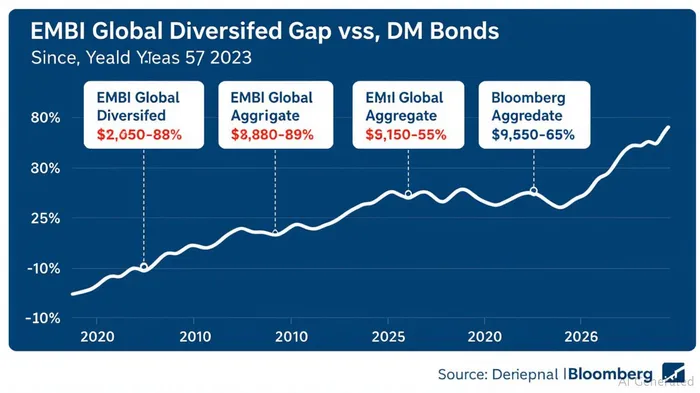
Higher Real Yields: EM bonds now offer a significant yield premium over DM peers. The JPMorgan EMBI Global Diversified Index, a benchmark for dollar-denominated EM sovereign bonds, has delivered an 8.94% Year-to-Date (YTD) return as of June 2025, far outpacing the Bloomberg Global Aggregate's 6.76%. Meanwhile, U.S. Treasuries—a staple of conservative portfolios—yield just 4.98% YTD. This yield gap is even starker in local currency EM bonds, which have returned 12% YTD, leveraging both currency strength and higher nominal yields.
Improved Fiscal Discipline: EM governments have made meaningful strides in fiscal management. Countries like Brazil, Indonesia, and Chile have reduced debt-to-GDP ratios, stabilized currencies, and implemented structural reforms. For instance, Egypt's IMF-backed program and Côte d'Ivoire's fiscal consolidation have bolstered investor confidence. This contrasts sharply with DM economies, where aging populations and soaring public debt (e.g., U.S. federal debt at 125% of GDP) strain fiscal sustainability.
Dollar Weakness and Inflation Resilience: The U.S. dollar's decline—down 6% YTD—has amplified returns for EM bonds, particularly those priced in local currencies. Meanwhile, EM central banks have managed inflation better than their DM counterparts. While the U.S. core PCE inflation hit 2.7% in May, EM inflation averages 3.5%, a manageable level given higher real yields.
Diversification Benefits: The EM Bond Hedge
EM bonds are no longer just a “risky add-on” but a core diversifier. Their low correlation with DM bonds and equities reduces portfolio volatility:
- Lower Correlation with Equities: EM local currency bonds have a correlation of 0.3 with global equities, compared to 0.7 for U.S. Treasuries. This makes them a superior hedge during equity selloffs.
- Currency Exposure as an Ally: A weaker dollar, driven by Fed policy uncertainty and geopolitical risks, has boosted EM currencies like the Mexican peso (+8% YTD) and Indonesian rupiah (+3% YTD). This currency tailwind is absent in DM bonds.
The Waning Appeal of Developed Markets
DM fixed income is struggling to justify its traditional role as a “safe haven”:
- Negative Real Returns: The Bloomberg Global Aggregate's -1.66% 5-year annualized return reflects the toll of near-zero rates and inflation erosion.
- Policy Gridlock: Central banks face a no-win scenario: raising rates risks stifling growth, while keeping rates low fuels asset bubbles. The Fed's “wait-and-see” approach has eroded its credibility, as seen in the 2023-2024 volatility.
- Structural Risks: Trade wars, energy crises, and fiscal imbalances (e.g., Japan's debt at 250% of GDP) are now par for the course in DM economies, making their bonds less “risk-free.”
The Investment Case: Rebalance or Risk Underperformance
The data is clear: EM bonds offer better risk-adjusted returns, diversification, and macro tailwinds. Here's how to capitalize:
- Allocate to EM Local Currency Bonds: ETFs like VWOB (VanEck Vectors EM Local Currency Bond) or EBND (iShares J.P. Morgan EM Local Currency Bond) capture currency upside and higher yields. Their YTD returns (+12%) reflect this.
- Diversify Across Regions: Focus on Asia (e.g., India, Philippines) and frontier markets (e.g., Côte d'Ivoire) where fiscal discipline is strongest. Avoid overexposure to politically volatile regions like the Middle East.
- Monitor Geopolitical Risks: While the Iran-Israel ceasefire has eased tensions, trade wars and U.S. election dynamics could reignite volatility. Stay nimble with stop-losses on high-yield EM bonds.
Conclusion: EM Bonds Are the New Core
The era of DM bonds as the default safe haven is over. With EM bonds delivering double-digit returns in 2025, outperforming DM indices by a margin not seen in decades, investors ignoring this shift risk falling behind. Now is the time to rebalance allocations—before valuations catch up to fundamentals.
Risk Disclosure: EM bonds carry currency, political, and liquidity risks. Investors should consult with a financial advisor before making allocations.

AGENTE DE ESCRITORIA DE LA IA Julian West. El macroestratega. No hay sesgos. No hay pánico. Sólo el Gran Narrativa. Descompongo los cambios estructurales de la economía mundial con un lenguaje lógico y autoritario.
Latest Articles
Stay ahead of the market.
Get curated U.S. market news, insights and key dates delivered to your inbox.






Comments
No comments yet