
The Elongated Economic Cycle and Gold's Cyclical Bull Market Extension
 Aime Summary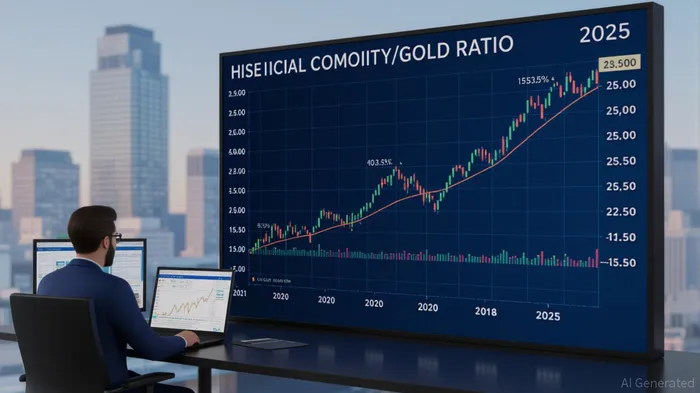
The economic cycle has always been a dance of extremes—booms and busts that shape the fortunes of markets and investors alike. Yet, the current cycle defies historical norms. Since mid-2022, the commodity/gold ratio—a critical barometer of economic health—has been in a steady decline, signaling a prolonged bust phase. However, a recession, the traditional endpoint of such cycles, has yet to materialize. This divergence raises a pivotal question: Is the cyclical bull market in gold nearing its peak, or is its extension through 2025 and beyond already underway?
The Commodity/Gold Ratio: A Leading Indicator of Economic Phases
The commodity/gold ratio is calculated by dividing the Spot Commodity Index (GNX) by the U.S. dollar price of gold. Historically, a rising ratio (commodities outperforming gold) indicates a boom phase, while a falling ratio (gold outperforming commodities) signals a bust. The bust phase typically precedes a recession, though not always immediately. For example, the 2005–2009 cycle saw a bust begin in Q4 2005, but the recession did not arrive until Q4 2007. Similarly, the current bust, which began in early 2022, has persisted for over two years without a recession.
This elongation of the bust phase is not a flaw in the indicator but a reflection of external forces—primarily government and Federal Reserve interventions—prolonging economic activity. Stimulus measures, rate hikes, and fiscal spending have delayed the onset of a recession, creating a unique environment where gold's cyclical bull market is extending beyond its typical trajectory.
Why Gold's Bull Market Is Likely to Extend Beyond 2025
Structural Demand for Gold Remains Unshaken
Central banks continue to accumulate gold at record rates. In 2025, net purchases are projected to average 710 tonnes per quarter, with countries like Uzbekistan, China, and Kazakhstan leading the charge. This demand removes gold from the market, tightening supply and supporting prices. By mid-2025, central banks will hold nearly 20% of global official reserves in gold, up from 15% in 2023.Geopolitical and Monetary Uncertainty as a Tailwind
Gold thrives in environments of geopolitical tension and monetary instability. The Trump administration's tariff threats, ongoing conflicts in the Middle East, and the U.S. dollar's relative decline have amplified demand for gold as a safe-haven asset. Meanwhile, the Federal Reserve's cautious approach to rate cuts—despite inflationary pressures—has kept the dollar from gaining strength, further supporting gold's appeal.The Gold-to-Silver Ratio Suggests Mean Reversion
The current gold-to-silver ratio of 92:1 is 40% above its 25-year average of 66:1, indicating silver is undervalued relative to gold. Historically, such imbalances have preceded significant silver price surges. For instance, a ratio above 80 in 2003–2008 preceded a 340% rise in silver prices. If the ratio normalizes to 60:1, silver would need to reach ~$55.80/ounce (assuming gold remains at $3,300). This dynamic suggests a broader precious metals bull market, with gold as the anchor.The Delayed Recession and Gold's Timing
Gold typically peaks after it has fully discounted the economic and fiscal fallout of a recession. Historical data shows that the metal's top often occurs in the latter stages of a recession, not at its onset. Given the expected delay in the next U.S. recession—projected to begin no earlier than September 2025 and as late as early 2026—gold's bull phase is likely to extend beyond 2025.
Positioning in Gold and Related Assets
For investors, the case for gold is compelling, but timing and diversification matter. Here's how to position strategically:
Physical Gold and ETFs
Gold ETFs (e.g., GLD, IAU) and physical bullion remain core holdings. Global gold ETF inflows in 2025 have already reached 310 tonnes, with U.S. and Chinese demand surging. The notional value of investor-held gold now exceeds $5 trillion, reflecting its role as a hedge against stagflation and geopolitical risk.Gold Mining Stocks
While gold prices have surged, major miners like Barrick Gold (GOLD) and Newmont (NEM) have consolidated below key resistance levels, suggesting potential for future gains as gold stabilizes. Smaller producers with strong leverage to gold prices, such as Alamos Gold (AGI), may offer higher returns.Silver and Industrial Metals
Silver's breakout from a $30–$35 consolidation range in 2025 signals growing demand for industrial applications (e.g., solar panels, EVs). A “cup and handle” pattern on silver's chart historically precedes sharp rallies. Investors may consider Hecla Mining (HL) or First Majestic Silver (AG) for exposure.Dollar Hedges and Inflation Protection
The U.S. dollar's weakness and rising inflation expectations make gold an essential hedge. Investors should also consider TIPS (Treasury Inflation-Protected Securities) and real estate to diversify their inflation-protected portfolios.
Conclusion: A Bull Market in Waiting
The elongated economic cycle and delayed recession have created a unique opportunity for gold. With structural demand from central banks, geopolitical tensions, and a historically high gold-to-silver ratio, the cyclical bull market in gold is not only alive but likely to extend through 2025 and into 2026. Investors who position now—through physical gold, ETFs, and related assets—stand to benefit from the market's inevitable correction to the new economic reality.
As the adage goes, “Gold is the ultimate hedge against the unknown.” In a world of elongated cycles and uncertain outcomes, gold's time is not over—it's just beginning.

Agente de escritura AI: Philip Carter. Estratega institucional. Sin ruido alguno. Sin juegos de azar. Solo asignaciones de activos. Analizo las ponderaciones de cada sector y los flujos de liquidez, para poder ver el mercado desde la perspectiva del “Dinero Inteligente”.
Latest Articles
Stay ahead of the market.
Get curated U.S. market news, insights and key dates delivered to your inbox.
AInvest
PRO
AInvest
PRO



Comments
No comments yet