
Elon Musk Net Worth Surpasses $800 Billion as SpaceX Merger With xAI Accelerates
 Aime Summary
- Elon Musk's net worth exceeds $852 billion, with SpaceX now representing over half of his wealth following a $1.25 trillion valuation after merging with xAIXAI--.
- The combined entity, valued at $1.25 trillion, is set to become the largest private company globally, surpassing TeslaTSLA-- in paper value.
- The merger aims to establish space-based data centers, leveraging near-constant solar energy for AI compute operations, though technical and regulatory hurdles remain.
Elon Musk’s corporate empire has taken a significant turn in 2026 as SpaceX’s valuation skyrockets to $1.25 trillion following its acquisition of xAI, the artificial intelligence venture he founded. This move not only repositions SpaceX as the most valuable private company in the world but also shifts the focus of Musk’s personal wealth away from Tesla toward his space and AI ambitions. His stake in SpaceX—estimated at 43%—now forms a larger portion of his net worth than his 13% ownership in Tesla, which still commands a $1.58 trillion market cap.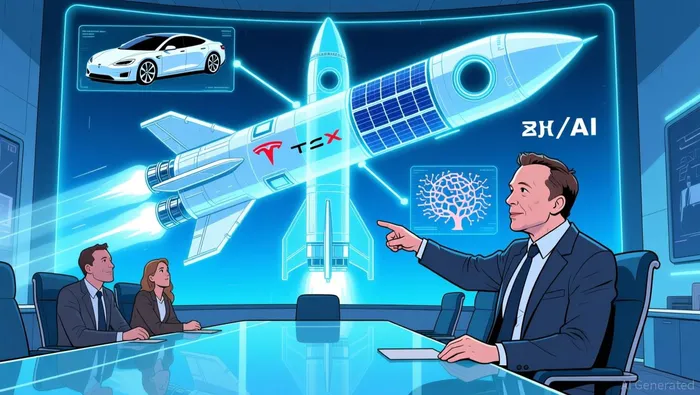
The strategic merger with xAI is driven by Musk’s vision of overcoming energy and infrastructure constraints for AI development on Earth. By deploying data centers in space, where solar energy is abundant, SpaceX and xAI aim to create a scalable and sustainable computing platform for the future. This initiative aligns with broader industry trends, as tech giants like Microsoft and Meta also invest heavily in AI infrastructure. However, the technical feasibility of orbital data centers remains unproven, with challenges including radiation, cooling, and massive capital requirements.
Why Is Elon Musk’s Net Worth Now Tied Heavily to SpaceX?
Elon Musk’s net worth has traditionally been closely tied to Tesla, the electric vehicle company that made him a household name. However, recent developments—particularly the valuation surge of SpaceX—have shifted the balance of his wealth. The acquisition of xAI at a $250 billion valuation has pushed SpaceX’s overall valuation to $1.25 trillion, significantly increasing the paper value of Musk’s 43% stake. This move has also created a more integrated corporate structure, combining SpaceX’s launch and satellite internet capabilities with xAI’s AI tools and social media platforms.
The shift in focus is partly a response to Tesla’s recent challenges, including slowing electric vehicle sales and regulatory scrutiny. Meanwhile, SpaceX has strengthened its market position with long-term contracts from NASA and the U.S. Department of Defense, as well as the commercial success of its Starlink satellite internet service. These factors have contributed to investor confidence in SpaceX, leading to a higher valuation despite the company’s private status.
How Does the SpaceX-xAI Merger Impact Elon Musk’s IPO Plans?
The merger between SpaceX and xAI is being framed as a precursor to a potential initial public offering (IPO) in 2026. Sources indicate that the combined entity could be valued at $1.5 trillion in the public market, making it one of the largest IPOs in history. This valuation is based on the projected demand for AI computing infrastructure and the unique capabilities of SpaceX’s satellite network. The IPO would provide Musk with an opportunity to liquidate a portion of his stake, though regulatory and technical hurdles remain.
One of the key challenges for an IPO is the integration of xAI, which has faced scrutiny for its AI tools, including Grok, a chatbot that has generated controversial content. Regulators in several markets are examining xAI’s practices, and these concerns could impact the public perception of the merged entity. Additionally, the technical and financial feasibility of space-based data centers is still uncertain, with some analysts suggesting that terrestrial alternatives will remain more practical for the near future.
Despite these risks, the merger represents a bold step toward Musk’s long-term vision of a robot-driven, AI-powered future. The integration of SpaceX and xAI is expected to accelerate the development of space-based infrastructure, with plans to launch up to 1 million satellites for computing and data storage. If successful, this initiative could redefine the landscape of AI and space exploration, positioning Musk at the forefront of technological innovation.

Stay ahead of the market.
Get curated U.S. market news, insights and key dates delivered to your inbox.


AInvest
PRO
AInvest
PRO



Comments
No comments yet