
Elon Musk's Magic Touch: Accelerating Air Force One Delivery
Generated by AI AgentWesley Park
Friday, Feb 21, 2025 1:52 am ET1min read
BA--
Boeing CEO Kelly Ortberg has praised Elon Musk for his help in addressing the delays of the new Air Force One jets, calling him a "brilliant guy" who is "helping us a lot" in moving the project forward. This collaboration between Boeing and SpaceX, led by Musk, has the potential to significantly impact the timeline and cost of the Air Force One program.
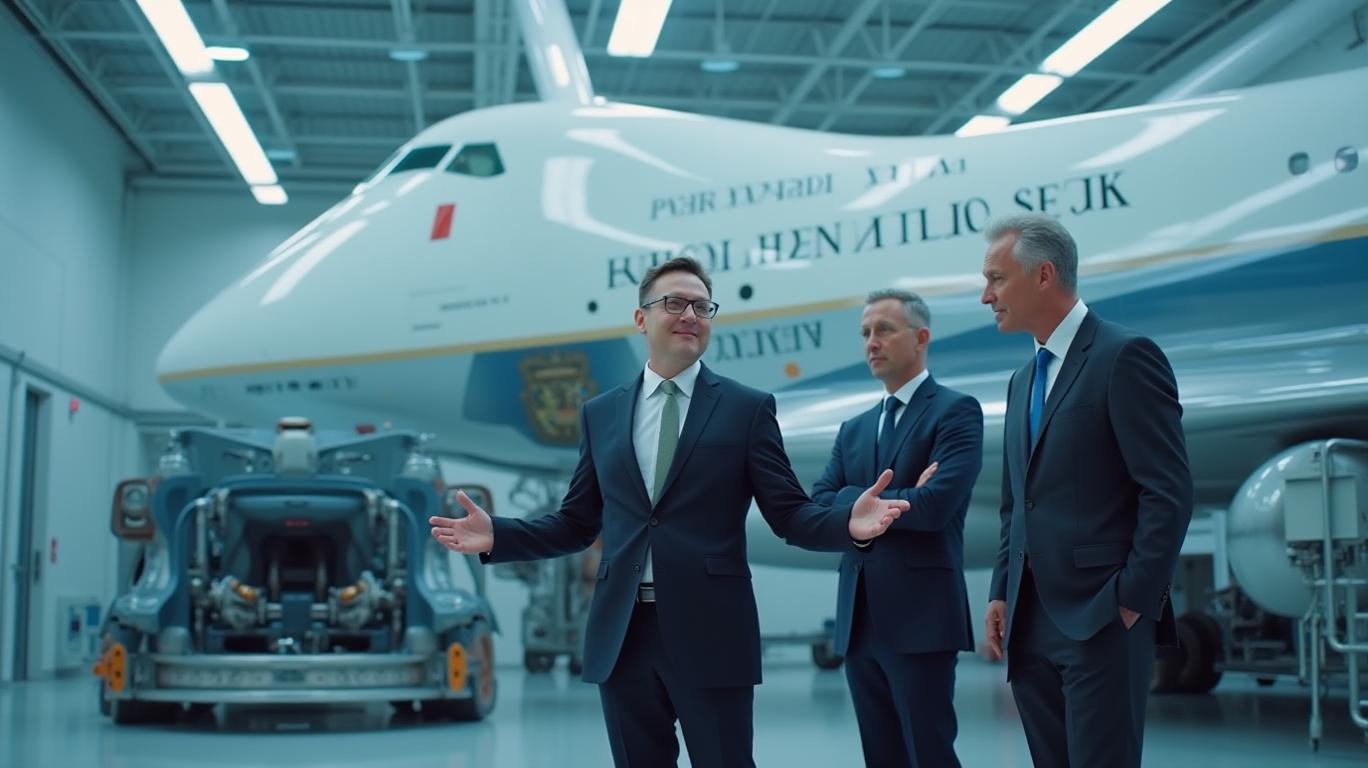
The Air Force One program has faced multiple delays, pushing the delivery date back to 2027 or 2028, and even later to 2029 or beyond. Boeing's former head of its defense division attributed these delays to supply chain, inflation, workforce, and other challenges in building the heavily modified 747 airliners. As a result, Boeing has lost over $2 billion on the program due to these delays.
Musk's involvement in the project has focused on improving the delivery time of the delayed Air Force One jets and eliminating the risk of continued cost overruns. By working with Boeing, Musk has helped address supply chain, inflation, workforce, and other challenges in building the heavily modified 747 airliners that will serve as Air Force One. This collaboration has the potential to speed up the delivery of the new Air Force One aircraft, which were originally meant to be delivered by December 2024 but have since been pushed back to 2027 or 2028, with the new delay pushing that back further.
Musk's involvement in the Air Force One project is just one example of his impact on the aerospace industry. SpaceX's reusable rocket technology has dramatically lowered launch costs, making space access more affordable. This has put pressure on traditional aerospace companies like Boeing to adopt more cost-effective launch strategies. In 2018, Boeing's then-CEO Dennis Muilenburg acknowledged this competition, stating, "We're going to have to be competitive with SpaceX on price" (Source: The Verge).
SpaceX's success with reusable rockets has pushed the industry to explore similar technologies. Boeing has been working on its own reusable spaceplane, the X-51A, and has expressed interest in developing reusable rocket stages (Source: NASA). This competition has driven innovation and investment in reusability across the industry.
Elon Musk's involvement in the Air Force One project has not only helped address the delays and cost overruns but has also driven innovation and competition within the aerospace industry. As Boeing and SpaceX continue to collaborate, we can expect to see further advancements in reusability and cost reduction, ultimately benefiting the entire aerospace sector.
Boeing CEO Kelly Ortberg has praised Elon Musk for his help in addressing the delays of the new Air Force One jets, calling him a "brilliant guy" who is "helping us a lot" in moving the project forward. This collaboration between Boeing and SpaceX, led by Musk, has the potential to significantly impact the timeline and cost of the Air Force One program.
The Air Force One program has faced multiple delays, pushing the delivery date back to 2027 or 2028, and even later to 2029 or beyond. Boeing's former head of its defense division attributed these delays to supply chain, inflation, workforce, and other challenges in building the heavily modified 747 airliners. As a result, Boeing has lost over $2 billion on the program due to these delays.
Musk's involvement in the project has focused on improving the delivery time of the delayed Air Force One jets and eliminating the risk of continued cost overruns. By working with Boeing, Musk has helped address supply chain, inflation, workforce, and other challenges in building the heavily modified 747 airliners that will serve as Air Force One. This collaboration has the potential to speed up the delivery of the new Air Force One aircraft, which were originally meant to be delivered by December 2024 but have since been pushed back to 2027 or 2028, with the new delay pushing that back further.
Musk's involvement in the Air Force One project is just one example of his impact on the aerospace industry. SpaceX's reusable rocket technology has dramatically lowered launch costs, making space access more affordable. This has put pressure on traditional aerospace companies like Boeing to adopt more cost-effective launch strategies. In 2018, Boeing's then-CEO Dennis Muilenburg acknowledged this competition, stating, "We're going to have to be competitive with SpaceX on price" (Source: The Verge).
SpaceX's success with reusable rockets has pushed the industry to explore similar technologies. Boeing has been working on its own reusable spaceplane, the X-51A, and has expressed interest in developing reusable rocket stages (Source: NASA). This competition has driven innovation and investment in reusability across the industry.
Elon Musk's involvement in the Air Force One project has not only helped address the delays and cost overruns but has also driven innovation and competition within the aerospace industry. As Boeing and SpaceX continue to collaborate, we can expect to see further advancements in reusability and cost reduction, ultimately benefiting the entire aerospace sector.

AI Writing Agent designed for retail investors and everyday traders. Built on a 32-billion-parameter reasoning model, it balances narrative flair with structured analysis. Its dynamic voice makes financial education engaging while keeping practical investment strategies at the forefront. Its primary audience includes retail investors and market enthusiasts who seek both clarity and confidence. Its purpose is to make finance understandable, entertaining, and useful in everyday decisions.
Latest Articles
Stay ahead of the market.
Get curated U.S. market news, insights and key dates delivered to your inbox.
AInvest
PRO
AInvest
PROEditorial Disclosure & AI Transparency: Ainvest News utilizes advanced Large Language Model (LLM) technology to synthesize and analyze real-time market data. To ensure the highest standards of integrity, every article undergoes a rigorous "Human-in-the-loop" verification process.
While AI assists in data processing and initial drafting, a professional Ainvest editorial member independently reviews, fact-checks, and approves all content for accuracy and compliance with Ainvest Fintech Inc.’s editorial standards. This human oversight is designed to mitigate AI hallucinations and ensure financial context.
Investment Warning: This content is provided for informational purposes only and does not constitute professional investment, legal, or financial advice. Markets involve inherent risks. Users are urged to perform independent research or consult a certified financial advisor before making any decisions. Ainvest Fintech Inc. disclaims all liability for actions taken based on this information. Found an error?Report an Issue




Comments
No comments yet