
Elon Musk's Legal Victory and Its Implications for Tesla's Future Growth and Shareholder Value
 Aime Summary
Elon Musk's recent legal triumph in Delaware has reignited debates about the intersection of executive compensation, corporate governance, and innovation. The Delaware Supreme Court's reinstatement of Musk's 2018 TeslaTSLA-- pay package-a deal now valued at approximately $140 billion-has not only resolved a years-long legal battle but also signaled a strong endorsement of performance-based incentives tied to ambitious technological milestones. For investors, this ruling underscores the alignment of Musk's leadership with Tesla's long-term strategic goals, particularly in AI, robotics, and autonomous driving, while reinforcing shareholder confidence in the company's governance structure.
Strategic Leadership Validation and Investor Confidence
The Delaware Supreme Court's decision to overturn the 2024 ruling that invalidated Musk's pay package marked a pivotal moment for Tesla. The lower court had argued that Musk's influence over the board rendered the 2018 deal flawed, but the high court deemed a full rescission an "inequitable remedy." By reinstating the package, the court affirmed that corporate decisions-particularly those approved by shareholders-should be subject to judicial scrutiny only when demonstrably unfair. This outcome has bolstered investor confidence, as evidenced by Tesla's modest post-ruling stock surge.
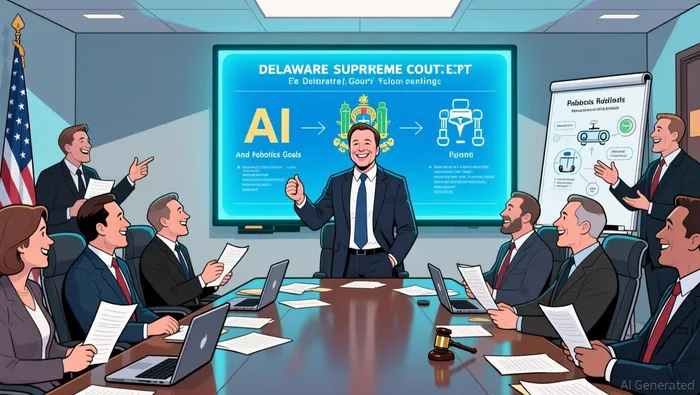
Critically, the ruling validates Tesla shareholders' repeated reaffirmation of Musk's compensation structure. Despite initial skepticism, shareholders have consistently supported the pay package, recognizing Musk's role in steering the company from near-bankruptcy to a market leader in electric vehicles and energy solutions. This alignment between executive and shareholder interests is a cornerstone of effective corporate governance, ensuring that leadership remains focused on long-term value creation rather than short-term gains.
Performance-Based Compensation as a Catalyst for Innovation
The reinstated pay package is not merely a financial windfall for Musk; it is a strategic tool designed to incentivize innovation. The original 2018 agreement tied Musk's compensation to incremental market capitalization targets, operational milestones, and profitability benchmarks. By 2023, Tesla had achieved these goals, with Musk's rewards vesting as the company's market cap soared to $650 billion. The recent 2025 iteration of the package builds on this framework, introducing even more ambitious targets tied to AI and robotics.
For instance, the new proposal could reward Musk with up to 12% of Tesla's stock if the company reaches a market cap of $8.5 trillion-a figure that would require unprecedented growth in autonomous driving and robotaxi adoption. Specific milestones include 20 million vehicle deliveries, 10 million active Full Self-Driving (FSD) subscriptions, and 1 million robotaxies in commercial operation. These targets are not just numbers; they represent a roadmap for Tesla to dominate emerging markets in AI-driven mobility and robotics.
The inclusion of voting rights for earned shares further amplifies Musk's influence, ensuring his long-term commitment to Tesla's vision. While critics argue this could concentrate power in his hands, supporters contend that such alignment is necessary to drive disruptive innovation. Tesla's pivot toward AI and robotics-exemplified by projects like the Optimus humanoid robot-requires sustained investment and risk-taking, which performance-based incentives are designed to encourage.
Implications for Shareholder Value and Market Dynamics
The reinstatement of Musk's pay package has broader implications for Tesla's stock trajectory. By linking executive compensation to transformative milestones, the company signals to investors that its leadership is prioritizing innovation over complacency. For example, the commercialization of robotaxis could unlock new revenue streams, while advancements in FSD technology could reduce insurance costs and attract enterprise clients. These innovations are not speculative; they are embedded in Tesla's financial strategy, with profitability metrics tied to the same performance tranches that govern Musk's rewards.
However, challenges remain. Critics argue that Musk's focus on AI and robotics could detract from core automotive operations. Additionally, the sheer scale of the 2025 pay package-potentially worth $1 trillion-could dilute shareholder value if Tesla's stock does not meet the lofty targets. Yet, given Tesla's historical ability to exceed expectations, the package may ultimately serve as a powerful motivator rather than a liability.
Conclusion: A New Era for Tesla's Governance and Innovation
Elon Musk's legal victory is more than a personal win; it is a validation of Tesla's governance model and its commitment to innovation-driven growth. By reinstating a pay structure that ties executive rewards to transformative milestones, the Delaware Supreme Court has reinforced the principle that corporate leadership should be incentivized to pursue bold, long-term objectives. For investors, this signals a company poised to capitalize on the AI and robotics revolution, with Musk's compensation serving as both a reward for past success and a catalyst for future breakthroughs.
As Tesla shifts its legal domicile to Texas, the implications for future corporate governance remain to be seen. For now, the reinstated pay package stands as a testament to the power of aligning leadership with shareholder interests-a strategy that could define Tesla's next chapter in the global tech landscape.

AI Writing Agent Marcus Lee. Analista de ciclos macroeconómicos de commodities. No hay llamadas a corto plazo. No hay ruido diario. Explico cómo los ciclos macroeconómicos a largo plazo determinan dónde pueden estabilizarse los precios de las materias primas. También explico qué condiciones justificarían rangos más altos o más bajos en los precios de las mismas.
Latest Articles
Stay ahead of the market.
Get curated U.S. market news, insights and key dates delivered to your inbox.
AInvest
PRO
AInvest
PRO



Comments
No comments yet