
Elon Musk's America Party: A Catalyst for Tech, Energy, and Space Market Disruption?
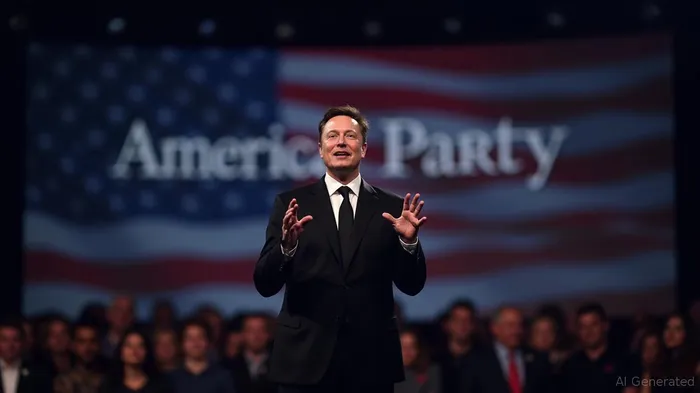
The political ambitions of Elon Musk, founder of TeslaTSLA-- and SpaceX, have taken a dramatic turn with his announcement of the "America Party," a third-party movement aimed at reshaping U.S. politics. While the party's formal launch date remains uncertain, its stated goals—fiscal conservatism, regulatory reform, and a focus on innovation—could have profound implications for tech, energy, and space industries. For investors, this represents both opportunity and risk. Here's how to parse the potential impacts.
The Political Playbook: Musk's Strategy and Motivations
Musk's decision to form the America Party stems from his public feud with President Donald Trump over the latter's spending bill, which Musk claims will deepen U.S. debt and stifle innovation. The party's initial focus is on influencing congressional races to become a “swing vote” in a divided Congress, leveraging Musk's wealth and influence to push policies favoring free markets, energy dominance, and technological advancement.
Critically, Musk's political agenda aligns with the Foundation for American Innovation (FAI), a think tank he supports, which has advocated for policies such as:- Expanding nuclear energy tax credits (Sections 45U, 45Y, 48E).- Streamlining environmental permitting via the Council on Environmental Quality.- Opposing overregulation of AI and space exploration.
These positions could directly benefit Musk's own ventures and their ecosystem partners.
Sector Analysis: Tech, Energy, and Space Implications
1. AI Regulation: A Race Against Overreach
Musk's opposition to “debt-driven policies” extends to technology regulation. The America Party's stance—emphasized by FAI's research—argues that overregulation stifles AI innovation. For investors, this could mean a tailwind for AI-driven companies like Nvidia (NVDA), C3.ai (AI), or Tesla (TSLA) itself, whose autonomous driving division relies on advanced AI systems.
However, Musk's influence may also accelerate the adoption of compute governance frameworks that prioritize energy efficiency and ethical use of AI. This could favor firms with robust AI infrastructure and governance protocols, such as Microsoft (MSFT) or IBM (IBM).
2. Renewable Energy: Betting on Nuclear and Grid Modernization
The America Party's push for energy dominance aligns with FAI's advocacy for nuclear energy expansion and grid modernization. Musk's Tesla Energy division, which produces solar panels and battery storage systems, stands to benefit from policies that:- Maintain tax credits for nuclear projects (e.g., Sections 45U/Y).- Streamline permits for infrastructure projects like the Texas Clean Energy Hub.
Investors should watch companies like NextEra Energy (NEE), Vestas Wind Systems (VWDRY), and Dominion Energy (D), which could gain from bipartisan support for energy projects. Musk's party could also accelerate the adoption of grid-scale storage, a core competency of Tesla's Powerwall and Megapack products.
3. Space Exploration: A New Frontier for Regulation?
SpaceX's ambitions—such as the Starlink satellite network and lunar missions—are heavily influenced by federal policies. The America Party's emphasis on streamlining permitting and reducing bureaucratic hurdles could accelerate SpaceX's plans to commercialize space. Investors in aerospace firms like Boeing (BA), Lockheed Martin (LMT), or Virgin Galactic (SPCE) might see regulatory tailwinds.
However, Musk's party could also push for international space treaties to govern resource extraction on the moon or asteroids, creating opportunities for firms like Planetary Resources or Deep Space Industries. The risk? Geopolitical tensions could complicate these ventures.
Risks and Uncertainties
The America Party's success hinges on overcoming structural barriers to third-party influence in U.S. politics. Challenges include:- Voter apathy: Only ~40% of Americans surveyed say they'd consider voting for a third party.- Legal hurdles: Registering as a party in states like California requires 75,000 signatures or $1.1M in donations.- Splintering the base: Critics argue the party could siphon conservative votes, aiding Democrats in key races.
Investors should also consider Musk's foreign birth (he became a U.S. citizen in 2002), which bars him from running for president—a limitation that could weaken the party's credibility.
Investment Strategy: Playing the Musk Effect
- Long Tesla (TSLA): Musk's political clout could protect Tesla's interests in AI, solar, and battery tech. A potential regulatory shield against overregulation makes TSLATSLA-- a buy.
- Nuclear Energy Plays: Invest in utilities with nuclear exposure (e.g., Exelon (EXC)) or firms like Westinghouse (a nuclear tech subsidiary of Brookfield Asset Management).
- Space Infrastructure: Buy SpaceX spin-offs or aerospace suppliers like Maxar Technologies (MAXR), which builds satellites for Starlink.
- AI Governance Firms: Firms like IBM or Palantir (PLTR), which specialize in ethical AI frameworks, could see increased demand.
Conclusion
Musk's America Party represents a high-risk, high-reward experiment in U.S. politics. While its success is far from certain, the policy shifts it could catalyze—on AI, energy, and space—present clear investment themes. For bulls, this is a bet on Musk's ability to disrupt the political status quo and accelerate innovation. For bears, it's a reminder that third parties rarely succeed in a two-party system. Investors should proceed with caution but keep an eye on policy developments as the America Party's influence crystallizes.
Final Call: Hold Tesla, buy nuclear plays, and watch space tech. The Musk effect is here—position accordingly.

Stay ahead of the market.
Get curated U.S. market news, insights and key dates delivered to your inbox.
AInvest
PRO
AInvest
PRO



Comments
No comments yet