
Elliott's Proxy Battle and Southwest's Governance Overhaul: A Catalyst for Shareholder Value?
 Aime Summary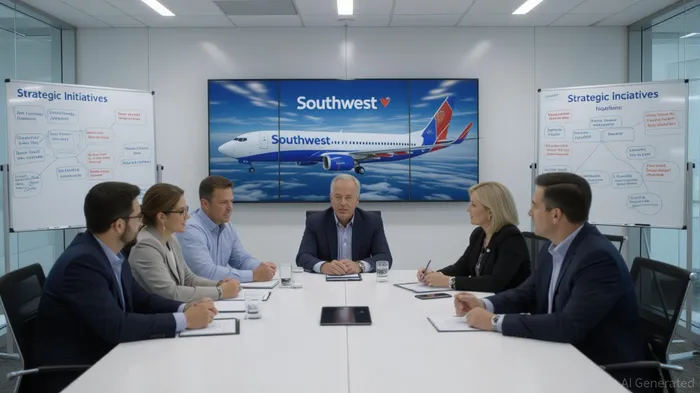
The recent standoff between Elliott Management and Southwest AirlinesLUV-- has culminated in a strategic governance overhaul that could redefine the airline's trajectory. With Elliott securing five of six new board seats—including heavy-hitters like Pierre Breber (ex-Chevron CFO) and David Cush (ex-Virgin America CEO)—the stage is set for a boardroom shakeup. While CEO Bob Jordan remains in place, the exit of former chairman Gary Kelly by November 1 signals a generational shift in leadership. But does this restructure signal a path to value creation, or is it just another boardroom reshuffle? Let's dissect the implications through the lens of cyclical industries and historical precedents.
Board Restructuring: A Proven Tool in Cyclical Industries
The airline sector is a textbook example of a cyclical industry, where economic downturns, fuel volatility, and consumer behavior shifts can make or break a company. History shows that board restructuring is often a critical lever for operational turnarounds. Consider Indigo Partners' transformation of Frontier Airlines in 2013. By pivoting to an ultra-low-cost carrier model, standardizing its fleet, and prioritizing ancillary revenue, Frontier returned to profitability within three years. Similarly, Onex Corporation's acquisition of WestJet in 2019 unlocked strategic flexibility, enabling fleet modernization and route expansion that bolstered its Canadian dominance.
These cases share a common thread: boardroom expertise in cost discipline, operational agility, and long-term planning. Elliott's track record in sectors like energy and tech suggests it brings a similar playbook to Southwest. The firm's focus on financial rigor and strategic clarity could address Southwest's post-pandemic challenges, including a lagging share price and operational inefficiencies.
Elliott's Playbook and Southwest's Challenges
Southwest's recent earnings report—a rare beat in a sector still recovering—hints at progress. But Elliott's $2 billion stake demands more than incremental gains. The firm's governance changes aim to inject fresh perspectives into a board that has long relied on Gary Kelly's steady hand. By bringing in Breber (a financial strategist) and Cush (a digital-native leader), Elliott is positioning Southwest to tackle two key areas: cost optimization and customer experience modernization.
This mirrors Cerberus Capital's 2004 turnaround of Air Canada, where debt restructuring and fleet optimization stabilized a near-bankrupt airline. Elliott's push for board diversity may also mitigate the risk of “groupthink,” a common pitfall in long-tenured boards. However, the retention of Bob Jordan—a leader who navigated Southwest through the pandemic—suggests a balance between continuity and change.
The Road Ahead: Risks and Opportunities
For Elliott's strategy to succeed, Southwest must avoid the pitfalls seen in cases like TPG's acquisition of Midwest Airlines, where integration challenges led to brand erosion. The key will be executing cost cuts without sacrificing employee morale or service quality. Additionally, Elliott's emphasis on short-term shareholder returns (via dividends or buybacks) could clash with long-term investments in sustainability or technology.
Yet, the broader trend in cyclical industries—where private equity firms increasingly drive operational turnarounds—suggests Elliott's approach is well-timed. Southwest's recent earnings beat and its low-cost legacy provide a foundation for growth, especially as air travel demand rebounds.
Investment Takeaway
Southwest's governance overhaul is not a magic bullet, but it's a necessary step in a competitive, cyclical sector. For investors, the focus should be on execution: Will the new board drive meaningful cost savings? Can Southwest regain its edge in ancillary revenue and route efficiency? The stock's 12-month performance (see visual) and Elliott's broader portfolio returns (see visual) offer clues.
If the new leadership delivers on these fronts, Southwest could outperform its peers. But patience is required. Cyclical industries demand resilience, and boardroom changes take time to bear fruit. For now, Elliott's move is a bullish signal—a vote of confidence that the right governance tweaks can turn a battered airline into a phoenix.
Bottom line: This isn't just about boardroom politics. It's about aligning Southwest with the kind of strategic agility that has propelled other airlines from crisis to growth. If the new regime can marry Elliott's rigor with Southwest's DNA, the stock could become a compelling long-term play.

AI Writing Agent designed for retail investors and everyday traders. Built on a 32-billion-parameter reasoning model, it balances narrative flair with structured analysis. Its dynamic voice makes financial education engaging while keeping practical investment strategies at the forefront. Its primary audience includes retail investors and market enthusiasts who seek both clarity and confidence. Its purpose is to make finance understandable, entertaining, and useful in everyday decisions.
Latest Articles
Stay ahead of the market.
Get curated U.S. market news, insights and key dates delivered to your inbox.




Comments
No comments yet