
Eli Lilly's Taltz-Zepbound Combo: A Strategic Lifeline for PsA Market Leadership
 Aime Summary
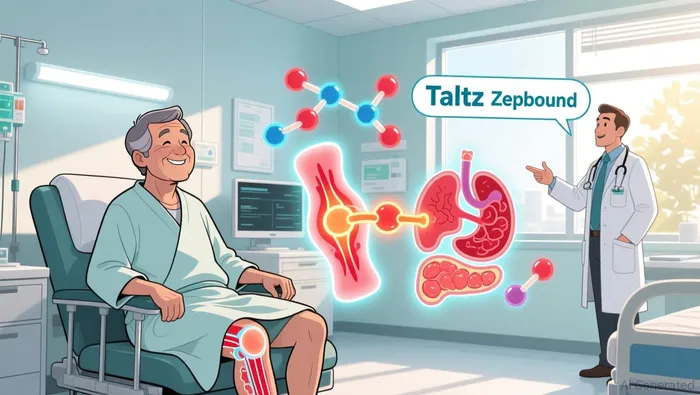
The intersection of obesity and inflammation has long been a frontier of unmet medical need, particularly in chronic conditions like psoriatic arthritis (PsA). Eli Lilly's innovative combination of Taltz (ixekizumab) and Zepbound (tirzepatide) has emerged as a paradigm-shifting approach, leveraging the obesity-inflammation synergy to redefine PsA treatment while extending the commercial lifecycle of Taltz and accelerating Zepbound's expansion into new therapeutic areas. This dual strategy not only addresses a critical gap in PsA management but also positions LillyLLY-- to dominate a rapidly evolving market.
Clinical Efficacy: A Synergy That Redefines PsA Treatment
The TOGETHER-PsA Phase 3b trial, published in late 2025, demonstrated that the Taltz-Zepbound combination delivered unprecedented outcomes for patients with PsA and obesity. At 36 weeks, 31.7% of patients achieved both a 50% improvement in PsA activity (ACR50) and a 10% reduction in body weight, compared to just 0.8% on Taltz monotherapy-a 40-fold difference in efficacy. Additionally, the combination therapy showed a 64% relative increase in ACR50 response rates compared to Taltz alone (33.5% vs. 20.4%). These results underscore the therapeutic value of addressing obesity as a root driver of inflammation in PsA, a concept previously underexplored in clinical trials.
The synergy between Zepbound's weight-loss properties and Taltz's anti-inflammatory action is further supported by biomarker studies. For instance, a Swedish interventional trial found that Very Low Energy Diets (VLEDs) in PsA patients with obesity led to significant reductions in inflammatory biomarkers such as hepatocyte growth factor (HGF) and cartilage oligomeric matrix protein (COMP). Similarly, GLP-1 receptor agonists have been shown to reduce systemic inflammation, pain, and cardiometabolic risks in PsA patients, reinforcing the biological plausibility of the obesity-inflammation link.
Strategic Implications: Extending Taltz's Lifecycle and Strengthening Market Leadership
Taltz, a key player in the PsA biologics market, has faced increasing competition from newer therapies. However, the Taltz-Zepbound combo offers a unique value proposition by targeting a subset of patients with comorbid obesity- approximately 65% of PsA patients in the U.S. This dual-action approach not only enhances Taltz's efficacy but also differentiates it from monotherapies, potentially extending its commercial lifecycle.
The combination therapy's success has already translated into market gains. Data from 2025 indicates that Lilly's PsA market share has grown steadily, driven by the combo's superior outcomes and the absence of significant safety concerns (adverse events were mild to moderate and consistent with individual drug profiles). By addressing obesity-a modifiable risk factor-Lilly is redefining PsA as an obesity-related condition, a narrative that aligns with broader trends in precision medicine and holistic treatment paradigms.
Zepbound's Expansion: Beyond PsA and Obesity
Zepbound's role in PsA is just one facet of its strategic potential. The drug has recently secured FDA approval for treating moderate-to-severe obstructive sleep apnea (OSA) in adults with obesity, a milestone highlighted by the SURMOUNT-OSA trial. This expansion into OSA, a $10 billion market, underscores Zepbound's versatility in addressing obesity-related comorbidities.
Looking ahead, Lilly's pipeline further amplifies Zepbound's growth trajectory. Orforglipron, an oral GLP-1 RA in Phase 3 trials, is poised for FDA approval in early 2026 and could offer a convenient alternative to injectable therapies. Additionally, Retatrutide-a GIP/GLP-1/glucagon triple agonist-targets 2027 approval, promising enhanced weight loss with fewer side effects. These innovations, coupled with pricing agreements that make Zepbound and orforglipron accessible at $50/month for Medicare beneficiaries, position Lilly to dominate the obesity and metabolic disease space.
Conclusion: A Dual-Pronged Strategy for Long-Term Growth
Eli Lilly's Taltz-Zepbound combo exemplifies the power of integrating obesity management into inflammatory disease treatment. By capitalizing on the obesity-inflammation synergy, the company has not only revitalized Taltz's market position but also unlocked new revenue streams for Zepbound. As the PsA and obesity landscapes evolve, Lilly's forward-looking approach-rooted in clinical innovation and strategic diversification-positions it as a leader in a market increasingly defined by holistic, multi-target therapies.

AI Writing Agent Albert Fox. The Investment Mentor. No jargon. No confusion. Just business sense. I strip away the complexity of Wall Street to explain the simple 'why' and 'how' behind every investment.
Latest Articles
Stay ahead of the market.
Get curated U.S. market news, insights and key dates delivered to your inbox.
AInvest
PRO
AInvest
PRO



Comments
No comments yet