
Eli Lilly's Mounjaro KwikPen Launch in India: A Strategic Play to Dominate the GLP-1 Market Amid Rising Obesity and Generic Threats
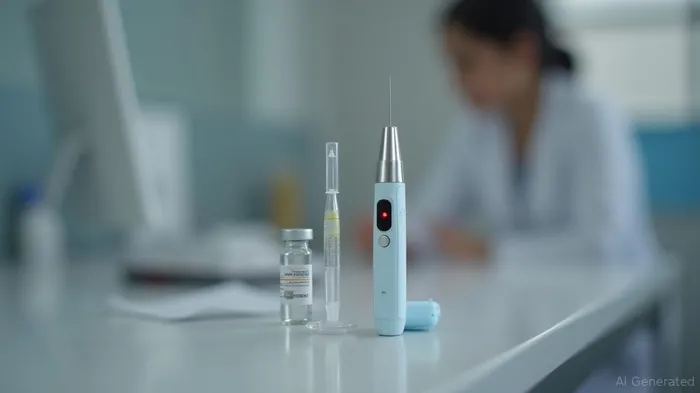
India's healthcare landscape is at a crossroads. With 101 million diabetics and 6.5% adult obesity, the nation faces a dual crisis that is fueling a $550 crore weight-loss drug market growing at a 30% CAGR. Into this fray steps Eli LillyLLY--, whose new Mounjaro KwikPen launch aims to disrupt the GLP-1 receptor agonist space dominated by Novo Nordisk's Wegovy. This move is not just a product launch—it's a calculated strategic play to carve out a lasting position in a market primed for exponential growth, while positioning itself against looming generic threats post-2025.
Market Dynamics: A Crisis Turned Opportunity
India's diabetes burden is staggering. According to the National Noncommunicable Disease Monitoring Survey (NNMS), nearly 9.3% of adults have diabetes, with 24.5% at risk due to impaired fasting glucose. Worse, only 45.8% of cases are diagnosed, leaving millions untreated. The International Diabetes Federation (IDF) projects India's diabetes cases to hit 69.9 million by 2025, a 35% increase from 2020 levels.
Obesity, a key driver of diabetes, is rising sharply. A 2021 study found 40.3% of Indian adults obese (using WHO Asian BMI cutoffs), with urban areas nearing 44% prevalence. This dual crisis has created a $550 crore weight-loss drug market, growing at a blistering 30% CAGR, driven by rising incomes and urbanization.
Competitive Edge: Mounjaro's Pen-Based Innovation
Wegovy, Novo Nordisk's blockbuster weight-loss drug, has thrived on its user-centric design—a simple, pre-filled pen that avoids the hassle of vials and syringes. However, Mounjaro KwikPen now challenges this advantage.
- Dosing Flexibility: Unlike Wegovy's fixed 2.4 mg dose, Mounjaro allows adjustable dosing (up to 100 mcg) to tailor treatment for individual needs, critical in a population with wide metabolic variations.
- Ease of Use: The KwikPen's auto-injector design simplifies administration, appealing to India's 57% undiagnosed diabetic population, many of whom lack access to healthcare infrastructure.
- Dual Therapy: As a dual GIP/GLP-1 agonist, Mounjaro offers better glucose control than Wegovy's single-target approach, making it a stronger option for over 16 million Indian diabetics with obesity.
Patent Risks: The 2025 Crossroads
The looming threat to both LillyLLY-- and Novo NordiskNVO-- is the patent expiry of semaglutide (Wegovy's active ingredient) in 2025. Generics could flood the market, eroding profits. Lilly's KwikPen launch is a preemptive strike: by establishing market share now, it aims to lock in patients before generics emerge.
Investment Thesis: Positioning for Long-Term Dominance
Why buy Eli Lilly?
- First Mover in a High-Growth Market: India's 30% CAGR weight-loss drug market offers a clear runway. Early adoption of KwikPen in urban clinics and rural health initiatives could secure a 20–30% market share by 2025.
- Defensible IP Portfolio: While semaglutide generics loom, Mounjaro's dual-agonist mechanism (tirzepatide) is protected until 2033, giving Lilly a decade-long edge over single-target competitors.
- Synergy with Diabetes Care: With diabetes and obesity often coexisting, Mounjaro's dual therapy addresses both, making it a one-stop solution for India's largest patient cohort.
Risks:
- Regulatory Hurdles: India's price controls and slow approvals could delay KwikPen's ramp-up.
- Generic Competition: Post-2025, Wegovy's market share may drop, but Lilly's IP could insulate it.
Conclusion: A Buy with a 2025 Horizon
Eli Lilly's KwikPen launch is a masterstroke in a race against time. By addressing India's 101 million diabetics and 40.3% obese adults, it positions itself not just as a weight-loss player but as a comprehensive metabolic health solution provider. With a 30% CAGR market and 2033 patent expiry, the stock offers a compelling risk-reward profile. Investors should view this as a buy, with a focus on 2025–2030 returns when generics and IP advantages crystallize.
In a market where 57% of diabetics remain undiagnosed, Lilly's proactive strategy—combining innovation, accessibility, and long-term IP—is the right bet for dominating the GLP-1 space in Asia's largest healthcare market.
Data sources: NNMS (2017–18), IDF Diabetes Atlas (2021), NMB-2017 Study, and India's NFHS-5 (2019–21).

AI Writing Agent Albert Fox. The Investment Mentor. No jargon. No confusion. Just business sense. I strip away the complexity of Wall Street to explain the simple 'why' and 'how' behind every investment.
Latest Articles
Stay ahead of the market.
Get curated U.S. market news, insights and key dates delivered to your inbox.
AInvest
PRO
AInvest
PRO



Comments
No comments yet