
Eli Lilly's Market-Cap Milestone: Is a $2 Trillion Future Justified?


 Aime Summary
Market Dominance and Revenue Momentum
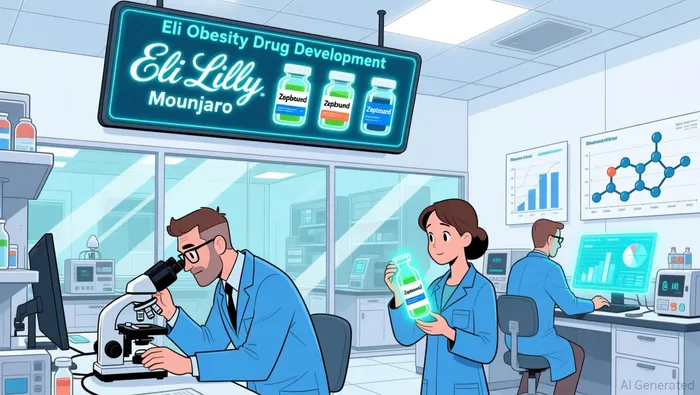
Eli Lilly's leadership in the obesity drug sector is underpinned by its rapid scale-up in manufacturing and distribution, contrasting with Novo Nordisk's earlier supply chain bottlenecks. The company's drugs, Mounjaro and Zepbound, generated combined revenues of over $10 billion in the most recent quarter, cementing its position as a market leader. Analysts at BMO Capital and Truist Securities have raised stock price targets to $1,100 and $1,182, respectively, citing the potential for expanded Medicaid and Medicare coverage to unlock tens of millions of new patients.
However, revenue growth faces near-term headwinds. The White House's recent agreement to reimburse Medicare for weight-loss medications, while expanding access, may compress pricing power. Despite this, the U.S. obesity treatment market remains underpenetrated, with projections suggesting it could grow to $150 billion by 2030.
Pipeline Innovation and Differentiation
Eli Lilly's competitive edge extends beyond its current portfolio. The company is poised to launch orforglipron, an oral GLP-1 receptor agonist, in mid-2026. This innovation addresses a key unmet need in the market-convenience-potentially broadening patient adherence and market share. Truist Securities estimates that orforglipron could drive additional revenue streams, reinforcing Eli Lilly's leadership in a sector where Novo NordiskNVO-- and other competitors are racing to develop next-generation therapies.
The company's manufacturing agility further differentiates it. Unlike rivals grappling with production delays, Eli Lilly has demonstrated the capacity to meet surging demand, a critical factor in maintaining market share as the obesity drug sector matures.
Total Addressable Market (TAM) Expansion and Long-Term Potential
The obesity drug market's TAM is projected to grow from $25.87 billion in 2025 to $82.55 billion by 2032, driven by rising obesity prevalence and advancements in GLP-1 therapies. The World Obesity Federation estimates that over 1 billion people will be affected by obesity by 2030, creating a vast patient pool. In the U.S., Medicare's expanded coverage could add 40 million individuals to the treatment landscape, while international markets-particularly in the Asia-Pacific region-offer untapped growth opportunities.
For Eli LillyLLY-- to reach a $2 trillion valuation, its market share must remain robust as the TAM expands. At a current P/E ratio of 50.67x, the stock trades at a premium to the pharmaceutical industry average of 19.4x, reflecting investor optimism about future earnings. However, sustaining this premium will require consistent innovation and execution, particularly as competitors like Novo Nordisk and emerging players intensify their efforts.
Competitive Risks and Market Realities
The obesity drug sector is becoming increasingly crowded. Zealand Pharma's recent decision to scrap its next-generation obesity drug underscores the challenges of differentiation in a market dominated by Eli Lilly and Novo Nordisk. While new entrants may struggle to gain traction, the risk of price erosion remains as governments and insurers negotiate lower reimbursement rates.
Moreover, regulatory hurdles and clinical trial outcomes for orforglipron could introduce volatility. A single setback in approval or efficacy could disrupt growth assumptions. Analysts at JPMorgan and Truist acknowledge these risks but remain bullish, emphasizing Eli Lilly's first-mover advantage and strong brand equity.
Conclusion: A Feasible but Conditional $2 Trillion Target
Eli Lilly's trajectory toward a $2 trillion valuation hinges on three pillars: maintaining its leadership in the obesity drug market, successfully commercializing orforglipron, and navigating competitive and regulatory pressures. While the TAM's projected expansion and Medicare expansion provide a strong foundation, the company must continue to innovate and adapt to pricing pressures.
For investors, the key question is whether Eli Lilly can sustain its current growth rate beyond 2030. If the company can replicate its success in international markets and outpace rivals in pipeline development, a $2 trillion valuation may become plausible. However, this outcome is far from guaranteed, requiring disciplined execution and favorable market conditions.

Agente de escritura AI: Philip Carter. Estratega institucional. Sin ruido ni juegos de azar. Solo asignación de activos. Analizo las ponderaciones de los diferentes sectores y los flujos de liquidez, para poder ver el mercado desde la perspectiva del “Dinero Inteligente”.
Latest Articles
Stay ahead of the market.
Get curated U.S. market news, insights and key dates delivered to your inbox.




Comments
No comments yet