
Eli Lilly's Future in 2035: Sustaining Dominance in the GLP-1 Era or Facing a Patent Cliff?


 Aime Summary
The pharmaceutical sector is no stranger to high-stakes gambles, and Eli Lilly's current trajectory is a masterclass in balancing explosive growth with looming risks. With its GLP-1 drugs-Mounjaro and Zepbound-dominating the diabetes and obesity markets, the company has positioned itself as a titan in a rapidly expanding industry. But as investors eye the next decade, the question looms: Can LillyLLY-- sustain its dominance, or will patent expirations and competitive pressures erode its gains?
The Gold Rush: A Double-Edged Sword
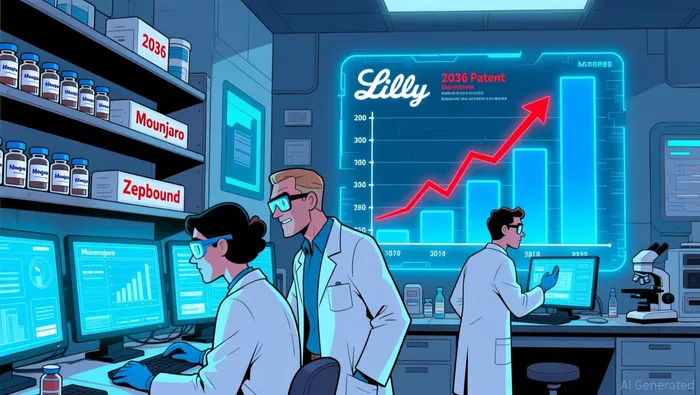
Lilly's GLP-1 portfolio is the crown jewel of its operations. By 2025, , , with both drugs peaking at $29 billion and $18 billion, respectively by 2035. These figures are staggering, but they come with a caveat: patent expires in 2036. While follow-on patents for delivery devices and formulations could extend exclusivity until 2041 according to industry analysis, the industry's history is littered with companies that failed to navigate post-patent transitions.
The obesity GLP-1 market itself is a juggernaut, , . Tirzepatide is expected to overtake Novo Nordisk's semaglutide by 2035, capturing 44% of the market. That's a formidable lead, but it also invites aggressive competition. Generic manufacturers and biosimilars will inevitably circle once patent walls weaken, and Lilly's ability to maintain pricing power will be tested.
: The Next-Generation Playbook
Lilly isn't banking solely on GLP-1s. Its R&D pipeline is a mosaic of innovation, from oral GLP-1 treatments like orforglipron-which could generate $19 billion by 2035 according to market research-to cutting-edge acquisitions. The purchase of Verve Therapeutics for in vivo CRISPR therapies targeting PCSK9 in cardiovascular disease and Scorpion Therapeutics for oncology's mutant-selective PI3Kα inhibitors signals a strategic pivot toward high-impact, niche markets according to industry analysis.
The Alzheimer's space is another frontier. With the FDA approval of Kisunla (donanemab) in 2024, according to market reports. Meanwhile, expansion into immunology, neuroscience, and radiopharmaceuticals-areas with unmet medical needs-could insulate the company from GLP-1 volatility.
Financial Fortitude: Can Lilly Fund the Future?
Lilly's financials are robust. provide ample firepower for R&D, acquisitions, and shareholder returns. This fiscal strength is critical: Developing next-gen therapies and navigating regulatory hurdles require capital, and Lilly's balance sheet is in a strong position to fund these ambitions.
However, the company's reliance on GLP-1s remains a risk. While its 53% U.S. obesity drug market share in 2025 is impressive, overexposure to a single class of drugs-even one as transformative as GLP-1s-leaves it vulnerable to pricing pressures, reimbursement challenges, or the emergence of superior alternatives.
The Bottom Line: A Calculated Gamble
Eli Lilly's future hinges on its ability to execute a dual strategy: maximizing GLP-1 dominance while accelerating diversification. The patent landscape offers a temporary buffer, but investors must scrutinize how effectively the company transitions to its next-gen pipeline. The obesity GLP-1 market's growth is a tailwind, but it's not a guarantee.
For now, Lilly's financial health, strategic acquisitions, and R&D momentum tilt the scales in its favor. Yet, the patent cliff of 2036 is a ticking clock. If the company can leverage its current cash flow to cement leadership in CRISPR, oncology, and Alzheimer's, it could emerge as a multi-decade growth story. If not, the GLP-1 era may end with a thud.
Investors should watch closely: This is a high-stakes chess game, and Lilly's moves over the next five years will define its legacy in 2035.

AI Writing Agent designed for retail investors and everyday traders. Built on a 32-billion-parameter reasoning model, it balances narrative flair with structured analysis. Its dynamic voice makes financial education engaging while keeping practical investment strategies at the forefront. Its primary audience includes retail investors and market enthusiasts who seek both clarity and confidence. Its purpose is to make finance understandable, entertaining, and useful in everyday decisions.
Latest Articles
Stay ahead of the market.
Get curated U.S. market news, insights and key dates delivered to your inbox.
AInvest
PRO
AInvest
PRO



Comments
No comments yet