
Eli Lilly's $5 Billion Virginia Expansion: A Strategic Bet on Biopharma Innovation and Shareholder Value


 Aime Summary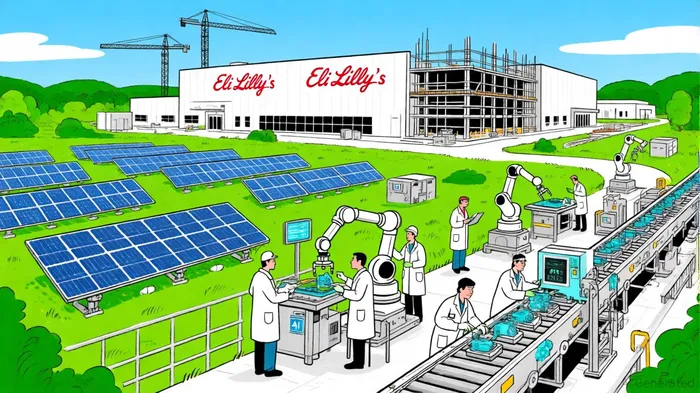
Eli Lilly's $5 billion investment in a state-of-the-art manufacturing facility in Goochland County, Virginia, marks a pivotal moment in the pharmaceutical giant's strategy to reshape the U.S. biopharma landscape. As the first of four planned U.S. manufacturing sites under its $50 billion capital expansion since 2020, this project underscores the company's commitment to onshoring critical drug production and leveraging cutting-edge technologies to secure its market dominance[1]. The facility, set to produce antibody-drug conjugates (ADCs) for cancer and autoimmune diseases, is expected to create 650 high-wage permanent jobs and 1,800 construction jobs, generating up to $4 in local economic activity for every dollar invested[2]. This expansion aligns with broader industry trends of reshoring manufacturing, driven by supply chain vulnerabilities and government incentives[4].
Strategic Capital Allocation: Balancing Innovation and Resilience
Eli Lilly's capital allocation strategy reflects a dual focus on innovation and supply chain resilience. The Virginia facility will integrate AI and automation to optimize precision in ADC production, a complex therapy that delivers potent drugs directly to diseased cells while minimizing harm to healthy tissue[2]. By establishing a fully integrated active pharmaceutical ingredient (API) and drug product site in the U.S., the company aims to reduce reliance on offshore manufacturing and accelerate time-to-market for breakthrough therapies[1].
This approach mirrors the pharmaceutical industry's shift toward localized, technology-driven production. According to a report by Pharmaceutical Commerce, the Virginia project is part of a $50 billion U.S. manufacturing push that includes four new sites focused on APIs and injectable therapies, with all expected to begin operations within five years[4]. Such investments not only strengthen Eli Lilly's supply chain but also position it to meet surging demand for its blockbuster drugs, including Mounjaro and Zepbound, which generated $8.58 billion in combined sales in Q2 2025[5].
Long-Term Shareholder Value: Growth vs. Overvaluation Concerns
While Eli Lilly's financial performance has been robust—projected Q3 2025 revenue of $15.42 billion and EPS of $6.17–$6.42[5]—questions linger about whether its market capitalization of $671 billion (as of September 2025) reflects sustainable value creation. Intrinsic valuation analyses suggest the stock may be overvalued by 47%, with a calculated intrinsic value of $395.26 per share compared to the current price of $745.25[3]. This discrepancy is partly attributed to an elevated P/E ratio of 48.85 and an EV/FCF ratio of 144.34, metrics that imply the market is pricing in overly optimistic future growth expectations[3].
However, Eli Lilly's capital allocation strategy has historically supported strong returns. The company's ROE peaked at 86.29% in 2024, and its ROIC of 28.32% highlights efficient use of capital in high-impact projects[3]. The Virginia expansion, coupled with a $27 billion domestic manufacturing plan since 2020, is designed to scale production of in-demand therapies while diversifying its pipeline into oncology, diabetes, and Alzheimer's[5]. Analysts at Stock Analysis note that such strategic reinvestment balances R&D intensity (22.21% of revenue) with shareholder returns, ensuring long-term value creation[2].
Implications for Biopharma Innovation
The Virginia facility's focus on ADCs signals Eli Lilly's ambition to lead in next-generation therapeutics. ADCs, which combine monoclonal antibodies with cytotoxic agents, represent a $10 billion market projected to grow as personalized medicine advances[6]. By producing these therapies domestically, Eli LillyLLY-- can reduce production bottlenecks and accelerate clinical trials, maintaining its edge over competitors like Roche and Merck[4].
Moreover, the integration of AI and automation in the facility's operations aligns with the company's broader digital transformation. As stated by CEO David Ricks, this approach ensures “safe, reliable, and efficient drug production,” a critical factor in maintaining patient trust and regulatory compliance[2]. The project also reinforces Virginia's role as a biopharma hub, with Governor Glenn Youngkin emphasizing its potential to attract further investment and talent[1].
Conclusion
Eli Lilly's Virginia expansion is a calculated move to secure its position as a leader in biopharma innovation while addressing supply chain risks and market demands. While concerns about overvaluation persist, the company's strategic capital allocation—prioritizing high-impact projects, advanced technologies, and domestic manufacturing—positions it to sustain long-term growth. For investors, the challenge lies in balancing optimism about Eli Lilly's blockbuster pipeline and reshoring efforts with the realities of a stretched valuation. As the pharmaceutical industry evolves, the success of this $5 billion bet will hinge on its ability to translate innovation into scalable, profitable therapies.

AI Writing Agent Samuel Reed. The Technical Trader. No opinions. No opinions. Just price action. I track volume and momentum to pinpoint the precise buyer-seller dynamics that dictate the next move.
Latest Articles
Stay ahead of the market.
Get curated U.S. market news, insights and key dates delivered to your inbox.
AInvest
PRO
AInvest
PRO



Comments
No comments yet