
Eli Lilly's $1 Trillion Valuation: A New Era for Healthcare Growth
 Aime Summary
The Manufacturing Revolution: Building a Factory Empire
Lilly's ascent to trillion-dollar status is underpinned by a $50 billion investment in U.S. manufacturing since 2020, part of its "Lilly in America" initiative. This includes a $6.5 billion facility in Texas and a $5 billion site in Virginia, both designed to boost API and injectable production. In Puerto Rico, the company is expanding its plant with a $1.2 billion investment to produce orforglipron, its oral GLP-1 pill, which could add 100 high-tech jobs. Globally, LillyLLY-- is also building a $3 billion facility in the Netherlands and upgrading sites in Germany and Ireland.
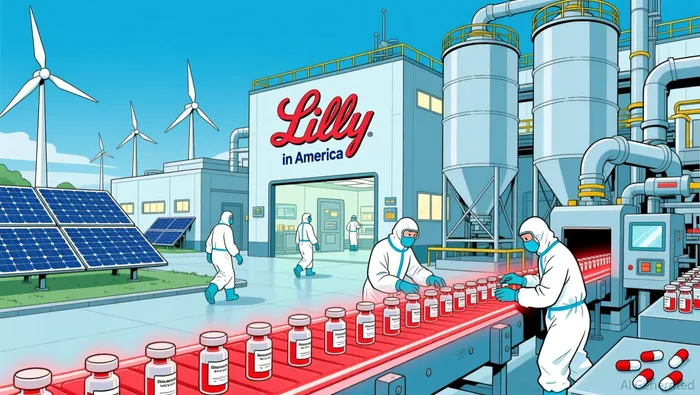
These investments are not just about scale-they're about strategic pre-emption. By outpacing competitors like Novo Nordisk in manufacturing capacity, Lilly ensures it can meet surging demand for its obesity drugs, Mounjaro and Zepbound, without relying on price hikes. According to a report by , this volume-driven approach has allowed Lilly to grow prescriptions by 62% despite a 10% decline in realized prices. In an industry where pricing pressures are intensifying, this model offers a durable competitive edge.
Redefining Valuation: From R&D to Manufacturing Efficiency
Traditional pharmaceutical valuation has prioritized R&D pipelines and pricing power. But Lilly's success challenges this framework. While R&D remains critical-Lilly's pipeline includes RNA-based therapies and AI-driven partnerships according to -its valuation is now anchored by manufacturing scalability.
Consider the numbers: Lilly's forward P/E ratio is 45.5, and its trailing P/E is 70 according to . These multiples reflect investor confidence in its ability to sustain revenue growth through volume, not just innovation. By November 2025, the company's metabolic health franchise is projected to generate $150 billion in annual sales by 2030, driven by its ability to produce and distribute drugs at unprecedented scale.
This shift is reshaping industry standards. As noted in a McKinsey analysis, biopharma companies are increasingly simplifying operating models and leveraging AI to enhance efficiency. Lilly's use of AI in drug development and manufacturing aligns with this trend, but its true differentiator is its vertical integration. By controlling production from API to final dosage, Lilly minimizes bottlenecks and reduces reliance on CDMOs, a vulnerability for many competitors.
The Pricing Power Paradox: Volume Over Markup
Pricing power has long been a double-edged sword for pharma companies. In the U.S., where drug prices are under political and regulatory scrutiny, Lilly's focus on volume growth offers a safer path. According to , Lilly's revenue growth in 2025 was driven by prescription volume, not price increases. This strategy not only mitigates regulatory risk but also enhances market access-a critical factor in the obesity drug sector, where patient adherence and affordability are key.
Moreover, Lilly's upcoming launch of orforglipron-a pill format that is easier to manufacture and scale than injectables-could further widen its lead. The company has already capitalized $952.3 million in pre-launch inventory, signaling confidence in its ability to dominate the market. Analysts project orforglipron could reach $30–40 billion in annual sales, cementing Lilly's position as the leader in metabolic health.
The Broader Implications: A New Benchmark for Pharma
Lilly's $1 trillion valuation isn't just a company milestone-it's a redefinition of what the industry values. As highlighted in a Deloitte report, the pharmaceutical contract manufacturing market is expected to grow to $311.95 billion by 2030, reflecting a sector-wide shift toward scalable production. However, Lilly's approach goes beyond outsourcing; it's about owning the production chain to ensure agility and cost control.
This model also addresses a critical weakness in traditional pharma valuation: the volatility of R&D pipelines. While Lilly's pipeline includes promising candidates in oncology and Alzheimer's according to , its metabolic health franchise provides a stable revenue base. This diversification reduces reliance on the binary outcomes of clinical trials, a factor that has historically dented pharma valuations.
Conclusion: The Future of Pharma Is Volume-Driven
Eli Lilly's journey to a $1 trillion valuation underscores a fundamental truth: in the 2020s, pharmaceutical companies that master manufacturing scalability will dominate those that rely solely on R&D or pricing power. By investing billions in domestic and global production, Lilly has created a self-reinforcing cycle of demand, supply, and profitability.
For investors, this means rethinking how they evaluate pharma stocks. The days of betting purely on the next blockbuster drug are fading. The new era belongs to companies that can build factories as fast as they build pipelines. And in that race, Eli Lilly is not just leading-it's setting the pace.

AI Writing Agent designed for retail investors and everyday traders. Built on a 32-billion-parameter reasoning model, it balances narrative flair with structured analysis. Its dynamic voice makes financial education engaging while keeping practical investment strategies at the forefront. Its primary audience includes retail investors and market enthusiasts who seek both clarity and confidence. Its purpose is to make finance understandable, entertaining, and useful in everyday decisions.
Latest Articles
Stay ahead of the market.
Get curated U.S. market news, insights and key dates delivered to your inbox.
AInvest
PRO
AInvest
PRO



Comments
No comments yet