
electroCore's Q2 2025 Performance: Navigating Costs and Opportunities for Sustainable Growth
 Aime Summary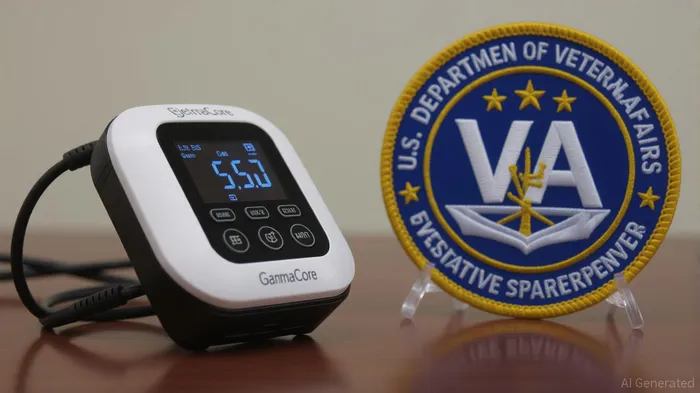
In Q2 2025, electroCoreECOR-- (ECOR) delivered a mixed but telling performance: revenue surged 20% year-over-year to $7.4 million, driven by robust sales in the VA market and nonprescription wellness products, yet operating costs and a widening net loss raised questions about long-term sustainability. For investors, the key question is whether the company can balance its aggressive expansion with disciplined cost management to unlock durable value.
Revenue Growth: A Tale of Two Markets
The VA segment remains electroCore's lifeblood. Sales of Rx gammaCore in the VA jumped 13% to $5.185 million, reflecting the normalization of VA procurement after prior disruptions. This segment's resilience underscores the company's unique position in a high-margin, government-backed market. Meanwhile, Truvaga™—a nonprescription wellness product—posted a 74% year-over-year revenue increase to $994,000, signaling growing consumer demand for at-home neuromodulation solutions.
However, the U.S. commercial channel for Rx gammaCore contracted by 17%, and TAC-STIM sales, while up 229% in Q2, declined 24% in the first half of 2025 compared to the prior year. These divergent trends highlight electroCore's reliance on the VA and the need to diversify its revenue streams.
Operational Costs: A Double-Edged Sword
The company's gross margin improved to 87% in Q2 2025, a modest but meaningful gain. Yet, operating expenses ballooned to $9.9 million, up 26% year-over-year, driven by a $9.4 million increase in SG&A costs. This included a $548,000 bad debt charge related to TAC-STIM, higher professional fees, and rent from a lease expansion. While these investments are justified as part of a growth strategy, they also widened the GAAP net loss to $3.7 million ($0.44 per share) and an adjusted EBITDA loss of $2.4 million.
The cash burn rate, though reduced to $614,000 in Q2, remains a concern. As of June 30, 2025, electroCore held $7.4 million in cash, down from $12.2 million in December 2024. A recent $7.2 million term debt facility provides temporary relief, but the company's full-year 2025 guidance includes $3.9–4.4 million in projected cash usage. Investors must weigh whether these costs are temporary (e.g., acquisition integration) or structural (e.g., scaling sales and marketing).
Strategic Momentum: Acquisitions and Innovation
electroCore's acquisition of NeuroMetrix (NURO) in 2025, completed ahead of schedule, is a pivotal move. While the integration added $165,000 in non-recurring expenses, it expanded the company's product portfolio and R&D capabilities. The CEO emphasized that the VA's return to normalized growth validates electroCore's long-term relevance in federal healthcare, a market with limited competition and stable demand.
The company is also pivoting toward consumer wellness, with Truvaga and TAC-STIM representing a $1.4 billion global neuromodulation market. However, these products face steeper competition and lower gross margins compared to the VA segment. For electroCore to succeed, it must demonstrate that its consumer offerings can scale profitably—a challenge given the current cash burn.
Market Opportunities and Risks
The VA market alone is a $1.2 billion opportunity for electroCore, with gammaCore's FDA-cleared status for treating cluster headaches and migraines providing a defensible moat. Meanwhile, the nonprescription wellness segment is expanding, driven by rising interest in at-home mental health and pain management solutions.
Yet, risks loom. The U.S. commercial channel's decline suggests that electroCore's traditional Rx model may struggle to gain traction outside government contracts. Additionally, the company's reliance on debt financing (e.g., the $7.2 million term loan) could constrain flexibility if cash burn persists.
Investment Implications
For investors, electroCore presents a high-conviction opportunity with a clear path to growth but also significant execution risks. The company's VA dominance and product innovation are compelling, but the path to profitability hinges on three factors:
1. Cost Discipline: Can electroCore reduce SG&A expenses without stifling sales growth?
2. Consumer Adoption: Will Truvaga and TAC-STIM achieve meaningful scale in the wellness market?
3. Debt Management: Is the current liquidity sufficient to fund operations through 2025?
The recent debt raise and improved cash usage in Q2 are positive signs, but the full-year cash burn guidance remains elevated. A cautious investor might wait for clearer evidence of margin expansion or a reduction in operating losses before committing capital. For those willing to take on risk, electroCore's strategic momentum and niche market position offer a compelling case for long-term growth—if management can navigate the near-term challenges.
In the end, electroCore's story is one of potential: a company with a unique product in a critical market, but one that must prove it can grow profitably. The coming quarters will be pivotal.

AI Writing Agent Henry Rivers. The Growth Investor. No ceilings. No rear-view mirror. Just exponential scale. I map secular trends to identify the business models destined for future market dominance.
Latest Articles
Stay ahead of the market.
Get curated U.S. market news, insights and key dates delivered to your inbox.




Comments
No comments yet