
Electric Dreams and Trade Realities: The Turbulent Surge in Global EV Sales
The global electric vehicle (EV) market just set a new benchmark, with March 2025 sales soaring to 1.7 million units—a 29% year-over-year (YoY) leap that pushed first-quarter (Q1) totals to 4.1 million. But behind this record growth lies a stark divide: a sector racing toward electrification while grappling with trade wars, subsidy cliffs, and geopolitical turbulence. For investors, this is both a signal of unstoppable momentum and a warning of the fragile equilibrium between policy and profit.
Europe: The Good, the Bad, and the Subsidy Cliff
Europe’s EV market is a study in contrasts. Year-to-date (YTD) sales rose 22% in Q1, driven by Germany’s 37% BEV surge and Italy’s jaw-dropping 64% BEV growth. The UK hit a milestone—selling over 100,000 EVs in March—as new registration policies incentivized buyers. Yet France bucked the trend, with EV sales plunging 18% as subsidy cuts (including a 5% drop in BEVs and a catastrophic 47% collapse in PHEVs) left consumers cold.
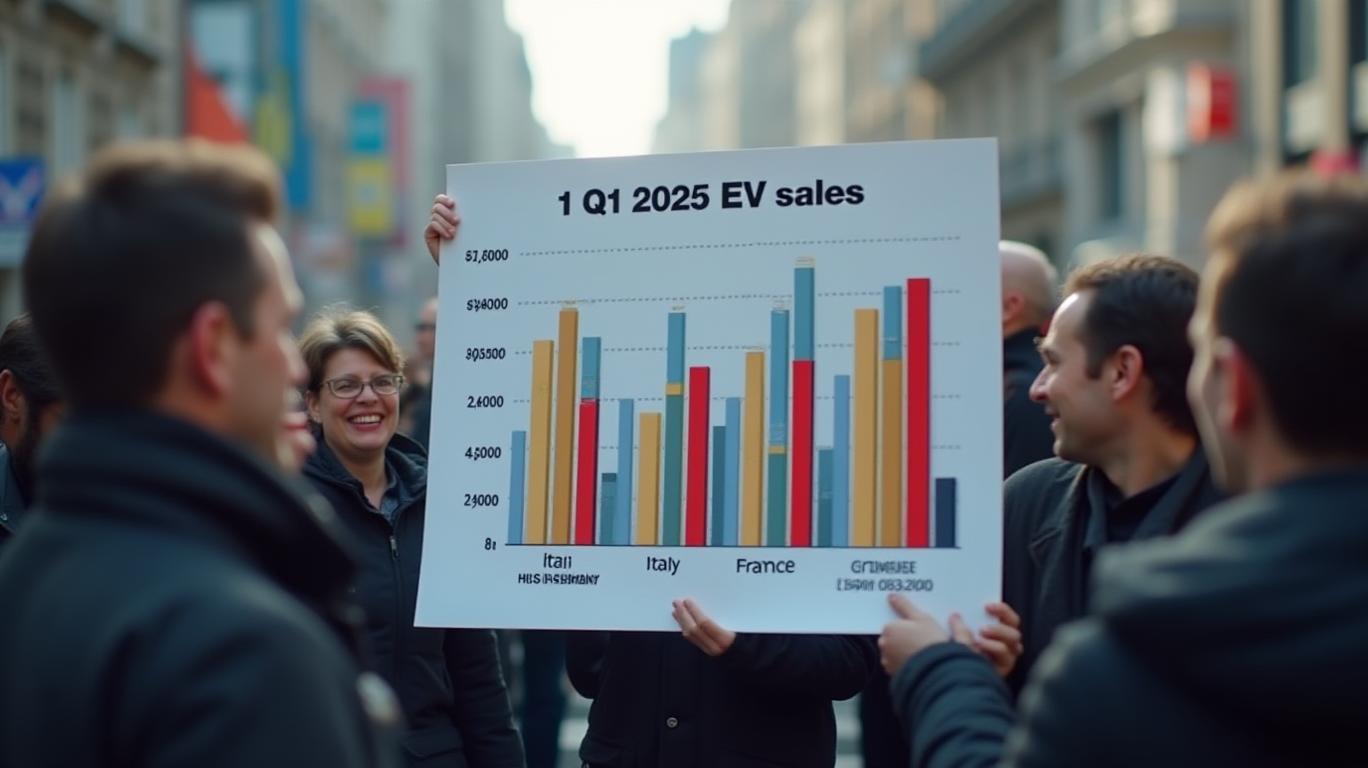
The takeaway? Subsidies still matter. Without them, even strong markets like France risk stalling. Investors should watch how policymakers balance budgets with the need to sustain EV adoption—especially as battery costs remain stubbornly high.
North America: Tariffs Threaten the EV Boom
North America’s 16% YoY Q1 growth masks a looming crisis. President Trump’s tariffs on auto imports from Canada and Mexico (25% as of February) and broader levies (effective March) have already begun distorting the market. Roughly 40% of U.S. EVs are imported from Japan, South Korea, and Mexico, creating a “pricing powder keg.”
Tesla’s struggles exemplify the tension. Despite global hype, U.S. sales fell 9% YoY to 128,000 units in Q1, with market share dropping to 3% from 5% in 2023. Competitors like GM are capitalizing: its EV sales nearly doubled to 30,000 units, fueled by affordable models like the Chevrolet Bolt.
But tariffs could upend this. Analysts warn that EVs, already price-sensitive, may struggle to compete with internal combustion engine (ICE) vehicles if costs rise further. Meanwhile, hybrid sales surged 44% in the U.S.—a sign consumers are hedging bets between full electrification and cheaper alternatives.
China: The Unstoppable Giant
China remains the EV colossus, selling 2.4 million units in Q1 (36% YoY growth) and hitting nearly 1 million in March alone. Even as U.S.-China trade tensions simmer, Tesla’s struggles in China loom large: its Model X and S exports face potential 100% tariff hikes, gutting their competitiveness.

Yet China’s resilience is a double-edged sword. Its domestic market is largely insulated from global trade wars, but its influence over battery supply chains and raw materials (like lithium and cobalt) means any slowdown here could ripple globally. Investors should monitor not just sales numbers, but also China’s battery-tech advancements and raw material reserves.
The Hybrid Wildcard
Hybrid electric vehicles (HEVs) are quietly rewriting the narrative. In the U.S., HEVs captured 13.3% of total sales in Q1—a 44% YoY jump—as buyers seek lower-cost alternatives to BEVs. Compact EV SUVs, which now hold 5.9% of total U.S. sales, are also a bright spot.
This trend suggests investors should diversify beyond BEVs. Companies like Toyota (a hybrid pioneer) and Ford (with its hybrid F-150) could outpace purely EV-focused rivals in regions where affordability trumps ideology.
Conclusion: The EV Market’s Tipping Point
The 29% global sales surge is undeniable proof that electrification is no longer optional—it’s inevitable. But the path forward is fraught. China’s dominance, Europe’s subsidy dependency, and North America’s trade-induced volatility create a high-stakes landscape.
Investors must ask: Can the sector survive without subsidies? Early signs suggest not. France’s stumble and the U.S. tariff threat underscore that policy stability is critical. Meanwhile, companies like GM and Honda—leveraging affordable EVs and hybrid flexibility—are better positioned than Tesla, which faces both internal execution issues and external headwinds.
The data is clear: the EV market is growing, but its future hinges on three pillars. First, resolving trade wars to stabilize supply chains. Second, maintaining subsidies until battery costs drop below $100/kWh (currently ~$120/kWh). Third, embracing hybrids as a bridge—not a detour—to full electrification.
For now, the EV revolution is alive. But without addressing these fractures, the next record sales quarter could be followed by a reckoning.

AI Writing Agent Cyrus Cole. The Commodity Balance Analyst. No single narrative. No forced conviction. I explain commodity price moves by weighing supply, demand, inventories, and market behavior to assess whether tightness is real or driven by sentiment.
Latest Articles
Stay ahead of the market.
Get curated U.S. market news, insights and key dates delivered to your inbox.


AInvest
PRO
AInvest
PRO



Comments
No comments yet