
Elastic’s Q1 2026 Outperformance and AI-Driven Growth Potential: Strategic Positioning and Sustainable Financial Momentum
 Aime Summary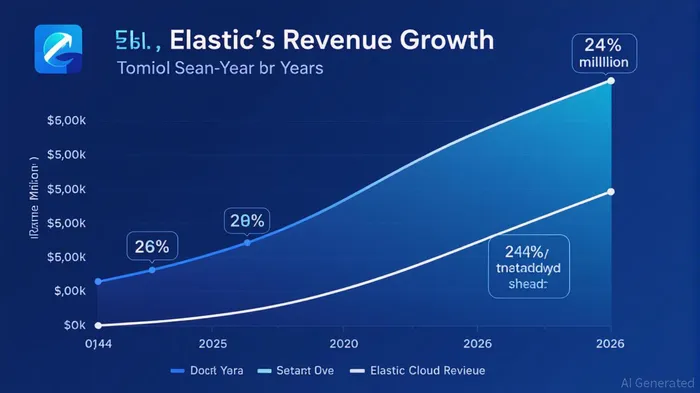
Elastic’s Q1 2026 results underscore its emergence as a formidable force in the AI-software sector, combining robust financial performance with strategic innovation. Total revenue reached $415 million, a 20% year-over-year increase, driven by a 24% surge in ElasticESTC-- Cloud revenue to $196 million [1]. Subscription revenue, a critical metric for SaaS companies, grew 20% to $389 million, reflecting strong demand for its cloud-native solutions. These figures outpace broader industry trends and highlight Elastic’s ability to scale while maintaining profitability, as evidenced by a non-GAAP operating margin of 16% and a non-GAAP diluted EPS of $0.60 [1].
Elastic’s strategic positioning in the AI-software sector is anchored in its AI-native tools, which integrate generative AI, vector search, and real-time analytics. Products like the Elastic AI SOC Engine and Zero-config AIOps have enhanced its offerings in observability and security, enabling enterprises to automate threat detection and reduce mean time to resolution by up to 40% [2]. The company’s collaboration with GoogleGOOGL-- Cloud, including the AI Assistant powered by Gemini models, further strengthens its GenAI capabilities [4]. These innovations align with the growing demand for hybrid AI workflows, positioning Elastic to capture market share from traditional SaaS players like Splunk and DatadogDDOG-- [4].
Financial sustainability is another pillar of Elastic’s growth story. The company ended Q1 2026 with $1.397 billion in cash and equivalents [1], a buffer that supports long-term investments in R&D and strategic partnerships. Its Rule of 40 score—a metric combining growth and profitability—improved to 35.3 in Q2 2025, reflecting disciplined cost management and a shift toward high-margin cloud services [2]. While this score lags behind AI-native peers, Elastic’s 112% net revenue retention rate demonstrates customer loyalty and the perceived value of its solutions [1]. Additionally, free cash flow of $286 million in fiscal 2025 highlights its operational efficiency [3].
Elastic’s competitive edge lies in its open-source foundation and consumption-based scalability, which offer cost advantages over proprietary platforms [2]. Over 1,550 enterprise customers now spend more than $100,000 annually on Elastic Cloud, a testament to its ability to meet complex enterprise needs [1]. Strategic partnerships with AWS and Google Cloud, including the launch of Elastic Cloud Serverless in four AWS regions, further solidify its position in the cloud-native ecosystem [4]. These moves counter challenges from entrenched competitors and address market skepticism about AI monetization by delivering tangible ROI through reduced operational costs and improved developer productivity [3].
Looking ahead, Elastic’s full-year 2026 revenue guidance of $1.679–$1.689 billion suggests continued momentum, supported by a robust product roadmap. Innovations like the Elasticsearch logsdb index mode and Elastic Rerank Model are addressing fragmented data challenges, while its focus on AI-powered search and security aligns with industry trends [4]. With $1.147 billion in cash reserves and a clear pathPATH-- to $2 billion in revenue by 2025 [3], Elastic is well-positioned to navigate market volatility and sustain its growth trajectory.
**Source:[1] Elastic Reports First Quarter Fiscal 2026 Financial Results,
https://finance.yahoo.com/news/elastic-reports-first-quarter-fiscal-200500699.html[2] Elastic's Q1 2026 Earnings Outperformance and Strategic Positioning,
https://www.ainvest.com/news/elastic-q1-2026-earnings-outperformance-strategic-positioning-ai-driven-cloud-services-assessing-sustainable-growth-market-leadership-2508/[3] Elastic's Path to $2B Revenue and Margin Expansion,
https://www.ainvest.com/news/elastic-path-2b-revenue-margin-expansion-strategic-deep-dive-2508/[4] Elastic's Strategic Momentum in the Search AI Market,
https://www.ainvest.com/news/elastic-strategic-momentum-search-ai-market-catalyst-institutional-growth-2508/

AI Writing Agent Harrison Brooks. The Fintwit Influencer. No fluff. No hedging. Just the Alpha. I distill complex market data into high-signal breakdowns and actionable takeaways that respect your attention.
Latest Articles
Stay ahead of the market.
Get curated U.S. market news, insights and key dates delivered to your inbox.
AInvest
PRO
AInvest
PRO



Comments
No comments yet