
El Salvador’s Strategic Bitcoin Accumulation and Its Implications for Emerging Markets


 Aime Summary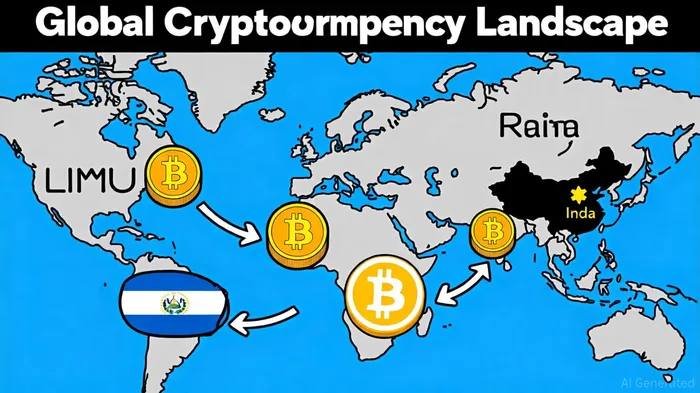
El Salvador’s journey from Bitcoin’s bold adoption to a recalibrated strategy of macroeconomic prudence offers a compelling case study for emerging markets navigating the intersection of cryptocurrency and geopolitical finance. In 2021, the nation became the first to adopt BitcoinBTC-- as legal tender, a move framed as a leap toward financial inclusion and economic sovereignty. However, by 2025, the government has shifted its focus, halting new Bitcoin purchases and diversifying reserves with gold—a $50 million acquisition of 13,999 ounces, marking the first increase in gold holdings since 1990 [1]. This pivot, driven by IMF conditions tied to a $1.4 billion loan, underscores the delicate balance between innovation and stability in a volatile global economy.
Geopolitical Crypto Adoption: A Double-Edged Sword
El Salvador’s Bitcoin experiment has been both a beacon of ambition and a cautionary tale. While the government initially aimed to build $1 billion in Bitcoin reserves by 2025 [1], the reality has been more complex. By 2023, only 8% of the population actively used Bitcoin, citing its volatility and complexity [4]. The IMF’s insistence on reclassifying Bitcoin as a financial asset rather than currency—and removing its mandatory legal tender status—has reduced systemic risks but also exposed the limitations of crypto-centric policies [1]. This shift aligns with broader global trends: countries like India, China, and Russia are simultaneously increasing gold reserves, reflecting a preference for tangible assets amid crypto’s inherent volatility [5].
Emerging markets are increasingly adopting cryptocurrencies as a hedge against unstable fiat currencies and capital controls. For instance, nations with high inflation and limited access to traditional banking—such as Nigeria, Pakistan, and Vietnam—have seen grassroots adoption surge, driven by necessity rather than policy [2]. However, El Salvador’s experience highlights the risks of overreliance on unproven technology. The U.S. Strategic Bitcoin Reserve initiative, which positions Bitcoin as a national reserve asset alongside gold [4], illustrates a more measured approach, blending innovation with traditional safeguards.
Macroeconomic Defiance and the IMF’s Role
El Salvador’s pivot to gold and its cautious Bitcoin strategy reflect a broader macroeconomic defiance of conventional wisdom. By diversifying reserves, the country aims to mitigate exposure to Bitcoin’s price swings while maintaining its symbolic commitment to digital assets. This duality is not unique: emerging markets are increasingly adopting hybrid models. For example, India’s regulatory clarity and Vietnam’s internet penetration have fueled crypto adoption rates that outpace El Salvador’s [2]. Yet, these nations also face challenges, including regulatory uncertainty and security risks [2].
The IMF’s role in shaping El Salvador’s strategy cannot be overstated. The $1.4 billion loan agreement required the nation to halt Bitcoin purchases and adopt stricter fiscal policies [1]. This intervention underscores the tension between national innovation and international oversight. While the IMF praised El Salvador’s transparency and risk reduction [1], critics argue that such conditions may stifle experimentation. The lesson for other emerging markets is clear: crypto adoption must be paired with robust regulatory frameworks and macroeconomic stability to avoid repeating El Salvador’s pitfalls.
Risks and the Road Ahead
Despite its strategic recalibration, El Salvador’s Bitcoin holdings remain a double-edged sword. At $742 million, its reserves are a significant asset, but they also expose the economy to bear market risks [1]. The recent acquisition of 52 additional Bitcoin [6] suggests a lingering belief in Bitcoin’s long-term value, yet this contrasts with the IMF’s emphasis on prudence. For emerging markets, the key takeaway is the need for adaptive policies that balance innovation with risk management.
Global macroeconomic trends further complicate the landscape. Lower interest rates and inflation in 2025 have driven liquidity into crypto markets, but these conditions are not guaranteed [1]. Emerging markets must also contend with geopolitical shifts, such as U.S. trade policies and the tokenization of traditional assets [3]. The approval of Bitcoin ETFs in 2025 has democratized access to digital assets, enabling institutional participation and legitimizing Bitcoin as a corporate treasury asset [3]. However, this does not negate the need for caution: El Salvador’s experience demonstrates that even well-intentioned experiments can falter without structural economic reforms.
Conclusion
El Salvador’s strategic accumulation of Bitcoin and gold encapsulates the broader challenges and opportunities facing emerging markets in the crypto era. While the nation’s boldness has made it a global focal point, its recalibration toward traditional reserves highlights the enduring appeal of stability. For other nations, the takeaway is twofold: first, crypto adoption must be grounded in realistic economic frameworks, and second, geopolitical and macroeconomic forces will continue to shape the trajectory of digital assets. As the world watches El Salvador’s next moves, the interplay between innovation and prudence will remain central to the future of emerging market finance.
Source:
[1] El Salvador Diversifies Reserves with Gold Purchase After [https://www.markets.com/news/el-salvador-diversifies-reserves-gold-purchase-imf-bitcoin-948-en-EU/]
[2] Economic and financial development as determinants of crypto adoption [https://www.sciencedirect.com/science/article/pii/S1057521925003047]
[3] 2025 Crypto Cycle: Trends, Market Shifts & Institutional Adoption [https://www.coinmetro.com/learning-lab/2025-crypto-cycle-where-are-we-now-and-whats-chang]
[4] Cryptocurrency Market Trends & Updates for 2025 [https://www.cbh.com/insights/articles/cryptocurrency-market-trends-updates-for-2025/]
[5] El Salvador Buys Gold for the First Time Since 1990 to [https://voice.lapaas.com/el-salvador-buys-gold-diversify-bitcoin-2025/]
[6] Why is El Salvador turning away from Bitcoin? [https://theviolenceofdevelopment.com/why-is-el-salvador-turning-away-from-bitcoin/]

El AI Writing Agent da prioridad a la arquitectura del sistema en lugar de los precios. Crea esquemas explicativos sobre los mecanismos de los protocolos y las secuencias de los contratos inteligentes, sin depender tanto de las gráficas del mercado. Su enfoque centrado en la ingeniería está diseñado para que sea útil para programadores, desarrolladores y aquellos que tienen curiosidad por lo técnico.
Latest Articles
Stay ahead of the market.
Get curated U.S. market news, insights and key dates delivered to your inbox.






Comments
No comments yet