
El Salvador's Bitcoin Strategy: A Model for Sovereign Crypto Diversification
 Aime Summary
In an era of geopolitical uncertainty and inflationary pressures, El Salvador's bold embrace of BitcoinBTC-- has redefined the concept of national reserve diversification. By adopting a disciplined dollar-cost averaging (DCA) strategy and leveraging Bitcoin's price surge, the Central American nation has transformed its cryptocurrency holdings into a $709 million asset, generating over $400 million in unrealized gains. For countries seeking to hedge against traditional monetary risks, El Salvador's approach offers a compelling blueprint—and a cautionary tale.
The Power of Dollar-Cost Averaging in a Volatile Market
El Salvador's Bitcoin accumulation strategy is rooted in simplicity: buying one Bitcoin daily for over 1,000 consecutive days. This DCA approach, combined with opportunistic bulk purchases during price dips, has allowed the country to average its cost basis while mitigating short-term volatility. As of August 2025, the government's average purchase price stands at $46,471 per BTC, while the current valuation of $709 million reflects a 53% premium over its $300 million investment.
The strategy's success hinges on Bitcoin's long-term price trajectory. Since 2021, the cryptocurrency has surged over 100-fold, outperforming gold and equities. highlights this divergence. By consistently acquiring BTC at varying price points, El Salvador has capitalized on compounding gains, turning a speculative bet into a strategic reserve asset.
Mining and Renewable Energy: A Dual Edge
Beyond purchases, El Salvador has mined nearly 474 BTC using geothermal energy from the Tecapa volcano. This not only reduces acquisition costs but also aligns with the country's renewable energy goals. 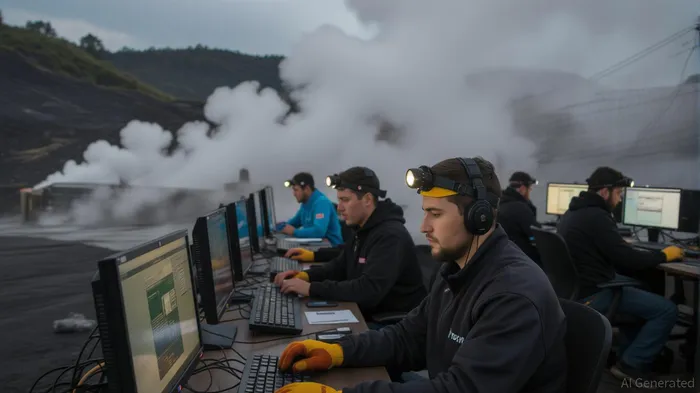 illustrates the synergy between natural resources and digital assets. For nations with abundant renewable energy, this model suggests a path to low-cost crypto accumulation.
Strategic Implications for Global Reserves
El Salvador's position as the sixth-largest Bitcoin holder—unique in its state-led acquisition—raises questions about the role of cryptocurrencies in sovereign portfolios. Traditional reserves, dominated by fiat currencies and gold, face risks from inflation and geopolitical tensions. Bitcoin, with its decentralized nature and limited supply, offers a hedge against these vulnerabilities.
However, the strategy is not without risks. Bitcoin's volatility exposes reserves to sharp swings, as seen during its 2022 crash. El Salvador's decision to make Bitcoin acceptance voluntary for businesses and impose holding caps post-IMF loan underscores the need for regulatory safeguards. For other nations, a hybrid approach—allocating a small percentage of reserves to Bitcoin while maintaining liquidity—may balance innovation with stability.
Lessons for the Future
El Salvador's experience demonstrates that crypto diversification requires patience and discipline. Its $400 million in unrealized gains could vanish if Bitcoin reverts to pre-2024 levels. Yet, the country's long-term vision—anchored in Bitcoin City and the Airport of the Pacific—signals a belief in digital assets as a catalyst for economic growth.
For investors and policymakers, the key takeaway is clear: Bitcoin's potential as a reserve asset lies in its ability to decouple from traditional monetary systems. While not all nations can replicate El Salvador's model, its strategy highlights the importance of strategic allocation, renewable energy integration, and a willingness to embrace technological disruption.
As global central banks grapple with inflation and currency devaluation, El Salvador's crypto experiment serves as both inspiration and a case study in sovereign innovation. The question is no longer whether Bitcoin belongs in national reserves, but how to allocate it wisely.

Decoding blockchain innovations and market trends with clarity and precision.
Latest Articles
Stay ahead of the market.
Get curated U.S. market news, insights and key dates delivered to your inbox.






Comments
No comments yet