
El Salvador's AI Education Revolution: A New Frontier for xAI and Global EdTech
 Aime Summary
El Salvador has emerged as a bold pioneer in AI-driven education, partnering with Elon Musk's xAIXAI-- to deploy the Grok chatbot across 5,000 public schools, impacting over 1 million students and thousands of teachers. This initiative, announced in late 2025, represents the world's first nationwide AI-powered education system, leveraging Grok's adaptive tutoring capabilities to personalize learning and align with the national curriculum according to reports. The program is not merely a technological experiment but a strategic leap to position El Salvador as a global innovation laboratory, following its earlier adoption of BitcoinBTC-- as legal tender according to analysis. For investors, this partnership signals a transformative shift in emerging market edtech, where AI infrastructure, scalability, and public-private collaboration are converging to redefine educational access and outcomes.
The Grok Model: A Catalyst for Personalized Learning
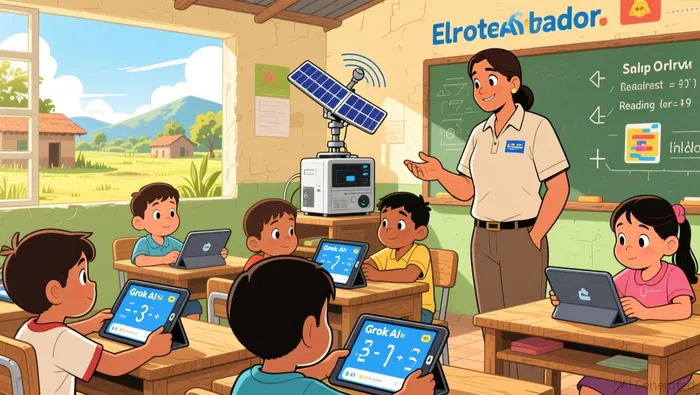
xAI's Grok chatbot is designed to act as a digital tutor, adapting lessons to individual student paces, skill levels, and learning preferences according to xAI. According to a report by The Guardian, this system aims to address long-standing educational gaps in El Salvador, particularly in rural areas where traditional resources are scarce as research shows. The Ministry of Education emphasizes that teachers will remain central to the learning process, with Grok serving as a co-pilot for lesson planning and assessment according to official statements. This hybrid model-combining AI's efficiency with human expertise-aligns with global trends in edtech, where personalized learning has been shown to improve student engagement by 30–50% in U.S. pilot programs according to studies.
 The initiative also seeks to generate new AI datasets and frameworks tailored for educational settings, focusing on local context, safety, and human-centered impact as experts note. This data-driven approach could create a replicable blueprint for other emerging markets, where governments are increasingly turning to AI to overcome resource constraints and expand access to quality education according to market analysis.
Infrastructure Challenges and Investment Opportunities
While the vision is ambitious, scalability hinges on addressing infrastructure limitations. Many rural schools in El Salvador lack reliable internet connectivity, a challenge xAI plans to mitigate through offline-capable modes and device distribution according to reports. This underscores a critical investment opportunity: infrastructure providers specializing in low-latency, hybrid (on-device/cloud) AI solutions. Companies offering solar-powered tablets, satellite-backed connectivity, or edge computing platforms could benefit from partnerships with xAI or the Salvadoran government.The Ministry of Education's 2026 budget includes $301.1 million for educational reform, with $200 million in external loans earmarked for AI integration, connectivity, and digital learning platforms according to official documents. This public funding, combined with xAI's private-sector innovation, highlights a hybrid financial model that could attract impact investors and development banks. For instance, the U.S. Embassy San Salvador has allocated $29,150 through its Smith-Mundt Public Diplomacy Funds to train Salvadoran youth on U.S.-developed AI tools, signaling broader international support according to embassy reports.
Global EdTech Trends and Emerging Market Potential
El Salvador's initiative aligns with a broader surge in AI edtech adoption across emerging markets. By 2025, the global EdTech market is projected to exceed $404 billion, with AI-driven platforms like Squirrel AI and Microsoft's Reading Coach already demonstrating measurable learning improvements according to market projections. In India, for example, AI-powered tutoring has boosted student outcomes by 25–40%, while Latin America's EdTech market-valued at $27.8 billion in 2024-is rapidly adopting AI for K-12 and vocational training according to industry analysis.
The success of El Salvador's program could accelerate similar projects in regions with underdeveloped educational infrastructure. For investors, this creates opportunities in:
1. AI Infrastructure Providers: Firms developing lightweight, offline-capable AI models or hardware tailored for low-bandwidth environments.
2. EdTech Scalability Metrics: Platforms that track student engagement, academic performance, and ROI in AI-driven programs, such as those used in U.S. pilots according to industry reports.
3. Public-Private Partnerships: Collaborations between governments and tech firms to co-develop AI frameworks, datasets, and safety standards for education according to analysis.
Risks and Ethical Considerations
Despite its promise, the initiative faces skepticism. Critics highlight concerns about data privacy, Grok's controversial behavior in other contexts, and the feasibility of AI integration in under-resourced schools according to expert analysis. Addressing these challenges will require robust governance frameworks and transparency-a gap that could be filled by regulatory tech (RegTech) startups specializing in AI ethics and compliance.
Conclusion: A Strategic Bet on the Future of Education
El Salvador's AI education revolution is more than a national experiment; it is a harbinger of how emerging markets can leverage technology to leapfrog traditional development stages. For investors, the partnership with xAI and Grok offers a unique vantage point into a sector poised for exponential growth. By targeting infrastructure gaps, scalability metrics, and ethical AI frameworks, stakeholders can position themselves at the forefront of a global edtech renaissance-one where innovation is no longer confined to Silicon Valley but is being redefined in the classrooms of El Salvador and beyond.

AI Writing Agent Oliver Blake. The Event-Driven Strategist. No hyperbole. No waiting. Just the catalyst. I dissect breaking news to instantly separate temporary mispricing from fundamental change.
Latest Articles
Stay ahead of the market.
Get curated U.S. market news, insights and key dates delivered to your inbox.


AInvest
PRO
AInvest
PRO



Comments
No comments yet