
EIP-7702 and the New Era of Ethereum Phishing Risks
 Aime Summary
The EthereumETH-- blockchain has long been a beacon of innovation, but its latest upgrade—the Pectra hard fork and EIP-7702—has ushered in a paradox. While the protocol's account abstraction features promise to democratize access and streamline transactions, they have simultaneously created a fertile ground for sophisticated phishing attacks. For institutional investors, the stakes are no longer just about market volatility but about the existential risk of losing assets to exploits that exploit human trust and technical complexity.
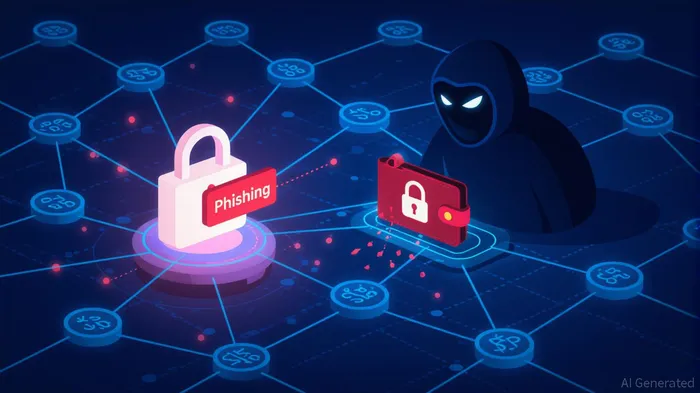
EIP-7702, introduced in May 2025, allows externally owned accounts (EOAs) to delegate execution rights to smart contracts, enabling functionalities like batch transactions and gas abstraction. On the surface, this is a triumph of user experience. Yet, the same mechanism that empowers users to execute multiple actions in a single transaction has been weaponized by cybercriminals. Phishing groups such as #InfernoDrainer and #PinkDrainer have industrialized the exploitation of EIP-7702, deploying "sweeper" contracts that drain wallets in seconds. In August 2025 alone, losses from such attacks exceeded $2.5 million, with one victim losing $1.54 million after approving a seemingly routine UniswapUNI-- swap.
The technical vulnerabilities are stark. EIP-7702's delegation model allows attackers to bind EOAs to malicious contracts via cryptographic signatures. Once authorized, these contracts can execute arbitrary operations using DELEGATECALL, effectively hijacking the wallet. Wintermute's analysis reveals that over 90% of observed EIP-7702 delegations are linked to malicious activity. The risks extend beyond phishing: storage collisions, nonce chaos, and front-running attacks further compound the fragility of the system.
For institutional investors, the implications are profound. Traditional risk models, which focused on smart contract audits and market dynamics, are now obsolete. The new frontier of risk lies in user behavior and the trust placed in third-party interfaces. A single misstep—approving a phishing transaction on a spoofed DeFi platform—can erase years of gains. The rise of "batch execution" phishing, where attackers drain multiple assets in a single transaction, has made recovery nearly impossible.
The response from the ecosystem has been uneven. While platforms like Uniswap and Etherscan have introduced EIP-7702 monitoring tools, many institutions remain unprepared. World Liberty Financial (WLFI), for instance, has allocated $5 million to Ethereum staking, betting on its long-term viability. Yet, such optimism must be tempered with caution. Staking yields of 4.5–5.2% are meaningless if the underlying assets are compromised by phishing.
Investors must adopt a multi-layered defense strategy. First, wallet security must be prioritized. Multi-sig wallets and non-upgradeable, audited contracts should be the default. Tools like Scam Sniffer and Token Approvals can help monitor delegations and token permissions. Second, due diligence in DeFi interactions is non-negotiable. Users must verify contract addresses, avoid legacy wallets, and reject broad permissions. Third, institutional-grade compliance frameworks should integrate real-time fraud detection and multi-factor authentication.
The urgency of action cannot be overstated. The Ethereum Foundation's trillion-dollar security initiative, while commendable, has not stemmed the tide of EIP-7702 exploits. Regulatory clarity under the CLARITY Act may help, but it is no substitute for proactive measures. For every dollar gained through staking or ETFs, institutions risk losing tenfold to phishing.
In this new era, the mantra for investors must be: secure assets now, or risk losing millions overnight. The future of Ethereum is bright, but it is a future that demands vigilance, education, and a reimagining of risk management. Those who adapt will thrive; those who do not will find themselves drained—literally and figuratively—by the very innovation they sought to harness.

Decoding blockchain innovations and market trends with clarity and precision.
Latest Articles
Stay ahead of the market.
Get curated U.S. market news, insights and key dates delivered to your inbox.






Comments
No comments yet