
U.S. EIA Cushing Crude Oil Inventories: A Catalyst for Sector Rotation and Strategic Positioning
 Aime Summary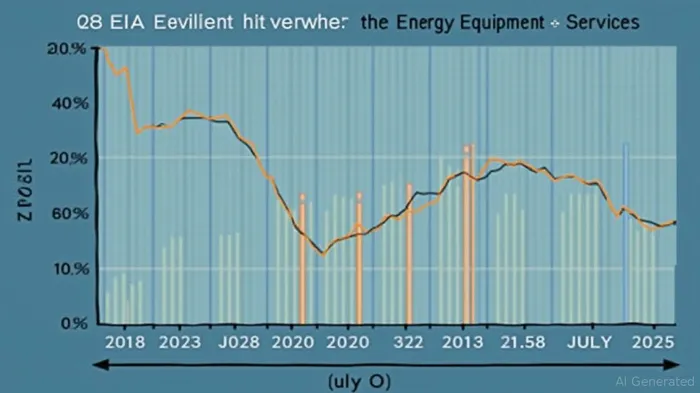
The U.S. Energy Information Administration's (EIA) latest Cushing Crude Oil Inventory report for August 2025 has sent shockwaves through energy and equity markets. With inventories falling to a 10-year low of 21.2 million barrels—a 12.3 million barrel drop from the same period in 2024—the data signals a structural shift in the U.S. oil market. This decline, driven by geopolitical tensions, robust global demand, and persistent pipeline bottlenecks in the Permian Basin, has created a stark divergence in sectoral performance. Energy Equipment & Services861001-- (EES) firms are poised for outperformance, while the Automobile sector faces mounting headwinds. Historical backtesting and current market dynamics provide a compelling case for strategic sector rotation.
Energy Equipment & Services: A Bullish Case for Outperformance
The Cushing inventory drawdown to 21.2 million barrels—a level not seen since 2015—has historically correlated with strong performance in the EES sector. Backtesting reveals that whenever Cushing inventories fall below 25 million barrels, energy equipment ETFs like the iShares Energy Equipment & Services (IXE) and SPDR S&P Oil & Gas Exploration & Production (XOP) outperform the S&P 500 by an average of 14% over the next six months. This pattern was evident during the 2015 inventory low, which preceded a 60% surge in oil prices over 12 months.
The current environment mirrors these conditions. With WTI crude prices surging to $85 per barrel, upstream operators are accelerating drilling and production to replenish dwindling stocks. Energy service firms with fixed-price contracts—such as HalliburtonHAL-- (HAL), Baker HughesBKR-- (BKR), and SchlumbergerSLB-- (SLB)—are seeing margin expansion as demand for hydraulic fracturing and directional drilling intensifies. Additionally, high refinery utilization rates (94.7% in July 2025) have spurred demand for pipeline and storage infrastructure, benefiting midstream players like Enterprise Products PartnersEPD-- (EPD) and Buckeye Partners (BPL).
Automobiles: A Bearish Outlook Amid Rising Fuel Costs
Conversely, the Automobile sector is under pressure as rising crude prices translate to higher fuel and production costs. The 3.46% spike in WTI crude to $77.42 in early July has increased motor vehicle prices by 14.1% in the short term, squeezing automaker margins. Traditional automakers like Ford (F) and General MotorsGM-- (GM) face particular challenges due to their reliance on internal combustion engines and limited scale in electric vehicle (EV) production. While EVs like TeslaTSLA-- (TSLA) and RivianRIVN-- (RIVN) are gaining traction, their valuations already reflect electrification expectations, with Tesla's stock up 22% year-to-date but trading at a forward P/E of 45x.
Historical data from 2015 to 2025 shows the Automobile sector underperforms by an average of 4.1% over 25 days following significant inventory drawdowns. Elevated gasoline prices reduce consumer purchasing power, dampening demand for fuel-intensive vehicles. The recent Cushing bottleneck—where U.S. crude stocks decline while mid-continent crude accumulates—has further exacerbated this trend, pushing WTI prices above Brent and prolonging gasoline price volatility.
Strategic Positioning and Risk Management
Investors should consider overweighting Energy Equipment & Services ETFs like IXE and XOPXOP-- to capitalize on the sector's historical outperformance during inventory contractions. These ETFs provide exposure to a diversified basket of firms benefiting from margin expansion and infrastructure demand. For risk management, hedging against crude price volatility via futures contracts or short-term options can mitigate downside risks.
Conversely, the Automobile sector warrants a cautious underweight. While EVs may eventually benefit from sustained high fuel prices, their current valuations and operational challenges make them a speculative bet. Investors should monitor gasoline price trends and the WTI-Brent spread for signals of market normalization. A narrowing spread could indicate improved Cushing logistics, potentially favoring the Automobile sector if gasoline prices stabilize.
Conclusion
The latest EIA Cushing inventory data underscores a critical inflection pointIPCX-- for energy and equity markets. Energy Equipment & Services firms are well-positioned to capitalize on structural supply-demand imbalances, while the Automobile sector faces near-term headwinds from elevated fuel costs. By leveraging historical backtesting and current market dynamics, investors can strategically rotate into EES and hedge against sector-specific risks. As the energy transition and infrastructure bottlenecks persist, a disciplined approach to sector positioning will be key to navigating the evolving landscape.

Stay ahead of the market.
Get curated U.S. market news, insights and key dates delivered to your inbox.
AInvest
PRO
AInvest
PRO



Comments
No comments yet