
U.S. EIA Crude Oil Imports Fall Below Historical Averages, Signaling Sector Divergence and Strategic Rebalancing Opportunities
 Aime Summary
The U.S. energy landscape is undergoing a seismic shift. Recent data from the U.S. Energy Information Administration (EIA) reveals that crude oil imports have fallen below historical averages, with a 6.11% weekly decline in October 2025, bringing imports to 6.497 million barrels per day. This trend, compounded by a 3.37% annual increase compared to 2024, underscores a structural realignment in energy markets. The implications are profound: as crude oil import dynamics diverge from historical norms, investors are presented with a clear inflection point for sector rotation, particularly between energy and automotive equities.
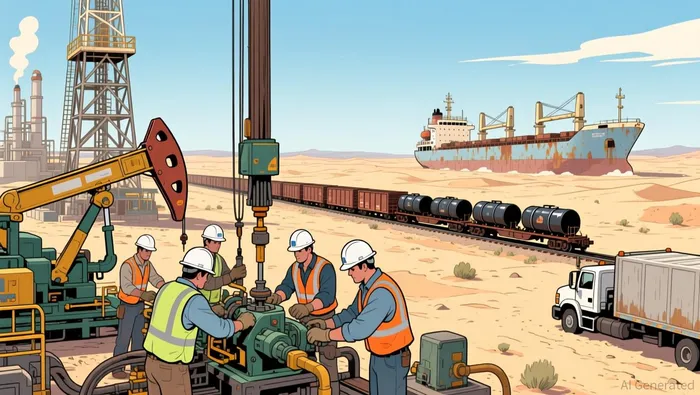
Energy Sector: A Defensive Play in a Volatile World
The energy sector has emerged as a cornerstone of defensive investing. U.S. domestic crude production surged to 13.58 million barrels per day in June 2025, driven by the Permian Basin and other shale plays. This self-sufficiency has reduced reliance on Middle Eastern imports, with Canada now supplying 60% of U.S. crude. Energy majors like ChevronCVX-- (CVX) and Marathon PetroleumMPC-- (MPC) have capitalized on refining bottlenecks and surging distillate exports, outperforming the S&P 500 by 6–8% in 2023 and likely continuing into 2026.
Risk-adjusted returns in energy equities have been bolstered by geopolitical tailwinds. OPEC+ production discipline and U.S. export constraints have driven oil prices up 8% in late 2025, while energy infrastructure—refining, grid modernization, and carbon capture—has become a strategic overweight in portfolios. For instance, ExxonMobilXOM-- (XOM) and ValeroVLO-- (VLO) have leveraged their export profiles to navigate tight distillate inventories, with the EIA projecting these conditions to persist through 2026.
Automotive Sector: Navigating Fuel Volatility and Transition Risks
In stark contrast, the automotive sector faces mounting headwinds. Diesel demand fell 4.9% in August 2025, exacerbating seasonal strains and squeezing margins for automakers like Ford (F) and General Motors (GM). Diesel price spikes, reaching $3.20 per gallon, have further eroded profitability. Even electric vehicle (EV) producers like Tesla (TSLA) are not immune to energy price volatility, as their supply chains remain tied to fossil fuels for battery materials and grid energy.
The sector's exposure to fuel price swings is compounded by regulatory shifts. The Biden administration's carbon reduction mandates and the global push for EVs have created a dual-edged sword: while EV adoption is inevitable, the transition period is fraught with margin pressures. For example, EV-focused automakers may face indirect costs from gasoline volatility, as energy grids and battery production rely on fossil fuels.
Sentiment-Driven Divergence and Strategic Rebalancing
Investor sentiment has amplified the divergence between these sectors. Energy stocks have been favored for their resilience amid geopolitical uncertainty, while automotive equities are underweighted due to their exposure to fuel price swings. This sentiment is reflected in risk-adjusted returns: energy and industrial equities outperformed the S&P 500 by 6–8% in 2023, a trend expected to continue through 2026.
For investors, the key lies in strategic rebalancing. Energy infrastructure—particularly refining and carbon capture—offers defensive characteristics, while automotive exposure should be hedged with renewable energy ETFs like ICLN. The concentration of U.S. crude imports in Canada also introduces new risks, including regulatory and labor-related disruptions, which investors must monitor.
Conclusion: A Call for Prudent Allocation
The U.S. gasoline supply shocks of 2023–2025 have marked a clear inflection point. Energy stocks and industrial equities provide resilience in a volatile macroeconomic environment, while the automotive sector remains vulnerable to fuel price swings and transition risks. Investors should prioritize energy infrastructure and underweight traditional automakers, while maintaining exposure to energy transition technologies. As OPEC+ and the EIA continue to monitor global markets, a balanced approach that combines short-term resilience with long-term adaptability will be critical.
In this era of sector divergence, the path forward is clear: energy's ascent and automotive's recalibration demand a strategic rebalancing of portfolios. The market's next move may hinge on how swiftly investors adapt to these shifting dynamics.

Stay ahead of the market.
Get curated U.S. market news, insights and key dates delivered to your inbox.
AInvest
PRO
AInvest
PRO



Comments
No comments yet