
Egypt's Cooling Inflation and Its Implications for Commodity Exports
 Aime Summary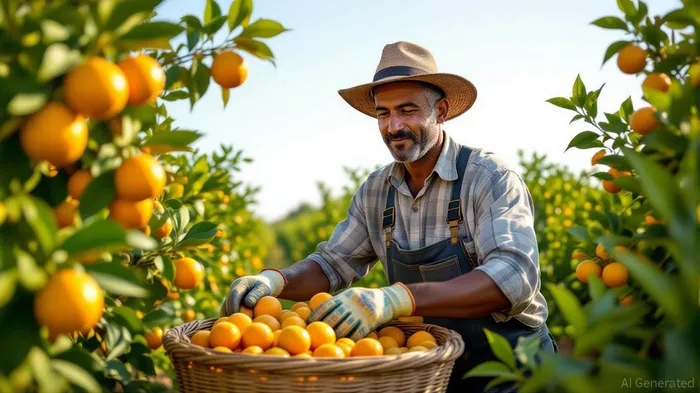
Egypt's urban consumer inflation rate has cooled to 13.9% in July 2025, down from 14.9% in June, marking the second consecutive month of decline. This trend, driven by falling food and beverage prices, signals a shift in fiscal discipline and offers a compelling case for investors to reassess Egypt's commodity-linked equities and emerging market debt. The Central Bank of Egypt (CBE) has maintained a 24% key overnight deposit rate since July, balancing growth stimulus with inflationary risks, while the Egyptian pound (EGP) stabilizes near 48.5 to the U.S. dollar. These developments create a unique window for investors to capitalize on Egypt's evolving economic landscape.
The Inflationary Turnaround: A Foundation for Export Competitiveness
Egypt's inflationary peak of 38% in September 2023 was a stark reminder of the fragility of its macroeconomic framework. However, the 13.9% annual rate in July 2025 reflects a 50% reduction from that high, driven by government interventions such as VAT reforms, energy price controls, and a $8 billion IMF-supported stabilization program. Food and beverage prices, which constitute a significant portion of Egypt's inflation basket, have moderated sharply. For instance, meat and poultry prices fell 4.9% monthly in July, while fruits and vegetables dropped 11% and 7%, respectively.
This cooling is not merely a short-term fluctuation but a structural adjustment. Lower domestic inflation reduces production costs for agricultural and manufactured goods, enhancing Egypt's export competitiveness. For example, Egypt's citrus and cotton exports—key commodities in global markets—could gain price advantages as local input costs decline. The CBE's Q2 2025 report projects headline inflation to average 15–16% in 2025 before easing to 11–12% in 2026, suggesting a durable disinflationary trajectory.
Commodity-Linked Equities: A Strategic Play on Agricultural and Trade Sectors
Investors should focus on Egypt's agricultural and trade-linked equities, which stand to benefit from improved fiscal discipline and export dynamics. Companies such as Orascom Construction (OCY) and Cairo International for Agricultural Commodities (CIAC) are positioned to capitalize on increased demand for Egyptian exports. CIAC, in particular, has expanded its logistics infrastructure to support agri-commodity trade, a sector poised for growth as global buyers seek stable suppliers in the Mediterranean.
The CBE's monetary easing, with projected rate cuts of 300 basis points by year-end, will further bolster equity valuations. Lower borrowing costs will incentivize investment in irrigation, storage, and transportation infrastructure, critical for scaling Egypt's commodity exports. Additionally, the narrowing current account deficit (down 50% year-on-year) and rising remittances ($15 billion in inflows since 2024) provide a tailwind for companies with export exposure.
Emerging Market Debt Valuation Shifts: Egypt's Attractive Yield Premium
Egypt's debt market has emerged as a high-conviction opportunity for investors seeking yield in an era of global monetary tightening. EGP-denominated bonds now offer yields above 20%, outpacing regional peers and U.S. Treasuries. The CBE's projected rate cuts and stable exchange rate (EGP 48.5/USD) reduce currency risk, making Egypt's debt more palatable to international investors.
The $8 billion IMF program and $15 billion in foreign inflows since 2024 have strengthened Egypt's external position, with net international reserves reaching $49 billion in July 2025. This liquidity cushion, combined with a 4.8% GDP growth rate, supports a favorable risk-reward profile for emerging market debt. Investors should prioritize shorter-dated bonds (e.g., 2–3 years) to hedge against potential geopolitical risks, such as renewed Red Sea shipping disruptions.
Risks and Mitigation Strategies
While the outlook is optimistic, investors must remain vigilant. Persistent inflation in essential sectors like healthcare (37.6%) and electricity (43.6%) could strain household budgets and dampen domestic demand. Additionally, geopolitical tensions in the Middle East and global trade policy shifts pose risks to Egypt's export-driven recovery.
To mitigate these risks, investors should adopt a diversified approach:
1. Sectoral Diversification: Allocate capital across agricultural equities (e.g., CIAC) and trade infrastructure (e.g., Orascom Construction) to balance exposure.
2. Currency Hedging: Use forward contracts to hedge EGP/USD volatility, particularly for long-term debt investments.
3. Geopolitical Monitoring: Track developments in the Red Sea and Middle East to adjust positions in Suez Canal-linked assets.
Conclusion: A Strategic Inflection PointIPCX-- for Egypt's Commodity Exports
Egypt's cooling inflation and fiscal reforms have created a fertile ground for commodity-linked equities and emerging market debt. As the CBE navigates a gradual easing path and global buyers seek reliable suppliers, Egypt's agricultural and trade sectors offer compelling opportunities. Investors who act now can position themselves to benefit from a country in transition—one where disciplined policy and structural reforms are reshaping the investment landscape.

Stay ahead of the market.
Get curated U.S. market news, insights and key dates delivered to your inbox.






Comments
No comments yet