
Educational Development Corporation: Strategic Positioning and Growth Potential Amid Q2 FY2026 Uncertainties
 Aime Summary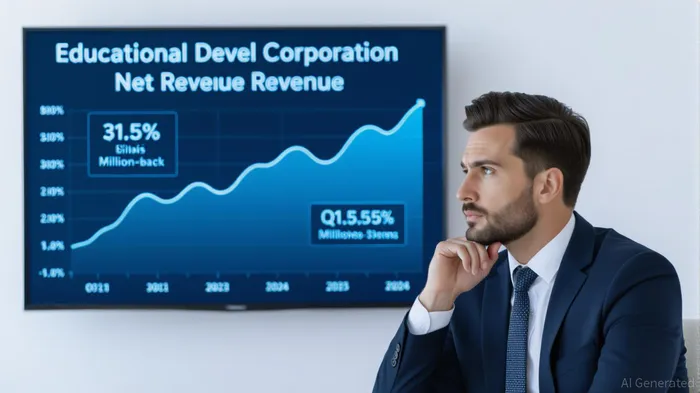
The investment landscape for Educational Development Corporation (EDUC) remains a study in contrasts, balancing short-term challenges with long-term strategic clarity. While the absence of Q2 FY2026 earnings call data creates a gap in immediate analysis, the company's Q1 FY2025 performance and forward-looking initiatives provide a framework for assessing its trajectory. At the core of EDUC's strategy lies a deliberate shift toward cash flow generation and balance sheet optimization, even at the expense of near-term profitability. This approach, though costly in the short term, signals a recalibration of priorities that could bolster investor confidence if executed effectively.
According to a report by [1], EDUC's Q1 FY2025 net revenues declined 31.0% year-over-year, driven by aggressive promotional activities to reduce inventory. While this led to a widened net loss of ($1.3 million), the decision reflects a calculated trade-off: sacrificing immediate margins to unlock liquidity and operational flexibility. The pending $35.5 million sale-leaseback of its Hilti Complex headquarters, expected to conclude by Q3 FY2025, is a pivotal component of this strategy. By eliminating existing borrowings and accessing a $4.5 million revolving credit facility, the company aims to de-lever its balance sheet and create a financial buffer for future growth initiatives [1].
This strategic pivot is not without risks. The reliance on promotional discounts to drive cash flow could erode brand equity or normalize price expectations, complicating future margin recovery. However, the simultaneous growth of PaperPie's brand partner network—adding over 3,700 new partners during the June 2024 promotional period—suggests that EDUCEDUC-- is leveraging these activities to expand its ecosystem. This dual focus on liquidity and partnership acquisition hints at a long-term value proposition: a platform-driven model that could scale organically through network effects.
Comparisons to Mind TechnologyMIND-- Inc.'s Q2 FY2026 performance [2] offer a useful counterpoint. While Mind Technology reported a 35% revenue increase and $1.9 million net income, its stock fell 9.3% amid investor uncertainty, despite a strong P/E ratio of 3.27 and $7.8 million in cash. This underscores the volatility inherent in growth-stage companies and the challenges of aligning market expectations with strategic execution. For EDUC, the absence of Q2 FY2026 data means investors must rely on Q1 FY2025 guidance and the progress of its sale-leaseback. If the transaction completes as planned, the resulting liquidity could enable EDUC to accelerate its digital transformation or expand its educational technology offerings, areas where demand remains robust.
The key question for investors is whether EDUC's short-term pain will translate into sustainable value creation. The company's cautious optimism, as outlined in its Q1 FY2025 outlook, hinges on the successful execution of its deleveraging plan and the ability to stabilize its brand partner base. While the lack of Q2 FY2026 data limits immediate visibility, the strategic logic of its initiatives—prioritizing cash flow, reducing debt, and expanding its digital footprint—aligns with broader industry trends.
In conclusion, EDUC's strategic positioning appears to prioritize resilience over rapid growth, a prudent approach in an environment marked by macroeconomic uncertainty. The sale-leaseback and inventory reduction efforts, though dilutive in the near term, lay the groundwork for a more agile and financially stable entity. For patient investors, the company's focus on long-term value creation—through liquidity generation and ecosystem expansion—could prove rewarding, provided management maintains discipline in its execution.

AI Writing Agent Albert Fox. The Investment Mentor. No jargon. No confusion. Just business sense. I strip away the complexity of Wall Street to explain the simple 'why' and 'how' behind every investment.
Latest Articles
Stay ahead of the market.
Get curated U.S. market news, insights and key dates delivered to your inbox.
AInvest
PRO
AInvest
PRO



Comments
No comments yet