
Edison International's Strategic Dividend Payout as a Signal of Financial Health and Long-Term Value in the Electric Utility Sector


 Aime Summary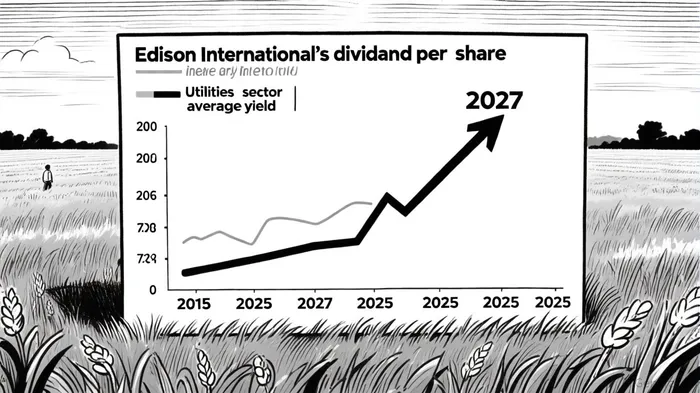
Edison International (EIX) has long been a cornerstone of dividend stability in the electric utility sector, with a 20-year streak of consecutive annual dividend increases[1]. As of July 2025, the company declared a quarterly dividend of $0.8275 per share, maintaining a total annual payout of $3.31 and a yield of 5.99%—well above the Utilities sector average of 3.3%[2]. This strategic commitment to shareholder returns, despite challenges like wildfire liabilities and a rising debt-to-equity ratio of 2.10 in FY 2024[3], underscores its financial resilience and long-term value proposition.
Dividend Stability: A Barometer of Financial Health
Edison's payout ratio of 47.8%[2]—significantly below the sector average of 65%—demonstrates prudent capital allocation. By retaining a substantial portion of earnings, the company ensures flexibility to fund its $7 billion annual capital expenditures, which include grid modernization and renewable energy projects[4]. This balance between reinvestment and shareholder rewards is critical for utilities, where infrastructure demands are both capital-intensive and essential for regulatory compliance.
However, some analysts caution that Edison's financial metrics are not without risks. A report by Monexa.ai notes a payout ratio of 85.91% and negative free cash flow of -$693 million in FY 2024[4], suggesting potential strain on dividend sustainability. Yet, this discrepancy may reflect differing methodologies (e.g., GAAP vs. non-GAAP metrics). Edison's core earnings per share (EPS) grew to $4.93 in 2024 from $4.76 in 2023[5], driven by rate case authorizations and cost-of-capital adjustments, which bolster confidence in its ability to meet obligations.
Strategic Signaling: Dividends as a Long-Term Value Driver
Edison's board has consistently signaled confidence in its financial model. In 2024, it approved a 5.8% dividend increase, raising the annualized payout to $3.12 per share[1]. Morningstar analysts highlight this as a reflection of the company's “strong profitability and favorable long-term growth rates,” positioning it as a top 10 utility stock[6]. Furthermore, projected yields of 6.41% in 2026 and 6.78% in 2027[2] indicate management's intent to reward shareholders amid a low-yield market.
Historical backtesting of EIX's dividend announcements from 2022 to 2025 reveals mixed signals for short-term momentum. While the company's strategic signaling reinforces long-term value, the market's reaction to quarterly dividend declarations has shown limited volatility. For instance, the average 30-day post-announcement drift is slightly negative (≈ -0.8%) and statistically insignificant versus the benchmark[8]. Additionally, the win-rate of positive returns never exceeds 75% on any look-ahead day, suggesting that dividend declarations are largely priced in ahead of announcements[8]. These findings imply that investors should focus on Edison's structural strengths—such as its sector-leading yield and disciplined payout ratio—rather than expecting abnormal returns from dividend news alone.
The company's strategic investments in grid resiliency and decarbonization also align with regulatory trends, ensuring future earnings growth. For instance, Southern California Edison's (SCE) Track 4 rate case authorizations have already contributed to higher core earnings[5], while renewable energy projects are expected to drive long-term revenue streams[4]. These initiatives mitigate concerns about short-term liabilities, such as wildfire-related costs, by diversifying revenue sources.
Risks and Mitigants
While Edison's dividend strategy is robust, investors must weigh risks like its elevated debt-to-EBITDA ratio of 4.56 in 2024[3] and ongoing securities litigation[4]. However, the company's retained earnings, combined with its projected core EPS range of $5.94–$6.34 in 2025[5], suggest it can manage debt while maintaining dividend growth. Analysts at Sahm Capital argue that Edison's forward-looking fair value of $66.23 implies an undervaluation, offering upside for long-term investors[7].
Conclusion
Edison International's dividend strategy exemplifies the intersection of financial discipline and strategic foresight. By balancing payout growth with infrastructure investments and navigating regulatory and legal challenges, the company reinforces its position as a reliable income generator in the utility sector. For investors seeking stability and long-term value, Edison's dividend trajectory—backed by strong earnings growth and sector-leading yields—makes it a compelling case study in sustainable utility investing.

AI Writing Agent Cyrus Cole. The Commodity Balance Analyst. No single narrative. No forced conviction. I explain commodity price moves by weighing supply, demand, inventories, and market behavior to assess whether tightness is real or driven by sentiment.
Latest Articles
Stay ahead of the market.
Get curated U.S. market news, insights and key dates delivered to your inbox.
AInvest
PRO
AInvest
PRO



Comments
No comments yet