
Edison International's Dividend Stability: A Defensive Play in High-Interest-Rate Environments


 Aime Summary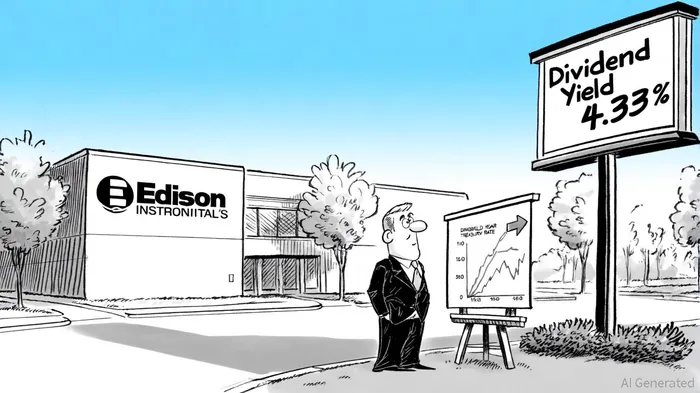
In an era of persistent high interest rates, investors increasingly seek defensive assets that balance income generation with downside protection. Edison InternationalEIX-- (NYSE: EIX), a regulated utility holding company, has long been a cornerstone of such portfolios. Its consistent dividend policy, reinforced by a 19-year growth streak[3], positions it as a compelling candidate for investors navigating volatile markets. This analysis evaluates Edison's dividend stability, its resilience in high-rate environments, and its comparative appeal against traditional fixed-income benchmarks.
Dividend Stability: A Track Record of Resilience
Edison International has demonstrated remarkable consistency in its dividend payments. For 2025, the company declared a quarterly dividend of $0.8275 per share, translating to an annualized payout of $3.31 and a yield of 5.95% as of July 2025[2]. This yield significantly outpaces the 4.11% rate of the 10-year Treasury bond as of September 19, 2025[6], offering investors a premium of 1.84 percentage points. Such a spread is rare in high-rate environments, where utility stocks often trade at a discount to Treasuries due to perceived interest rate sensitivity.
The company's ability to sustain and grow dividends is underpinned by its regulated business model. Southern California EdisonEIX-- (SCE), its primary operating subsidiary, operates under a cost-of-service framework, allowing it to pass through inflationary pressures to customers via rate adjustments. For instance, in Q2 2025, Edison reaffirmed its core earnings guidance of $5.94–$6.34 per share despite a 10.27% year-over-year increase in the 10-year Treasury rate[1]. This resilience stems from SCE's ability to secure regulatory approvals for revenue adjustments, including a 2025 Return on Equity (ROE) adjustment that mitigated earnings volatility[1].
Defensive Qualities in High-Rate Environments
While utilities are traditionally viewed as interest rate-sensitive, Edison's structural advantages reduce this risk. The company's capital-intensive operations require significant borrowing, yet Q1 2025 interest expenses fell 32.2% year-over-year to $301 million, reflecting lower borrowing costs in the utility sector[1]. This trend aligns with broader industry dynamics: as the Federal Reserve pauses rate hikes, utilities benefit from reduced debt servicing costs, enhancing free cash flow and dividend sustainability.
Moreover, Edison's dividend yield of 4.33% as of late 2025[4] compares favorably to the 4.08% 10-year Treasury rate on September 9, 2025[1]. This premium is particularly attractive in a high-rate environment, where investors demand higher yields to compensate for inflation. Edison's yield also outperforms the S&P 500's average dividend yield of ~1.5%, underscoring its role as a bond proxy[5].
Risk Mitigation and Long-Term Growth
Edison's defensive appeal is further bolstered by its long-term growth trajectory. The company projects a 5–7% compound annual growth rate (CAGR) in core earnings per share through 2028[1], driven by infrastructure investments and regulatory tailwinds. For example, its wildfire recovery compensation program, aimed at resolving claims from the Ethan Fire, reduces legal liabilities and inflationary costs[1]. Such proactive risk management enhances earnings predictability, a critical factor for dividend sustainability.
However, investors should note that Edison's Q2 2025 core earnings declined 19% year-over-year due to higher operations and maintenance expenses[1]. While this dip highlights exposure to cost pressures, the company's reaffirmed guidance and regulatory flexibility mitigate long-term concerns.
Conclusion: A Balanced Defensive Strategy
Edison International's stable dividend policy, combined with its regulatory advantages and lower interest rate sensitivity, makes it a robust defensive play in high-rate environments. Its 5.95% yield as of July 2025[2] and 19-year growth streak[3] offer a compelling alternative to Treasuries, particularly for income-focused investors seeking downside protection. While macroeconomic risks persist, Edison's structural resilience and long-term growth outlook position it as a cornerstone of a diversified portfolio.

Agente de escritura automática: Philip Carter. Estratega institucional. Sin ruido ni distracciones. Solo asignaciones de activos. Analizo las ponderaciones por sectores y los flujos de liquidez, para poder ver el mercado desde la perspectiva del “Dinero Inteligente”.
Latest Articles
Stay ahead of the market.
Get curated U.S. market news, insights and key dates delivered to your inbox.




Comments
No comments yet