
EdgeX Initiates Daily Token Burns and Locks Supply Following Airdrop Backlash
 Aime Summary
EdgeX has initiated a significant deflationary strategy by burning 2,528,370.62 EDGE tokens acquired through its buyback program. Announced on March 15, 2025, this marks the first of scheduled daily token destruction events, fundamentally altering the supply dynamics of the EDGE cryptocurrency. The exchange designed this program to systematically reduce circulating supply by executing burns every twenty-four hours using tokens purchased from the open market.
This move follows community backlash over concentrated token distribution during an initial airdrop, prompting the platform to lock 140 million EDGE tokens in audited smart contracts. These locked tokens represent 14% of the total supply and are secured with time-lock functions to prevent premature withdrawals. The platform simultaneously introduced a buyback program using trading fee revenue to further stabilize the token and align exchange performance with token value.
Market participants have reacted positively to these structural changes, with the token surging 120% from its weekly lows as volume hit record highs. The price action is accompanied by a volume-to-market-cap ratio of 12.5%, signaling genuine institutional accumulation rather than wash trading. EdgeX currently trades just 6.9% below its all-time high of $1.17, reflecting strong investor confidence in the new tokenomics.
How Does the Daily Burn Mechanism Alter Supply Dynamics?
EdgeX allocates a percentage of trading fees to market purchases of EDGE tokens, creating consistent buying pressure independent of speculative trading. The subsequent burning of these tokens removes them permanently from circulation, ensuring that successful exchange operation naturally reduces token supply over time. Market participants can verify burn transactions on-chain in real-time using blockchain explorers.
Historical data suggests that platforms implementing consistent burns demonstrate stronger price resilience during market downturns. The transparency of EdgeX's daily schedule may enhance this effect, as investors can model predictable supply curves. The inaugural burn destroyed tokens valued at approximately $380,000, signaling a serious commitment to the deflationary program.
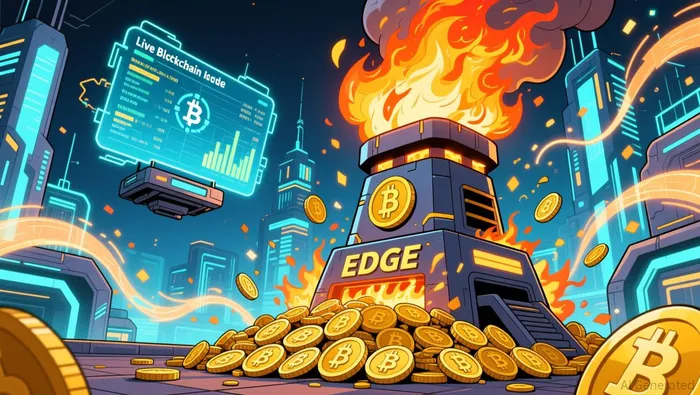
The decentralized derivatives sector has seen exponential growth, and EdgeX differentiates itself through this sophisticated tokenomic strategy. This approach positions the token utility central to its competitive advantage by linking platform success directly to token scarcity. By combining buyback and burn mechanisms, the platform creates predictable supply reduction pressure that benefits long-term holders.
What Governance Measures Address Token Distribution Concerns?
EdgeX faced community backlash after on-chain data revealed that a significant portion of the $EDGE token supply was allocated to a limited number of large wallets during an airdrop. To address concerns regarding fairness and transparency, the platform announced a one-year lock-up of 140 million $EDGE tokens. These tokens are stored in an audited smart contract featuring time-lock functions and multi-signature requirements to prevent premature withdrawals.
The 140 million locked tokens have undergone comprehensive security auditing by multiple blockchain security firms to ensure compliance with industry standards. The locking mechanism provides real-time visibility into token status and includes emergency governance provisions requiring multi-signature approval for modifications. This proactive governance approach addresses distribution concerns, stabilizes markets, and enhances community confidence.
Complementing the lock-up, EdgeX introduced a buyback program that uses a portion of trading fee revenue to systematically repurchase tokens from the open market. This initiative aims to stabilize the token's price and align with market trends favoring transparent tokenomics. By removing tokens from circulation, the program reduces the float available for sale.
What Are the Current Market Risks and Technical Levels?
EdgeX has emerged as one of the most volatile performers in the mid-cap cryptocurrency space, posting a 19.7% gain in the past 24 hours to reach $1.089. More significantly, the token has surged 61.7% over the past seven days and 120% from its all-time low of $0.49. This price action is accompanied by a volume surge of $47.6 million, representing a volume-to-market-cap ratio of 12.5%.
Despite the impressive performance, several risks warrant attention. The 65% of tokens still locked or unvested represents significant future selling pressure if vesting schedules release large quantities. The token's correlation to broader market conditions remains untested; if Bitcoin or Ethereum correct, mid-cap tokens typically see 2-3x the downside volatility.
Technical analysis identifies $1.12 as the immediate resistance, with a potential target of $1.17. Support zones are established at $0.95 and $0.85, while the $0.70 level represents the critical 61.8% Fibonacci retracement. Failure to hold $0.95 would likely trigger a deeper correction to $0.70-$0.75.
The $EDGE token empowers users by granting them the ability to participate in governance and staking, enabling community members to vote on protocol updates. A significant portion of the token supply is set aside for airdrops and community rewards, which has sparked debate over fairness and the potential for early-stage volatility. The buyback program incorporates safeguards such as daily purchase caps and multi-signature wallets to deter market manipulation.
Future plans may include burning tokens or allocating repurchased tokens to a community treasury. The success of the buyback program depends on balancing decentralization with distribution transparency while managing token volatility and holder participation. Investors are encouraged to conduct comprehensive research and evaluate their risk tolerance before engaging with the platform.

Blending traditional trading wisdom with cutting-edge cryptocurrency insights.
Latest Articles
Stay ahead of the market.
Get curated U.S. market news, insights and key dates delivered to your inbox.


AInvest
PRO
AInvest
PRO



Comments
No comments yet