
EDGE Token Debuts as Decentralized Perpetual Trading Platform Gains Momentum
 Aime Summary
- edgeX introduces the $EDGE token as a governance and utility token for its decentralized perpetual trading platform, with 25% of the supply released in an airdrop.
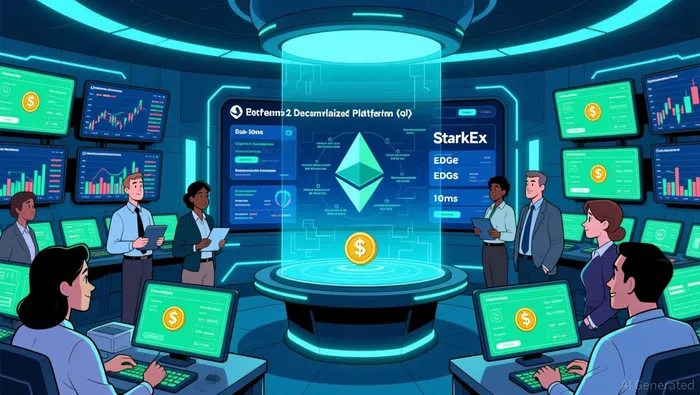
- The platform combines centralized order books with decentralized settlements, enabling sub-10ms latency and aiming to bridge traditional finance with DeFi transparency.
- edgeX has experienced significant price growth, with $EDGE surging 29.5% in 24 hours due to increased institutional interest and on-chain accumulation.
edgeX is a decentralized derivatives exchange that launched its $EDGE token to provide governance, staking, and utility functions. The token airdrop targeted NFT and points holders, with 55% of the token supply allocated to community rewards. The platform leverages Ethereum Layer 2 solutions and StarkEx zero-knowledge proofs to deliver fast, scalable trading.
edgeX's trading volume has exceeded $2.28 billion in 24 hours, with open interest reaching $775 million. The platform supports over 170 trading pairs, including real-world assets like US stock perpetual contracts.
To address concerns about airdrop fairness, edgeX locked 14% of its $EDGE token supply for one year. This move aims to prevent the concentration of distribution benefits among a limited group of participants and reduce immediate sell pressure.
edgeX has expanded its accessibility by listing on major exchanges like Bitget, HTX, and KuCoin, allowing traders to access tokenized assets such as stocks and commodities. The platform's hybrid model supports multi-asset trading, offering faster execution than traditional platforms while maintaining a trustless infrastructure.
Despite its technological advancements, edgeX faces challenges related to airdrop fairness and token distribution. Some stakeholders have reported inconsistent allocations, particularly among users who acquired airdrop points via secondary markets. Additionally, 35% of the circulating supply is currently held by early adopters.
The future of edgeX depends on addressing governance challenges and ensuring transparent tokenomics. The locked supply is expected to be released after one year, which could affect price stability. Analysts remain divided on the platform's potential, with some highlighting buyback support and others warning of short-term sell pressure due to the unlocked supply.
edgeX has also launched a buyback program for its $EDGE token, allocating a portion of trading fee revenue to repurchase tokens from the open market. This initiative follows a one-year lockup of 140 million tokens and aims to stabilize volatility and reduce circulating supply.
What Drives edgeX's Market Volatility?
edgeX has faced scrutiny over a $90 million airdrop distributed to 80+ newly created wallets. This activity raised questions about transparency and fairness, even though the edgeX team denied ownership of these wallets and explained they were part of a proxy system.
The price movement of $EDGE was driven by the unlocking of 25% of the airdropped tokens and zero-fee trading promotions on some platforms. This surge was followed by a 1300% increase in price within 24 hours of the token generation event.
How Does edgeX Compare to Traditional and Decentralized Exchanges?
edgeX distinguishes itself by combining the efficiency of centralized order books with the security of decentralized settlements. This model offers faster execution and lower fees than traditional platforms while retaining a trustless infrastructure. It also stands apart from peer-to-peer exchanges by providing deep liquidity and professional-grade trading tools.
The platform's proprietary EDGE Chain is designed for high-performance trading with real-time on-chain settlements and audit trails, enhancing transparency for users. Traders benefit from a revenue-sharing model where a portion of platform fees is distributed to token stakers.
Despite these advantages, edgeX will need to ensure the reliability and security of its network to sustain long-term appeal, especially among high-frequency traders who demand rapid execution and minimal latency.
What's Next for edgeX?
edgeX is expected to continue refining its governance and tokenomics to address community concerns and ensure long-term sustainability. The locked supply is set to be released after one year, which could influence price stability and investor sentiment. Analysts remain divided on the platform's potential, with some highlighting buyback support and others warning of short-term sell pressure due to the unlocked supply.
Investors are advised to monitor wallet movements and price behavior for further insights into the platform's performance and potential for sustained growth.

Blending traditional trading wisdom with cutting-edge cryptocurrency insights.
Latest Articles
Stay ahead of the market.
Get curated U.S. market news, insights and key dates delivered to your inbox.


AInvest
PRO
AInvest
PRO



Comments
No comments yet