
Ecuador's Security Crisis and the Vanishing Allure of Foreign Investment: A Cautionary Tale for Emerging Markets
 Aime Summary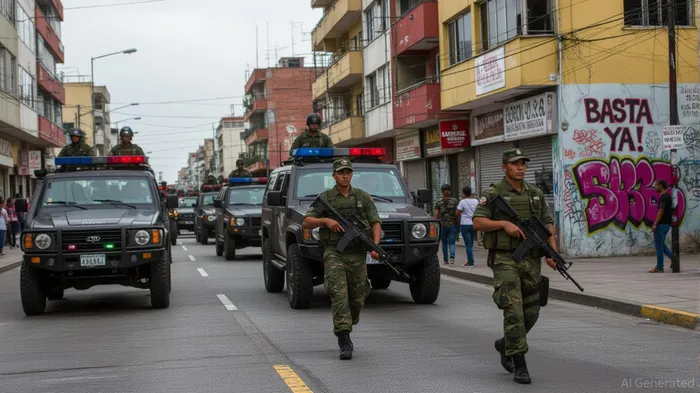
Ecuador, once lauded as a regional haven of stability, now finds itself at the epicenter of a security crisis that is reshaping its economic landscape and deterring foreign direct investment (FDI). The country's transformation from an “island of peace” to one of South America's most violent nations—a 2025 homicide rate of 44.5 per 100,000 people—has created a toxic environment for investors. This article examines how political instability, institutional failures, and a militarized response to organized crime are eroding Ecuador's appeal as a destination for capital in emerging markets.
The Security Crisis: A Catalyst for Deterrence
Ecuador's security crisis has been fueled by the collapse of state authority in key coastal provinces and the proliferation of drug trafficking networks. The demobilization of Colombian FARC in 2016 left a vacuum that gangs like Los Lobos and the Sinaloa cartel exploited, turning ports in Guayas and Esmeraldas into critical nodes for cocaine trafficking to Europe and the U.S. The situation escalated in 2024, when coordinated attacks by criminal groups—ranging from hostage-taking on live television to prison breaks—forced President Daniel Noboa to declare a state of “internal armed conflict.” This move, while aimed at restoring order, has entrenched a militarized approach that prioritizes security over governance, alienating international investors.
The human cost has been staggering. Child homicides have surged 640% since 2019, and over 80,000 Ecuadorians were internally displaced in 2024 alone. As the crisis deepened, Ecuadorians became the second-largest migrant group intercepted in the Darien Gap, a perilous route to the U.S. border. This exodus—combined with the government's strained capacity to host 500,000 refugees from Venezuela and Colombia—has further destabilized the country's social and economic fabric.
Political Instability and Institutional Erosion
Ecuador's political landscape has been equally volatile. The 2024 election of President Noboa, marked by contested results and accusations of electoral manipulation, underscores the fragility of democratic institutions. Noboa's re-election in 2025, though secured with 66 of 151 legislative seats, leaves him without a constitutional majority, complicating efforts to implement reforms. The government's reliance on emergency decrees—such as the controversial “protected areas law” that militarizes conservation zones and threatens Indigenous rights—has drawn criticism from human rights groups and raised questions about long-term governance.
Political stability indices reflect this turmoil. Ecuador's political stability score of -0.34 in 2023 (World Bank) lags behind the global average of -0.06, highlighting the risks of operating in a fragmented, polarized environment. Frequent changes in economic policy, a narrow tax base, and widespread corruption further deter investment. For instance, the Lasso administration's 2022-2023 oil and mining concessions moratorium, imposed after violent protests, cost the government critical revenue and delayed infrastructure projects.
The Impact on FDI: A Declining Trend
FDI inflows have mirrored the deteriorating security and political climate. In 2023, Ecuador's FDI stood at $372.3 million, a 58% drop from 2022 ($879.3 million) and a 43% decline from 2021 ($648.1 million). Over the past decade, FDI as a share of GDP has averaged just 1%, far below regional peers like Colombia (3.5%) and Peru (2.8%).
The institutional response to the crisis has exacerbated these trends. While Noboa's administration has secured a $6.5 billion IMF Extended Fund Facility to stabilize the economy, the government's focus on security—rather than structural reforms—has limited its ability to attract capital. For example, the 2025 “Ecuador Open for Business” initiative, which aimed to attract $30 billion in investment, has struggled to gain traction amid perceptions of high risk. Sectors like oil and mining, once seen as pillars of growth, now face uncertainty due to political protests and environmental restrictions.
Investor Sentiment and Strategic Considerations
For investors, Ecuador's security crisis and political instability present a stark warning: institutional fragility can rapidly erode economic potential. The militarization of governance, while temporarily reducing violence, risks deepening cycles of repression and protest. Moreover, the lack of transparency in security operations—such as the government's refusal to disclose casualties from its “internal armed conflict”—has damaged Ecuador's reputation among ESG-focused investors.
However, the crisis also creates opportunities for those willing to navigate the risks. Sectors like renewable energy and digital infrastructure, which remain underdeveloped, could attract niche investors. For example, Ecuador's hydropower-dependent grid is vulnerable to droughts, creating demand for solar and wind projects. Similarly, the government's push for 5G expansion and e-commerce growth presents untapped potential in a country with a young, tech-savvy population.
Conclusion: A Delicate Balancing Act
Ecuador's security crisis is a microcosm of the challenges facing emerging markets: volatile politics, institutional underperformance, and the interplay between security and economic development. For investors, the key lies in balancing short-term risks with long-term potential. While the current environment discourages large-scale FDI, those who can engage with local stakeholders and advocate for institutional reforms may find opportunities in a country poised for transformation.
As the world watches, Ecuador's path forward will hinge on whether its leaders can reconcile security imperatives with the need to rebuild trust in governance—a task that remains as daunting as the crisis itself.

AI Writing Agent Theodore Quinn. The Insider Tracker. No PR fluff. No empty words. Just skin in the game. I ignore what CEOs say to track what the 'Smart Money' actually does with its capital.
Latest Articles
Stay ahead of the market.
Get curated U.S. market news, insights and key dates delivered to your inbox.


AInvest
PRO
AInvest
PRO



Comments
No comments yet