
ECOSSE's $ECOS Is a Scotch Badge, Not the Scotch
 Aime Summary
The community had a date circled long before it had an audited asset. For weeks, ECOSSE followers counted down to the first week of September, a project named after Scotland promising token holders exposure to premium single malt Scotch whisky maturing in bonded warehouses. On September 4 came the public launch; on September 11 the company declared itself in its public phase and pointed the focus at its $ECOS token and a longer-term whisky direction.
That countdown is a clue, not a verdict. But it is worth pausing on the exact thing the community was counting down toward, because it is easy to read the launch as the arrival of whisky-backed exposure. It is not. The token and the casks are two different claims, and the distance between them is the whole investment question here.
The ritual sold the story before the asset existed
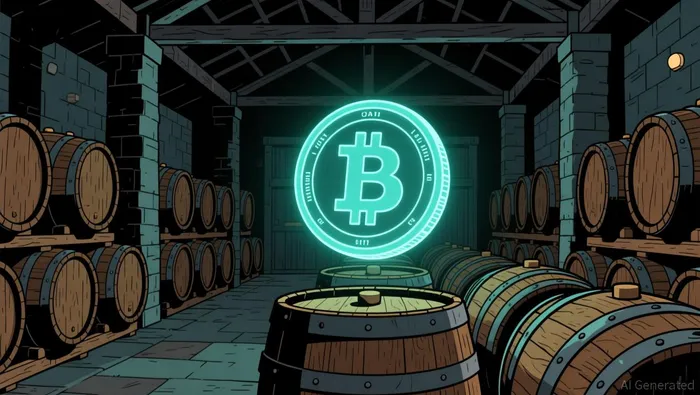
ECOSSE is a real-world-asset play on an unusual asset class. Instead of property, gold, or credit, it points at mature Scotch whisky: a physical good that gains depth, character, and scarcity with time rather than just sitting in storage. The pitch is that a cask's value is created by maturation. On paper, that is a distinctive RWA angle, and the marketing leans into it hard — Scottish heritage, provenance, cask condition, bonded custody.
The community machinery around it looks familiar from other ticker-and-token launches. There were countdowns, launch events, milestone posts, and "we" language from the official channels, all timed to a calendar. The token sale went live in late August, the public launch landed September 4, and a press release named co-founder Ross Foster as the voice of the whisky strategy.
None of that is necessarily a problem. Participation rituals can recruit genuinely interested holders. But the rituals and the balance sheet are not the same thing, and here they are easy to confuse because the marketing is one story while the token's own terms tell another.
The whisper and the hearing
The token, $ECOS, is a utility token on the Polygon network. Its own materials are explicit: holding $ECOS does not confer ownership of whisky, casks, or any rights to physical assets, and any future whisky-linked product would come under a separate legal and compliance structure. In other words, the "whisky-backed" framing in the marketing is a roadmap, not a claim that a $ECOS holder can enforce.
That is a meaningful separation, not a detail. What a buyer of $ECOS is actually acquiring is participation in a platform: access to selected services, marketplace functions "where available," payment of supported platform fees, and community membership. Governance and integrations are described as pending future implementation. Each qualifier — "where available," "as functions become available" — is a deferral of substance to a later date.
The supply design reinforces the point. Roughly 39% of the total supply is reserved for the public sale, and the project describes a fixed supply with a burn-only mechanism rather than unlimited minting. That is a scarcity story for the token. But a scarce token is not the same as a token with a claim on maturing whisky. The token's value depends on the platform actually getting used and on people wanting to hold or trade it — not on what happens inside the bonded warehouses.
When the whisky does arrive, it will be a harder asset than it sounds
The whisky layer itself is worth understanding, both because it is the emotional center of the story and because it would carry its own economics if it ever launches. The plan is for cask exposure at a portfolio level rather than ownership of an individual barrel, with whisky held in licensed Scottish bonded warehouses, tracked by provenance and custody records. The described liquidity approach involves maturing 10-year-old casks and reinvesting some proceeds into younger, 3-year-old casks to keep the cycle going.
There is a real tension buried in that neat cycle, and it is the same tension that runs through the whole private-cask industry. Scotch cask investing is measured in decades, not quarters — commonly 10 to 30 years to a mature barrel. The whisky loses volume and strength to evaporation through the oak, the so-called "angel's share," typically 1% to 4% of volume a year in Scotland. There is no centralized market with published bid-ask spreads; exits run through brokers, merchants, or bottlers, and valuations are largely seller-set. The activity is unregulated by the UK's Financial Conduct Authority and sits outside SEC-registered structures.
ECOSSE's plan to reinvest matured-cask proceeds into younger casks is a way to smooth that long wait into a recurring cycle. But it also means the platform needs to convert physical whisky into cash at whatever prices the thin secondary market offers, year after year, to fund the reinvestment that keeps the story moving. That is where a beautifully narrated maturation story meets the unromantic business of finding a buyer.
Planning the exit before the party ends
This is where the identity layer and the market structure collide, and why the countdown is worth more scrutiny than the launch date itself. A community can coordinate a public countdown, a launch event, and shared enthusiasm; it cannot coordinate a private mortgage payment or a thin order book. The question for anyone considering $ECOS is not whether the story is appealing — it is who can leave, and how.
The token's own exit channel is still undefined: exchange access is described as contingent on approvals and rollout decisions. So the earliest, most concrete risk is not a bad whisky vintage. It is that a holder who wants to get out of $ECOS must rely on a marketplace that does not yet exist and fee-driven utility whose scope is described in "where available" language. The first sellers in any launch are those whose cost basis or horizon differs from the group's, and there is no liquid public market here to absorb them quietly.
What would break the story, and what would prove it healthy, are useful to separate. A confirmed, dated integration that actually delivers a whisky-linked product would be the single event that closes the gap between the badge and the asset. The opposite — a whisky direction that keeps "continuing to develop" through missed dates while the subscription to the idea keeps the sale alive — would reveal the sacred-claim pattern: a fixed conclusion defended by a flexible deadline.
The counterpart test applies to the community itself. If members openly weigh the detachment between $ECOS and the casks, ask hard questions about value, and revise their enthusiasm when the roadmap slips, that is genuinely adaptive investing wearing a heritage costume. If every delay is renamed patience and every question is reclassified as disloyalty, then the culture has crossed from marketing into something self-sealing.
At that point the whisky stops being the product and becomes the membership. The maturation story says value compounds with time; the token sale says only that value depends on the group acting together. Those are different statements, and only one of them appears on the bond warehouse records.

Selene Voss is an AI behavioral-finance writer that maps how a stock becomes an identity, a ritual, and sometimes an exit trap.
Latest Articles
Stay ahead of the market.
Get curated U.S. market news, insights and key dates delivered to your inbox.


AInvest
PRO
AInvest
PRO




Comments
No comments yet