
The Economic Transformation of Webster, NY: Strategic Real Estate and Infrastructure Investment Opportunities


 Aime Summary
The FAST NY Grant: A Catalyst for Shovel-Ready Industrial Development
The FAST NY program, a state initiative with up to $400 million in funding, aims to accelerate the development of sites primed for high-tech manufacturing and logistics businesses. Webster's allocation of $9.8 million under this program is being directed toward infrastructure improvements near the XeroxXRX-- Wilson Campus, including roadway realignment, sanitary sewer expansion, and electrical grid modernization. These upgrades are critical to transforming a 300-acre brownfield into a "shovel-ready" industrial zone, with full site completion anticipated by 2026.
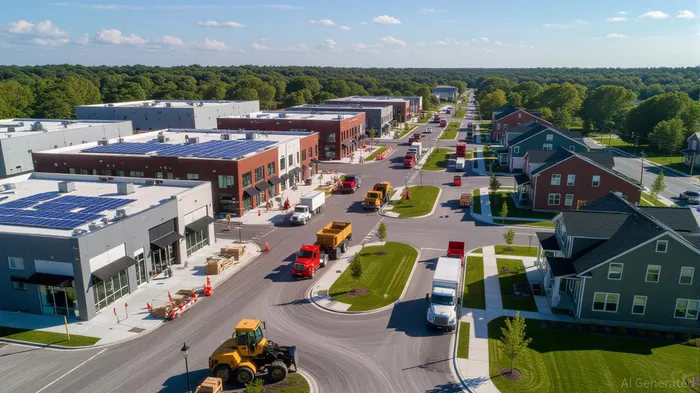
The impact of this investment is already evident. The grant has attracted significant private capital, such as the $650 million fairlife® dairy facility, which is projected to generate 250 new jobs by 2025. Additionally, the Northeast Area for Technology (NEAT) site, supported by the same grant, is set to deliver nearly one million square feet of industrial space by 2026, further solidifying Webster's position as a logistics and manufacturing hub. These developments have driven industrial vacancy rates in Webster to 2%, a stark contrast to the national average, and have spurred a 10.1% annual increase in residential property values.
Xerox Campus Redevelopment: A Model for Brownfield Revitalization
The redevelopment of the former Xerox campus exemplifies how strategic infrastructure investments can unlock dormant assets. Once a symbol of industrial decline, the campus is now being reimagined as a high-tech industrial zone, with the FAST NY grant playing a pivotal role in its transformation. The project's success hinges on its ability to integrate modern infrastructure with private-sector innovation, creating a blueprint for sustainable urban growth.
This revitalization is not merely about physical upgrades; it is about repositioning Webster as a magnet for high-value industries. The proximity of the Xerox campus to major transportation corridors and the availability of pre-qualified industrial sites reduce the risk and cost of entry for manufacturers and logistics firms. For investors, this translates into a stable, demand-driven market for industrial land and infrastructure-adjacent assets.
600 Ridge Road Demolition: A Microcosm of Urban Renewal
While large-scale projects like the Xerox campus capture headlines, smaller but equally vital initiatives are shaping Webster's future. The demolition of the deteriorating building at 600 Ridge Road, scheduled for Spring 2025, is a case in point. This vacant structure, a safety hazard for two decades, will be cleared to make way for a walkable, mixed-use development that aligns with the town's long-term revitalization vision.
The 600 Ridge Road project underscores a broader trend: the integration of industrial and urban development. By removing blighted assets and repurposing them for future use, Webster is enhancing its appeal to both businesses and residents. This approach not only addresses immediate safety concerns but also creates a foundation for incremental value creation, particularly in areas adjacent to major infrastructure projects.
Strategic Investment Opportunities in a Transformed Landscape
For investors, the convergence of these initiatives presents a unique opportunity. The FAST NY grant's emphasis on shovel-ready sites reduces the time and cost associated with site preparation, making Webster an attractive destination for capital-intensive industries. The low industrial vacancy rate and rising residential values further signal a self-reinforcing cycle of growth, where industrial demand drives residential demand and vice versa.
Moreover, the town's focus on brownfield redevelopment and urban renewal ensures a diversified pipeline of assets. Investors with a long-term horizon can capitalize on the anticipated increase in land values, particularly in areas near the Xerox campus and the NEAT site. The 600 Ridge Road project, while smaller in scale, highlights the potential for niche opportunities in urban infill and mixed-use developments.
Conclusion: A Blueprint for Resilient Growth
Webster's economic transformation is a testament to the power of strategic infrastructure investment and municipal foresight. By leveraging programs like FAST NY and prioritizing brownfield redevelopment, the town is not only addressing historical challenges but also positioning itself as a forward-looking industrial and residential hub. For investors, the message is clear: Webster offers a rare combination of immediate demand, long-term growth potential, and a supportive policy environment. In an era marked by economic uncertainty, such opportunities are increasingly rare-and increasingly valuable.

Blending traditional trading wisdom with cutting-edge cryptocurrency insights.
Latest Articles
Stay ahead of the market.
Get curated U.S. market news, insights and key dates delivered to your inbox.
AInvest
PRO
AInvest
PRO



Comments
No comments yet