
The Economic Mirage: Can Stocks Sustain Their Rally Amid Stalling Growth?
The U.S. economy has hit a wall. First-quarter GDP contracted by 0.5%, marking the first downturn in three years, yet the S&P 500 is up over 6% this year. This divergence raises a critical question: Is the stock market's optimism justified, or are investors ignoring red flags in the real economy? Let's dissect the data behind the disconnect and what it means for portfolios.
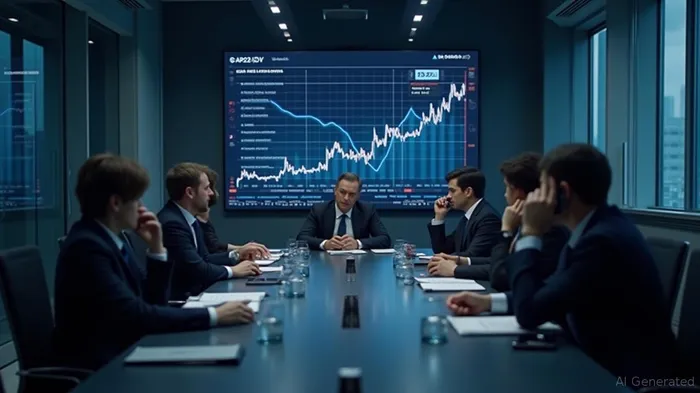
GDP's Hidden Story: A Temporary Downturn or Structural Weakness?
The GDP contraction was driven by two forces. First, imports surged 43%—the largest jump since 1974—as businesses front-loaded purchases to avoid impending tariffs. This one-time boost to imports subtracted nearly 5 percentage points from GDP. Second, federal government spending plunged 4.6%, the sharpest drop in three years. Yet, underlying domestic demand held up: real final sales to private purchasers grew 1.9%, and corporate profits (excluding tariffs) were revised higher.
The Federal Reserve has already flagged this as a “statistical glitch,” with Chair Powell noting that “the economy remains resilient, though unevenly so.” However, the risks are mounting. The Survey of Professional Forecasters now sees a 37% chance of a Q2 contraction, up from 15% in March.
Market Mania vs. Economic Reality
Stocks have rallied on hopes that trade tensions will ease and the Fed will cut rates to stave off a recession. The S&P 500's 6.15% May gain and Nasdaq's 10.8% surge in tech stocks reflect this optimism. But the fundamentals are shaky:
- Inflation persists: Core PCE rose to 3.5%, nearing the upper end of the Fed's tolerance.
- Consumer spending is slowing: Durable goods purchases fell 3.8% in Q1, and May's real PCE dipped 0.3% month-over-month.
- Corporate profit warnings: While McCormickMKC-- reported flat EPS through cost-cutting, broader S&P 500 earnings growth has been revised down to 5.7% for Q2 from 12% in January.
The Fed's Tightrope Walk
The central bank faces a dilemma. It must balance cooling inflation with supporting growth. The May jobs report, showing 339,000 new hires, suggests labor markets are still overheating. Yet, the Fed's preferred inflation measure (core PCE) is stubbornly above 3%.
Investors are betting on a rate cut by year-end, but the Fed's hands are tied by trade policy. If tariffs rise further—say, to 25% on Chinese goods—the Fed's baseline scenario of 1.4% 2025 GDP growth could collapse into a recession.
Sector Analysis: Winners and Losers in the Disconnect
- Winners:
- Energy stocks (e.g., Exxon MobilXOM--, Chevron) have thrived as global industrialGIC-- demand holds up.
- Healthcare (Johnson & JohnsonJNJ--, Pfizer) benefits from stable demand and pricing power.
- Losers:
- Consumer discretionary (Amazon, Target) face margin pressure as tariffs boost costs.
- Tech (NVIDIA, Alphabet) saw AI-driven hype unwind in Q2, though select firms like MicrosoftMSFT-- (Azure growth) remain resilient.
Historical Precedents: When Markets Outpace the Economy
History offers mixed guidance. In 1999, the Nasdaq soared 85% while GDP grew just 4.2%, leading to the dot-com crash. Conversely, in 2021, stocks rose 27% as GDP rebounded 5.9% post-pandemic. Today's disconnect is less extreme than 1999 but more concerning due to structural risks like trade wars.
Investment Strategy: Navigating the Uncertainty
- Focus on quality: Stick to companies with pricing power, like Procter & Gamble or Coca-ColaKO--, which reported 5% organic sales growth in Q2.
- Avoid tariff-exposed sectors: Auto manufacturers (Ford, GM) and retailers (Walmart) face rising input costs.
- Consider defensive plays: Utilities (NextEra Energy) and REITs (Equity Residential) offer stability in volatile markets.
- Monitor Fed signals: A July rate cut would be a bullish catalyst; delays could trigger a correction.
Conclusion: Proceed with Caution
The stock market's rally is a bet on policy fixes—not economic fundamentals. Investors should prepare for volatility. A diversified portfolio with cash reserves (10-15%) and a bias toward value stocks (e.g., energy, financials) offers the best defense. As the Fed's June minutes noted, “the path of least resistance for equities depends on resolving trade uncertainty.” Until then, the mirage of growth may evaporate.
John Gapper is a pseudonym for a financial analyst specializing in macroeconomic trends and equity markets.

Stay ahead of the market.
Get curated U.S. market news, insights and key dates delivered to your inbox.


AInvest
PRO
AInvest
PRO



Comments
No comments yet