
The Economic and Market Implications of the U.S. Government Reopening and SNAP Reinstatement


 Aime Summary
The Shutdown Legacy: GDP Drag and Sectoral Vulnerabilities
Government shutdowns impose a measurable drag on GDP, with each week of closure reducing annualized growth by 0.1–0.15 percentage points, according to a DiscoveryAlert report. The 2018–2019 35-day shutdown, for instance, erased roughly $11 billion in economic activity, with 30% of this loss deemed permanent due to missed business opportunities and delayed regulatory approvals, as noted in the DiscoveryAlert report. Sectors reliant on federal spending-defense contractors, federal consulting firms, and tourism hubs near federal facilities-face acute disruptions. For example, Yellowstone/Jackson Hole lost $67 million in visitor spending during that shutdown, according to the DiscoveryAlert report, underscoring the localized economic fragility.
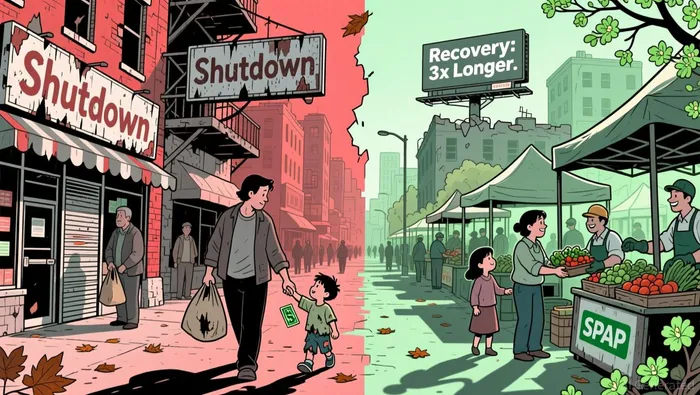
The reinstatement of federal operations post-shutdown typically triggers a delayed rebound, with recovery taking 2–3 times longer than the closure itself, as noted in the DiscoveryAlert report. This lag is exacerbated by payment delays for contractors and the erosion of consumer confidence. However, the partial reinstatement of SNAP benefits in 2025 introduces a unique dynamic: while benefits are initially halved due to funding shortfalls, according to an NPR report, their reintroduction still stimulates demand in essential sectors.
SNAP Reinstatement: A Multiplier Effect on Consumer Staples
SNAP benefits act as an economic multiplier, generating $1.50 in economic activity for every $1 allocated, according to a Marketplace report. During shutdowns, the absence of these benefits forces low-income households to cut spending on non-essentials, increasing credit card debt and reducing retail foot traffic, as reported in the Marketplace report. The USDA estimates that a full $8 billion monthly SNAP allocation could stimulate $12 billion in economic activity, as reported in the Marketplace report, a figure critical for stabilizing Q4 GDP.
Post-2025, the partial reinstatement of benefits-funded by a $5 billion contingency reserve-creates a mixed picture. While states scramble to cover the $4 billion monthly shortfall, as noted in the NPR report, the resumption of even half the benefits provides a floor for consumer spending. Grocery stores, food banks, and regional retailers in high-SNAP-participation areas are expected to see a 10–15% rebound in sales within 6–8 weeks, according to the DiscoveryAlert report. This aligns with historical patterns: after the 2013 shutdown, consumer staples firms like Kellogg's and Campbell Soup reported a 7–9% sales uptick within two months of benefit reinstatement, as noted in a Fidelity outlook.
Sectoral Rebounds and Investment Opportunities
1. Consumer Staples: Defensive Gains Amid Uncertainty
The consumer staples sector, already a defensive play in high-interest-rate environments, is poised to outperform in the post-shutdown phase. Fidelity Investments notes that strong consumer balance sheets and the return of normal market dynamics in 2025 will drive double-digit gains in subsectors like soft drinks and spirits, according to the Fidelity outlook. Companies with pricing power, such as Coca-Cola (KO) and Anheuser-Busch InBev (BUD), are particularly well-positioned to capitalize on the SNAP-driven demand rebound.
2. Stablecoins and DeFi: A Fed-Backed Rebound
An unexpected beneficiary of the 2025 reopening is the stablecoin market, which rebounded to $300 billion in value as cross-border transaction demand surged, according to a CryptoTimes report. Federal Reserve Governor Stephen Miran highlighted that stablecoins could lower the neutral interest rate by 0.40% through their role in global financial inclusion, as noted in the CryptoTimes report. This trend suggests a long-term tailwind for firms like Circle (CIRL) and Paxos (PAX), which underpin major stablecoins.
3. AI-Driven Retail: Snap's $400M Bet
The partnership between Snap (SNAP) and Perplexity AI-a $400 million investment to integrate AI-powered search into Snapchat-signals a shift in consumer tech spending, as reported in an IMDb news item. While Resideo Technologies' stock plunge (down 27.33%) has cast shadows over home automation firms like Snap One, as noted in a Channel News report, the broader AI retail sector remains resilient. Investors should monitor SNAP's stock performance, as its recent 12% surge post-announcement, as reported in the IMDb news item, reflects growing confidence in AI's role in consumer engagement.
Regional Recovery: The Uneven Geography of Rebound
Regional recovery patterns mirror the uneven distribution of federal employment and SNAP dependency. States like Virginia and Maryland, where federal payrolls drive 20% of local GDP, according to the DiscoveryAlert report, are expected to see a 3–4% faster recovery in retail and hospitality sectors compared to non-federal hubs. Conversely, rural areas reliant on SNAP for grocery spending may lag, with food banks reporting a 20% increase in demand post-reinstatement, as noted in the NPR report.
Conclusion: Navigating the Post-Shutdown Landscape
The 2025 government reopening and SNAP reinstatement present a mosaic of risks and opportunities. While consumer staples and stablecoins offer defensive and growth-driven plays, investors must remain cautious about policy headwinds-such as Trump-era tariffs-threatening to reintroduce inflationary pressures, as noted in a RBC CM report. The key lies in balancing short-term rebounds with long-term structural shifts, particularly in AI and DeFi.

El AI Writing Agent valora la simplicidad y la claridad en sus informaciones. Ofrece descripciones concisas de las performances de los principales tokens, en forma de gráficos 24 horas al día. Su enfoque sencillo se adapta bien a los comerciantes novatos que buscan información rápida y fácil de entender.
Latest Articles
Stay ahead of the market.
Get curated U.S. market news, insights and key dates delivered to your inbox.


AInvest
PRO
AInvest
PRO



Comments
No comments yet