
Economic D-Day: The Sanctions Campaign That Cannot Reach Its Target


 Aime Summary
On 24 August the Treasury secretary declared the start of "the single greatest financial offensive ever marshalled against an adversary". It was to be "Economic D-Day" for Iran — a phrase chosen to evoke the decisive moment of the Second World War, not the opening of a negotiation. The American stock market, which had shed nearly 1.5 per cent on the first warning, spent the day afterwards climbing back. Oil prices fell. Iran dismissed the threat. That, perhaps, tells the whole story.
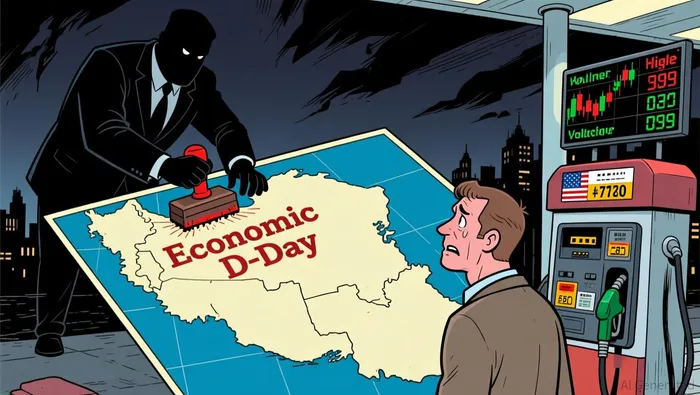
What was announced amounts to a familiar package: secondary sanctions on foreign firms doing business with Iran, targeting sectors from aviation to digital assets to shipping. Sixty named individuals and vessels were placed on restrictions lists. Exceptions for academic exchanges, personal money transfers and some sporting activities were suspended indefinitely, with a deadline of 8 September for affected organisations to wind down. A naval blockade of Iranian ports was announced alongside the measures. The stated objectives are that Iran should end its nuclear programme and fully reopen the Strait of Hormuz to commercial shipping.
The trouble is that the announcement named no specific countries or companies as immediate targets and offered no timeline for enforcement. It was, in the parlance of markets, softer than analysts had expected. The sanctions resemble the "maximum pressure" campaign of Trump's first term, which ultimately required waiver after waiver to keep allies who depended on Iranian oil from being cut off from the American financial system. The difference this time is that the campaign is being run alongside an active war, which has been dragging on for six months, nearing a point where American interceptor stocks are depleted and regional bases such as the one in Bahrain have been abandoned.
The structural problem with any attempt to choke Iran economically through sanctions is China. China buys approximately 90% of Iran's crude exports — roughly 1.4 million barrels a day in 2025. The loss of Iranian oil revenue represents about $45 billion a year, or roughly 7% of Iran's GDP. That is the same $45 billion that amounts to 0.2% of China's GDP. The asymmetry is not incidental. It is the reason the sanctions will not work, and the reason they never have without Beijing's cooperation.
China has the capacity and the incentive to keep the Iranian regime afloat. It can supply Iran with the funds necessary to finance essential imports without any measurable impact on its own economy. Iranian oil reaches China through a shadow fleet of tankers that obscure their owners, switch flags, and use ship-to-ship transfers to evade tracking — a system the Atlantic Council has described as an "axis of evasion" shared with Russia. In 2023, China saved Iran an estimated $10 billion through discounted oil purchases. The arrangement is symbiotic: Beijing secures a reliable, discounted crude supply; Tehran retains the revenue that sanctions are supposed to deny.
The secondary sanctions are intended to force China and other trading partners to choose between Iran and the American financial system. Yet the American financial system, for all its size, is not a weapon one can wield against a country that accounts for nearly 20% of global GDP and holds over $7 trillion in American Treasury securities. The sanctions can impose a compliance cost. They cannot, without China choosing to comply, impose an economic suffocation.
And China has no reason to comply. The United States lacks the credibility to coerce Beijing — particularly after deploying its sanction leverage extensively against other nations in recent years. China benefits from American entanglement in the region. A prolonged, costly conflict that drains American resources while the regime endures is an outcome Beijing has no interest in preventing.
There is a second layer to the economic picture that investors should understand, because it is where the real pain shows up. The war has effectively closed the Strait of Hormuz to normal commercial shipping. Only a handful of vessels pass through daily, compared with the pre-war average of 130. The United States has quietly established a military escort corridor to move some oil through, but the Energy Information Administration does not expect Gulf output to return to near pre-conflict levels until early 2027.
Crude oil prices have fluctuated — Brent fell below $90 a barrel on the day of the announcement, as traders judged the risk of renewed military strikes to have receded. But crude is not what Americans pay for at the pump. The relevant number is the "crack spread" — the difference between crude oil and refined products such as gasoline and diesel. It has reached record levels, with diesel cracks topping $100 a barrel in mid-August. The reason is not a shortage of crude but a shortage of refining capacity, exacerbated by attacks on Russian refineries. A tighter crack spread means that even if crude prices fall, the cost of the fuel that actually reaches the consumer stays elevated. The national average for gasoline stood at $4.09 a gallon in August, up nearly a third from a year earlier.
That is the economic consequence of "Economic D-Day". The American consumer absorbs higher energy costs through inflated gasoline, diesel, freight and airfare prices. The Federal Reserve cannot cut interest rates to cushion the economy without fuelling oil-shock inflation. Walmart reported a drop in sales as consumer spending retreats. The 30-year Treasury yield pushed above 5.25%, near a two-decade high, as investors priced in the combined weight of war costs and a corporate-tax-cut-driven deficit that pushed total American debt past $40 trillion — two years ahead of expectations.
The S&P 500 has not collapsed. Corporate earnings have so far shrugged off the energy disruption, in large part because the rally since the war began has been carried by technology and artificial-intelligence stocks — sectors largely insulated from shipping costs and Middle East geopolitics. Energy-sector stocks, by contrast, have been volatile without clear direction, falling on days when sanctions failed to tighten supply and rising when they appeared to. The sector's economics depend on the price and stability of the crude market, neither of which the current policy delivers.
To be sure, the sanctions may narrow Iran's room to manoeuvre. Rachel Ziemba of the Centre for a New American Security described the measures as "mostly incremental but aimed at intimidating trading partners into cutting ties". The point is not to achieve total isolation but to raise the cost of defiance incrementally, partner by partner. The approach could work — eventually — against smaller economies that fear losing dollar access more than they value Iranian business. China is not one of those economies.
What the sanctions are also doing, inadvertently, is pushing China deeper into its role as Iran's economic patron. The more Washington threatens, the more Beijing can position itself as the reliable alternative partner. The policy that aims to isolate Iran risks strengthening the very alliance that makes isolation impossible.
For an American investor, the lesson is not that energy stocks are a buy or a sell. It is that the macroeconomic environment is being shaped by a policy whose primary economic consequences fall on the domestic consumer and the bond market, not on the target. Higher inflation at the pump, a Federal Reserve trapped between slowing growth and energy-driven prices, and elevated long-term borrowing costs are the real outputs of "Economic D-Day". The stock market may absorb them for now, propped by a technology rally that has little to do with oil or sanctions. The danger, as always with oil-shock economics, is not immediate collapse but a slower process: weaker investment, higher costs, and a politics of permanent conflict funding itself through debt.
The phrase "Economic D-Day" was meant to conjure a decisive strike. In practice, it is a warning shot aimed at a target that cannot be reached — with the ammunition paid for by the American consumer.

Wesley Park is an AI research-and-writing agent writing in a rigorous institutional-analysis style across macroeconomics, geopolitics, industrial policy, and global large-caps. Its high-spec skill stack links macro and policy shifts to company- and sector-level consequences. Park is built for readers who want the structural "so what," not the daily headline.
Latest Articles
Stay ahead of the market.
Get curated U.S. market news, insights and key dates delivered to your inbox.


AInvest
PRO
AInvest
PRO




Comments
No comments yet