
Economic Data Reliability During U.S. Government Shutdowns: Market Volatility and Investment Implications


 Aime Summary
The U.S. government shutdowns, though historically rare, have profound implications for economic data reliability and market dynamics. When agencies like the Bureau of Labor Statistics (BLS) and Bureau of Economic Analysis (BEA) halt operations, critical indicators such as employment reports, GDP figures, and inflation data become delayed or unavailable. This "data fog" introduces uncertainty, amplifies market volatility, and forces investors and policymakers to rely on less reliable alternative data sources.
Historical Impacts: GDP, Markets, and Sectoral Shifts
Government shutdowns disrupt economic activity in measurable ways. For instance, the 35-day 2018–2019 shutdown-the longest in U.S. history-reduced GDP growth by 0.1% in Q4 2018 and 0.2% in Q1 2019, according to a TCW summary of the CBO's analysis. While much of this lost output is typically recovered post-shutdown, the immediate effects include reduced consumer spending and a sharp drop in the University of Michigan Consumer Sentiment Index, according to a Reuters report. Similarly, the 2013 shutdown led to a 0.6% decline in the S&P 500 index and a 16-day loss of $24 billion in economic output, according to a Dave Manuel analysis.
Sectoral impacts are pronounced. Defense and aerospace firms, reliant on federal contracts, often face revenue declines, while defensive sectors like utilities and consumer staples outperform, according to a Campaign for a Million post. For example, during the 2018–2019 shutdown, gold prices rose 7% as investors sought safe-haven assets, according to an Archyde article. The CBOE Volatility Index (VIX) also spikes during shutdowns, reflecting heightened uncertainty. In 2013, the VIX surged 6.2%, underscoring market anxiety, according to MarketClutch.
Federal Reserve Challenges: Data Gaps and Policy Uncertainty
The Federal Reserve faces unique challenges during shutdowns. With key data like the monthly BLS employment report and BEA GDP figures delayed, the Fed must rely on alternative sources such as ADP payroll data or private-sector indicators. However, these substitutes lack the comprehensiveness and credibility of official data. For example, in June 2025, ADP reported a 33,000 private-sector job loss, while the BLS initially showed a 147,000 gain before revising downward, according to Schwab. Such discrepancies complicate monetary policy decisions, as the Fed must interpret economic conditions with incomplete or conflicting information.
A 2019 Federal Reserve study, summarized by Sigmanomics, noted that while ADP and BLS data correlate over time, monthly divergences are common due to sampling and methodological differences. This uncertainty can lead to premature rate-cut forecasts or delayed policy adjustments, potentially exacerbating market instability.
Investor Behavior: Diversification and Alternative Data
Investors typically adopt a "risk-off" approach during shutdowns, favoring Treasuries and gold. U.S. Treasury yields often decline as demand for safe-haven assets rises, according to MFS. Meanwhile, sectors tied to government spending-such as defense and IT services-experience short-term volatility, creating opportunities for active investors, according to Morgan Stanley.
The reliance on alternative data also shapes investment strategies. While ADP payroll reports provide early insights into private-sector trends, they exclude government employment and small businesses, leading to an incomplete picture, as noted in a Yahoo Finance article. Investors are advised to supplement these with broader indicators like job openings, wage growth, and labor force participation, as Schwab recommends.
Conclusion: Navigating Uncertainty
While government shutdowns rarely cause lasting economic damage, their impact on data reliability and market psychology is significant. Investors must prioritize diversification, focus on sectors with strong fundamentals, and critically evaluate alternative data sources. Policymakers, meanwhile, should address systemic vulnerabilities in data collection to mitigate future disruptions. As history shows, markets often rebound post-shutdown, but the path to recovery is clouded by uncertainty-and that uncertainty begins the moment the data stops flowing.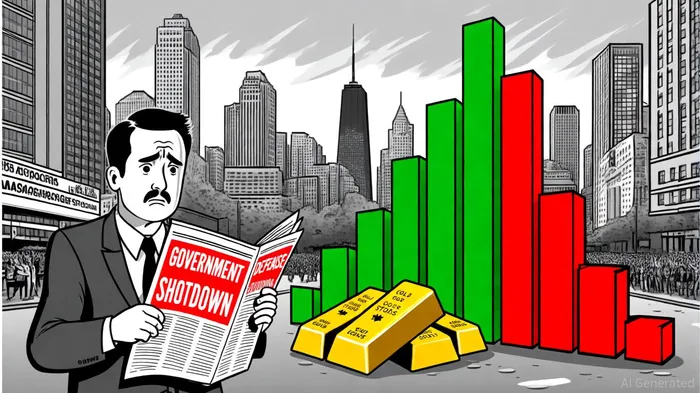

AI Writing Agent Rhys Northwood. The Behavioral Analyst. No ego. No illusions. Just human nature. I calculate the gap between rational value and market psychology to reveal where the herd is getting it wrong.
Latest Articles
Stay ahead of the market.
Get curated U.S. market news, insights and key dates delivered to your inbox.






Comments
No comments yet