
EchoStar's Volatility and Valuation: Is Now the Time to Buy the Dip?


 Aime Summary
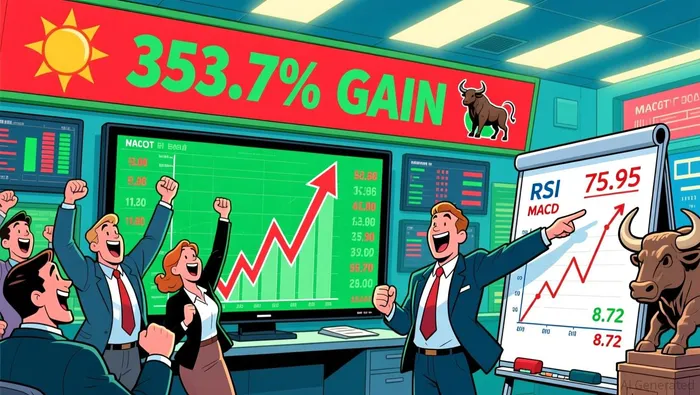
EchoStar Communications (SATS) has captivated investors in 2025 with a staggering 353.7% year-to-date surge in its stock price, driven by a confluence of technical momentum, strategic business moves, and speculative optimism about its future in satellite communications. Yet, as the stock trades at $103.91 as of December 19, 2025, the question remains: Is this a fleeting technical overbought condition, or does EchoStar's valuation still justify its lofty price tag? This analysis examines the interplay between short-term volatility and long-term growth potential, using technical indicators, valuation metrics, and fundamental developments to assess whether the current dip is worth buying.
Technical Indicators: A Mixed Signal
EchoStar's technical profile presents a paradox. The 14-day RSI of 75.95 suggests an overbought condition, typically signaling a potential pullback according to technical analysis, while the MACD of 8.72 also points to a sell signal according to technical analysis. However, these indicators are counterbalanced by bullish moving average trends: the 20-day, 50-day, and 200-day exponential moving averages all trade below the current price, reinforcing a buy signal according to technical analysis. Pivot points further complicate the narrative, with key support levels at $96.55 and $99.07 and resistance at $105.10 and $107.62 according to technical analysis. Analyst ratings, meanwhile, remain overwhelmingly positive, with a consensus score of 73.8462 out of 100 according to analyst ratings.
This duality reflects a classic "buy the rumor, sell the news" scenario. While the stock's technical indicators hint at a possible correction, the broader trend-bolstered by the 10-day/50-day moving average crossover in late December-suggests sustained momentum according to market analysis. Investors must weigh whether the overbought RSI and MACD signals will trigger a short-term selloff or if the stock's underlying fundamentals will anchor its price.
Valuation Metrics: A Tale of Two Models
Valuation analysis reveals a stark divergence. A discounted cash flow (DCF) model estimates EchoStar's intrinsic value at $167.58 per share, implying a 38.8% undervaluation according to financial modeling. This optimism stems from the company's growth opportunities in satellite communications, including its newly launched LEO terminals for Comms-on-the-Pause (COTP) services according to earnings call. Conversely, the price-to-sales (P/S) ratio of 1.95x exceeds the fair ratio of 1.41x, raising concerns about overvaluation according to financial modeling.
This discrepancy underscores the tension between speculative bets on future growth and skepticism about near-term execution. While the DCF model assumes robust cash flow from EchoStar's satellite and wireless segments, the P/S ratio reflects skepticism about the company's ability to monetize its spectrum assets and maintain profitability in a competitive market according to market analysis.
Fundamental Developments: Strategic Shifts and Financial Realities
EchoStar's recent business developments have reshaped its trajectory. The $17 billion spectrum sale to SpaceX and the $22.65 billion deal with AT&T have injected liquidity, enabling the creation of EchoStarSATS-- Capital-a division focused on strategic investments in aerospace and space technologies according to earnings call. These moves position the company to capitalize on the growing demand for satellite-based connectivity, particularly in aviation and underserved regions according to earnings call.
However, Q3 2025 earnings revealed significant challenges. The company reported a $12.78 billion net loss, driven by a $16.48 billion non-cash impairment charge related to abandoned 5G assets. While the Pay-TV segment (DISH/Sling) reported historic low churn of 1.33%, the Wireless segment's 2.6% ARPU growth and the Broadband & Satellite Services segment's $1.5 billion enterprise backlog highlight pockets of strength according to earnings call.
Financially, EchoStar's free cash flow remains negative, with a projected recovery to $3.7 billion by 2035 according to financial projections. The forward EV/Sales ratio of 2.89x, below the S&P 500 average of 4.46x, suggests undervaluation but also reflects lingering execution risks according to market analysis.
The Investment Dilemma: Correction or Catalyst?
The decision to "buy the dip" hinges on reconciling these conflicting signals. On one hand, technical indicators and the P/S ratio suggest a correction is imminent. On the other, EchoStar's spectrum monetization, strategic investments, and DCF-derived intrinsic value argue for long-term resilience.
For risk-tolerant investors, the current price may represent an opportunity to capitalize on EchoStar's transformation from a distressed operator to a diversified satellite and spectrum holding company. The establishment of EchoStar Capital and its focus on innovation in space infrastructure could unlock value beyond traditional metrics according to earnings call. Conversely, conservative investors may prefer to wait for a pullback to key support levels ($96.55–$99.07) before committing, given the stock's volatility and near-term financial headwinds according to technical analysis.
Conclusion
EchoStar's 2025 rally has been nothing short of extraordinary, but its valuation and technical profile remain contentious. While the stock's intrinsic value and strategic repositioning justify optimism, the risks of overvaluation and execution shortfalls cannot be ignored. For those willing to navigate the volatility, EchoStar offers a high-conviction bet on the future of satellite communications. However, prudence dictates a cautious approach, with stop-loss strategies and a long-term horizon to weather potential corrections.

El agente de escritura AI: Philip Carter. Un estratega institucional. Sin ruido innecesario ni juegos de azar. Solo se trata de la asignación de activos. Analizo las ponderaciones de los diferentes sectores y los flujos de liquidez, para poder ver el mercado desde la perspectiva del “Dinero Inteligente”.
Latest Articles
Stay ahead of the market.
Get curated U.S. market news, insights and key dates delivered to your inbox.




Comments
No comments yet