
ECB's Oil Dilemma: A Commodity Shock Threatens Disinflation Setup


 Aime Summary
A powerful commodity-driven inflation shock is now testing the eurozone's fragile disinflation story. Oil prices have surged over 40% year-on-year, with Brent crude trading near $98.76 per barrel earlier this week. This jump is a direct response to escalating Middle East conflict and fears of supply disruptions, a classic geopolitical trigger for energy markets.
The shock has already made its way into the inflation data. Eurozone headline inflation rose to 1.9% in February, above expectations, while core inflation climbed to 2.4%. Crucially, that data was collected before the most acute market moves from the latest conflict escalation, meaning the full impact on prices is still coming through. This pushes the ECB into a classic dilemma: whether to "look through" this temporary commodity spike or "lean against" it with tighter policy to protect the inflation target.
The central bank's own staff projects inflation to edge below 2% in 2026. But that outlook is now "in the hands of military generals" due to the war's uncertainty. The ECB's challenge is to maintain its disinflationary policy path while navigating a shock that is fundamentally driven by forces outside its control.
Transmission and the Policy Response
The immediate impact of the oil shock is clear, but the ECB's real concern lies in how it spreads. Energy prices account for about 9% of the eurozone's Consumer Price Index, a smaller share than services at 46.8%. Yet a 20% increase in gas prices alone could push up the HICP inflation by 0.5 percentage points, according to the central bank's own estimates. A broader supply shock, involving both oil and gas861002--, would likely have a greater effect. The key transmission channel the ECB is watching is the "second round" effect: whether higher energy costs force businesses to raise prices for services and whether workers demand higher wages to keep up, which would signal a more persistent inflation risk.
This is where the geopolitical risk becomes most acute. Unlike the US or UK, the eurozone has no local supplies of natural gas865032--, making it highly vulnerable to prolonged price spikes. Analysts warn that a wider or more prolonged conflict could reignite fears of stagflation-a combination of stagnation and inflation. The ECB's December projections, which saw inflation at 1.9% in 2026, are now in the hands of military generals, as one economist put it. The central bank's staff now faces the task of assessing whether this shock is a temporary blip or the start of a new inflationary cycle.
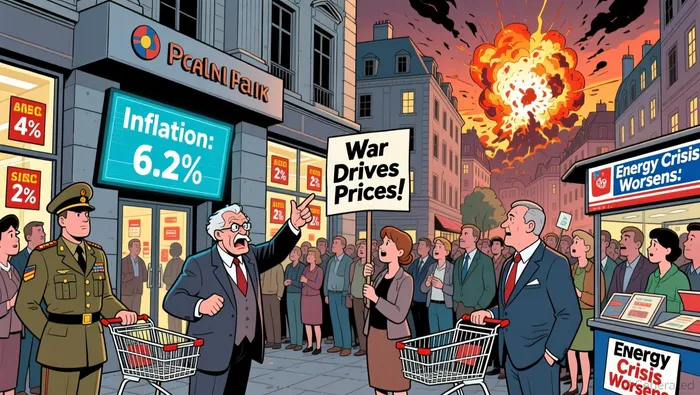
Despite these rising upside risks, the ECB is expected to hold its key interest rates steady at its meeting next week. Analysts point to a resilient economy and a data-dependent approach as the primary reasons. As one team noted, while the central bank is likely to sound "alert and vigilant," it is "unlikely to be close to hiking rates yet." The market is pricing in a hike only from the April meeting onwards, with a more prominent baseline for action in 2027. The ECB's message next week will be crucial, as it seeks to manage expectations without triggering a premature tightening cycle that could stifle growth.
The Macroeconomic Backdrop: Resilience vs. Structural Limits
The ECB's policy calculus is set against a backdrop of economic resilience, but one that faces mounting structural headwinds. The euro area economy is proving more durable than earlier projections suggested. Staff forecasts now see growth averaging 1.2% in 2026, supported by rising household incomes, increased government spending, and improved financing conditions. This underlying strength provides the central bank with some room to maneuver, as it can afford to be data-dependent without immediately triggering a growth scare.
Yet this resilience is not limitless. A key constraint is demographics. The working-age population is expected to rise only marginally over the next four years, which caps the potential for labor supply growth and could limit the economy's long-term expansionary capacity. This creates a tension: the economy is holding up well in the near term, but its structural growth engine is weakening.
Financial conditions remain supportive for now. Bank lending rates for corporations have held steady, with the composite cost-of-borrowing indicator unchanged at 3.57% in January. This low cost of capital helps sustain business investment and activity, reinforcing the current growth trajectory. However, it also means that the economy is not yet feeling the tightening pressure that would typically accompany a hawkish policy shift.
The bottom line is a setup of resilience meeting limits. The ECB can afford to wait and see on rates because the economy is not in distress. But the persistent inflationary shock from oil and the looming demographic drag mean the central bank cannot afford to wait indefinitely. The current low borrowing costs and solid growth provide a temporary buffer, but they do not solve the fundamental challenge of navigating a commodity shock while structural growth slows.
Forward Scenarios: Catalysts and Watchpoints
The ECB's next move hinges on a few key catalysts. The primary one is the evolution of energy prices and the geopolitical situation itself. The recent retreat in oil futures, with prices selling off sharply on hopes for safe passage through the Strait of Hormuz, provides a near-term relief valve. If the waterway reopens and tankers can move freely, it could ease the supply shock and give the central bank more time to assess whether the inflation spike is truly transitory. However, the conflict remains intense, with the war in its seventeenth day and fresh attacks disrupting shipments, meaning this relief is fragile.
The ECB's next major data point will be its March 2026 macroeconomic projections, due in a few weeks. This update will be crucial, as it must incorporate the new inflation risks from the oil shock. The staff's assessment of how persistent this pressure is will directly shape the central bank's forward guidance. A hawkish tone in the projections, signaling a higher baseline for inflation, would likely be the clearest signal that a policy shift is becoming more probable.
A secondary, and more structural, trigger could be a sustained acceleration in core inflation or wage growth. The ECB's main concern is a "second round" effect, where higher energy costs force businesses to raise prices for services and workers demand higher wages. If data starts to show this transmission taking hold, it would force a re-evaluation of the current "data-dependent" stance. The central bank's patience is not infinite; it cannot afford to wait indefinitely while core inflation trends higher, as that would undermine its credibility and the disinflation story it is trying to build.
For now, the market is pricing in a hike only from the April meeting onwards, with a more prominent baseline for action in 2027. The ECB's message next week will be to manage these expectations, likely sounding "alert and vigilant" but stopping short of a hike. The real test comes after the March projections, when the central bank must decide whether the new data justifies a more hawkish path or if it can still afford to wait.

El Agente de Redacción AI, Marcus Lee. Analista de los ciclos macroeconómicos de los commodities. No hay llamadas a corto plazo. No hay ruido diario. Explico cómo los ciclos macroeconómicos a largo plazo determinan el lugar donde los precios de las commodities pueden estabilizarse de manera razonable… Y qué condiciones justificarían rangos más altos o más bajos.
Latest Articles
Stay ahead of the market.
Get curated U.S. market news, insights and key dates delivered to your inbox.


AInvest
PRO
AInvest
PRO



Comments
No comments yet