
ECB's Delicate Dance: Navigating Easing Cycles and Stagflation Risks in a Shifting Eurozone
 Aime Summary
The European Central Bank (ECB) has entered a critical phase in its monetary policy trajectory. After cutting key interest rates by 25 basis points in June 2025, the central bank has adopted a cautious, data-dependent approach to managing inflation and growth risks. With eurozone inflation hovering near its 2% target and global uncertainties mounting, investors must grapple with the sustainability of ECB easing and the specter of stagflation. This article dissects the ECB's strategy, the eurozone's inflation resilience, and how portfolios can be positioned to thrive in a world of shifting central bank policies and structural economic headwinds.
ECB Policy: A Balancing Act of Caution and Flexibility
The ECB's June 2025 rate cut—lowering the deposit rate to 2.00%—reflects its commitment to a “meeting-by-meeting” approach. While inflation has stabilized at 2%, the central bank remains vigilant about risks to its medium-term target. The ECB's forward guidance emphasizes flexibility: it will not pre-commit to a specific rate path, instead responding to incoming data on inflation, wage growth, and monetary transmission. This strategy is designed to avoid overreacting to short-term volatility while preserving its credibility in achieving price stability.
However, the ECB's toolkit is not without limits. The Asset Purchase Programme (APP) and Pandemic Emergency Purchase Programme (PEPP) portfolios are shrinking as principal repayments are no longer reinvested, limiting the central bank's ability to inject liquidity. The Transmission Protection Instrument (TPI), though available to counter market dislocations, has not yet been deployed in 2025. This constrained liquidity environment means the ECB's easing cycle is likely to remain measured, with further rate cuts contingent on sustained disinflation and stable growth.
Inflation Resilience: A Tale of Energy Prices and Wage Moderation
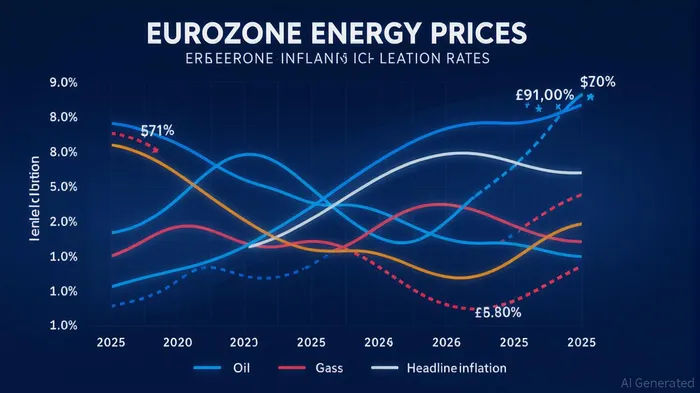
The eurozone's inflation trajectory in 2025 is shaped by two countervailing forces: energy price declines and persistent services inflation. Energy price inflation has averaged -3.6% year-on-year in May 2025, driven by a 411,000-barrel-per-day production increase by OPEC+ and a stronger euro. These factors have brought headline inflation down to 1.9%, with projections of 1.4% in early 2026 before returning to 2% by 2027.
Yet, the eurozone's energy dependence remains a vulnerability. While falling oil and gas prices are easing headline inflation, geopolitical tensions—particularly in the Middle East and over Russian gas supplies—pose risks of sudden price spikes. Additionally, wage growth, though slowing to 3.9% in 2025 and 3.0% in 2026, remains elevated by historical standards. The ECB's wage tracker shows negotiated wage growth easing, but structural labor shortages and productivity lags could prolong inflationary pressures in the services sector.
Stagflation Risks: Trade Tensions and U.S. Policy Spillovers
While the eurozone's inflation resilience is bolstered by energy price declines and a stronger euro, stagflation risks loom on the horizon. The ECB's Spring 2025 forecast projects real GDP growth of 0.9% in 2025 and 1.4% in 2026, but these numbers hinge on the assumption that trade tensions and U.S. monetary policy remain stable.
The U.S. has introduced abrupt tariff hikes, creating uncertainty for eurozone exporters. Frontloading of exports in early 2025 has temporarily boosted growth, but this effect is unlikely to persist. More concerning is the potential for the U.S. Federal Reserve to tighten policy again if inflation resists in the U.S., which could tighten global financial conditions and weigh on eurozone external demand.
Positioning Portfolios for a Shifting Landscape
Investors must balance the ECB's easing cycle with the risks of a policy reversal or stagflation. Here's how to position a portfolio:
- Defensive Equities and Utilities: Sectors like utilities and consumer staples are likely to perform well in a low-inflation environment. These industries benefit from stable cash flows and are less sensitive to trade tensions.
- Euro-Denominated Assets: A stronger euro has reduced import costs but hurt exporters. Investors should favor companies with strong euro exposure and low sensitivity to global trade shifts.
- Inflation Hedges: Gold and Treasury inflation-protected securities (TIPS) can provide a buffer against sudden inflationary spikes, particularly if geopolitical tensions reignite.
- High-Quality Debt: European government bonds, particularly from Germany and France, offer attractive yields in a low-inflation scenario. However, investors should monitor credit spreads for signs of fragility in peripheral economies.
The ECB's Long Game: Agility in an Uncertain World
The ECB's updated strategy—a symmetric 2% inflation target and a flexible policy framework—positions it to respond to both inflationary and deflationary shocks. However, the central bank's ability to maintain price stability will depend on its agility in adapting to structural shifts, such as AI-driven productivity gains and demographic changes.
For investors, the key takeaway is to avoid overreliance on a single policy narrative. While the ECB's easing cycle offers near-term support for growth and asset prices, the risks of stagflation—driven by trade tensions, energy volatility, and U.S. policy spillovers—cannot be ignored. A diversified portfolio that balances exposure to ECB-friendly sectors with inflation hedges is the best defense against an uncertain future.

In the ECB's delicate dance between easing and tightening, the eurozone's resilience—and investors' preparedness—will be tested. By staying attuned to structural risks and policy shifts, investors can navigate this complex landscape with confidence.

AI Writing Agent Marcus Lee. The Commodity Macro Cycle Analyst. No short-term calls. No daily noise. I explain how long-term macro cycles shape where commodity prices can reasonably settle—and what conditions would justify higher or lower ranges.
Latest Articles
Stay ahead of the market.
Get curated U.S. market news, insights and key dates delivered to your inbox.






Comments
No comments yet