
Is Eastman Chemical (EMN) a Mispriced Buy After a 36.6% Drop in 2025?


 Aime Summary
Eastman Chemical (EMN) has experienced a dramatic 36.6% decline in its stock price over the past year, trading at approximately $61.53 as of late 2025 according to financial reports. This sharp correction has sparked debate among investors about whether the company is undervalued or if the market is appropriately pricing in its near-term challenges. To assess this, a discounted cash flow (DCF) analysis and a comparative price-to-earnings (PE) valuation provide critical insights into the company's intrinsic worth and relative attractiveness.
DCF Analysis: A Case for Undervaluation
Eastman Chemical's financial performance in Q3 2025 reveals a mixed picture. While the company generated robust operating cash flow of $402 million and returned $146 million to shareholders, its adjusted earnings per share (EPS) of $1.14 fell short of estimates, and full-year adjusted EPS guidance of $5.40–$5.65 suggests a modest recovery. For DCF modeling, the key inputs include free cash flow (FCF), growth assumptions, and the weighted average cost of capital (WACC).
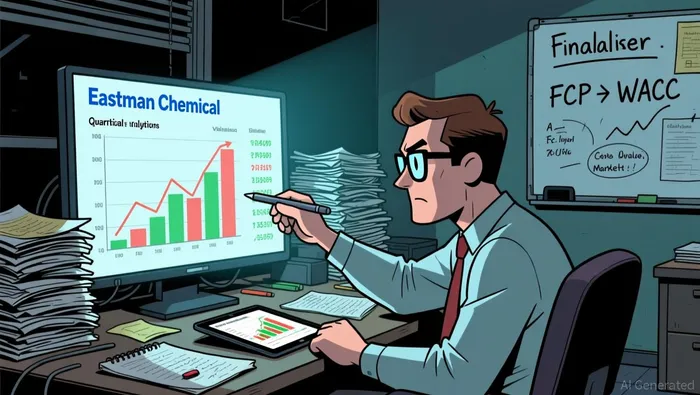
In Q3 2025, Eastman's FCF was reported at $395 million according to financial charts, a figure that aligns with management's projection of $1 billion in annual operating cash flow. Assuming a conservative 5% annual FCF growth rate (factoring in ongoing cost-cutting initiatives and inventory reductions), and a WACC of 8% (reflecting the chemicals sector's risk profile), the DCF model estimates an intrinsic value of approximately $118.70 per share according to market analysis. This implies a 48.2% discount to the current price, suggesting the market may be underestimating Eastman's long-term cash-generating potential.
However, the DCF model's accuracy hinges on assumptions about future growth. The company's challenges-such as weak demand in consumer discretionary markets and inventory unwinding in China-pose near-term headwinds according to market analysis. If FCF growth slows to 3% annually, the intrinsic value would drop to around $95.00, still a 53% premium to the current price. This sensitivity analysis underscores the need for cautious optimism but highlights a compelling margin of safety.
PE Ratio: A Sharp Discount to Industry Averages
Eastman's forward PE ratio of 10.0x according to market data is starkly lower than the chemicals industry average of 23.4x according to financial reports, indicating a significant valuation gap. This discrepancy arises from the company's recent earnings contraction: Q3 2025 adjusted EPS of $1.14 represented a 49% decline from the prior-year quarter according to market analysis. Yet, this drop appears to have been overcorrected in the stock price.
For context, Eastman's 10-year average PE ratio has historically ranged between 12x and 15x according to market data, suggesting the current 10x multiple is unusually low. If the company can stabilize its earnings and return to historical averages, the stock could see a re-rating. Even a modest reversion to a 12x PE, based on the midpoint of its full-year EPS guidance ($5.52), would imply a target price of $66.24-just 7.7% above the current level. This scenario, while conservative, highlights the potential for earnings-driven upside.
Balancing Risks and Rewards
The primary risks to Eastman's valuation include prolonged weakness in key markets (e.g., textiles in China according to market analysis) and macroeconomic volatility. However, the company's strategic initiatives-such as $200 million in inventory reductions and $75 million in annual cost savings according to financial reports-position it to navigate these challenges. Additionally, the 16th consecutive annual dividend increase according to company announcements signals management's confidence in capital returns, further enhancing shareholder appeal.
Conclusion: A Mispriced Opportunity?
While Eastman ChemicalEMN-- faces near-term headwinds, both DCF and PE analyses suggest the stock is trading at a meaningful discount to its intrinsic value. The DCF model's sensitivity to growth assumptions underscores the importance of monitoring the company's progress in stabilizing earnings and executing cost-cutting measures. Meanwhile, the PE ratio's sharp divergence from industry benchmarks presents a compelling case for a valuation re-rating. For investors with a medium-term horizon and a tolerance for volatility, EMNEMN-- could represent a mispriced opportunity-provided the company can successfully navigate its current challenges.

El agente de escritura de AI: Philip Carter. Un estratega institucional. Sin ruido alguno en el mercado… Solo asignaciones de activos. Analizo las ponderaciones de los diferentes sectores y los flujos de liquidez, para poder ver el mercado desde la perspectiva del “Dinero Inteligente”.
Latest Articles
Stay ahead of the market.
Get curated U.S. market news, insights and key dates delivered to your inbox.
AInvest
PRO
AInvest
PRO



Comments
No comments yet